Saturday, April 5, 2014

Newtapalooza

The Eastern newt (Notophthalmus viridescens) is an interesting amphibian.  One particularly fascinating aspect of its life is its 4-stage life cycle - egg, aquatic larva, terrestrial eft, then aquatic adult.  Most other woodland salamanders will hatch from an egg, live as an aquatic larva, and then metamorphose into a terrestrial adult.  Examples of such species are our very own blue-spotted, spotted, and tiger salamanders.  Other interesting characteristics of the Eastern newt, and newts in general, are its rough skin and toxicity.

Here in northern Illinois, the newts are of the central newt subspecies (Notophthalmus viridescens louisianensis).  Their natural range is spotty, and their numbers in the Chicago region are rather low.  Like other amphibians, they are particularly vulnerable due to their delicate nature and the fact that they require multiple environments in order to reproduce and survive.  If a population of newts are found in a pristine woodland habitat but are forced to live and breed in water that has been polluted by runoff, then it doesn't matter a whole lot how good of quality the woodland is.  The same can be said of the opposite - If the newts have access to clean water but the surrounding landscape has been compromised, it is just a matter of time before the newts are gone.  Most local wetlands, ponds, and streams have either been filled, channelized, or drained since the arrival of Europeans.  Many others still exist but have been so heavily engineered that only the most hardy amphibians could survive (bullfrogs, etc).  A lot of these kinds of water bodies are now the selling point for brand new, sprawling subdivisons.  Some artificial ponds, such as suburban overflow basins or stormwater retention ponds, create suitable habitat, but again for species such as bullfrogs, and not so much for other amphibians.  It would seem that central newts in the Chicago region are only found where the appropriate habitat is protected - forest preserves.  And even there, some populations are vulnerable to heavy human activity, introduced game fish such as bluegill, pollution, and invasive species (to name a few).

Few things make me happier than witnessing uncommon species persisting in the right habitat near my home.  There is one preserve I go to to find central newts, and I am never skunked.  I find them when it is 42 degrees outside in April like today, and I find them when it is in the 90's in July or August.  They are a joy to find and to learn about.  I only worry that since these animals are in fact so restricted to relatively small parcels of protected land, they are all the more susceptible to human impacts or even "acts of God" such as an unusually harsh drought.  That's why I am a huge advocate of natural habitat conservation.  Setting aside large plots of land to remain undeveloped is key.  Then, coordinating restoration efforts if and when necessary.  Limiting human intrusion is ideal.  Banning practices such as off-roading, campfires and grilling, and off-leash dogs is important.  All of these activities put extra pressure on the plants and animals living there.  Many people are more than satisfied with the amount of undeveloped natural space that is available in the area.  But I would implore you to look at an aerial map such as Google maps.  Scan over the Chicago suburbs and exurbs.  Notice the wide, irregular blotches of new subdivisions, many of which creep along or into wooded areas and ponds/streams.  Many of those ponds' and streams' denizens are marked for death by developers looking to make a quick buck selling huge, crudely-constructed McMansions.

Off on a tangent much?  Yeah, I know.

I am happy to report a total of five central newts were found today, all underneath logs, having recently risen from their subterranean lairs.  Another highlight were the bald eagles - three of them.  I have never seen bald eagles this close to Chicago.  They were being harassed by gulls way up in the sky, too far up for me to get a good photo, so I just stood and watched.

Flooded woodland depression.  Multiple newt efts were found in this area.
Detail of oak leaves under water.

 The first newt I encountered.  Without hesitation, it assumed the unken reflex - a position used to ward off predators by revealing the colorful belly.  In many cases in nature, bright colors mean bad tasting or toxic.  Such is the case with these newts!
More of the famous "Don't you dare eat me" pose.
Notice the rough skin texture of the newt.
These newts have beautiful yellow (or orange) ventrals (undersides) with small black spots.
A group of three TINY efts, all found together in a cluster under a big log.
These three were returned unscathed to their depression under the log.
A big black ash - at least it used to be.  A victim of the emerald ash borer beetle.
 One of many tufts of green sphagnum moss.  Spring is here.


Sunday, March 23, 2014

Winter "blues"

March 22nd, 10:00 am.  It is cold out, 37 degrees Fahrenheit to be exact.  The sky is grey, the air is raw.  The wind is whipping up and broadcasting the aromas of woodland detritus and char.  The sounds of distant traffic provide an ambient noise level, through which the occasional lonely red-winged blackbird calls.  I stand, looking upwards with a look of suspicion at a large gap in the canopy, and watch for warnings from the sky.  I adjust the cotton-knit hat over my ears, and trudge forward, toward what most might call a mud hole in the middle of the woods.  Looking down, the mire appears lifeless.  The ground is plastered in decaying bur oak leaves.  Everything is a shade of brown.  Nary an indicator of spring has been conjured by the suprafreezing temperatures.  Strewn about the woods, in patches of various sizes, is snow.  I notice, as I kick aside a few leaves lying next to a glacial erratic, an earthworm.   It disappears in a split second, as if some clandestine subterranean force pulled it from one end down.  I kneel down to inspect the small boulder.  I passed my hand lightly over its eroded surface, and visions of it bearing the weight and pressure of ancient glaciers, while many of its counterparts were reduced to grit, fill my mind.  Standing, I gaze to the North.  The vernal pool, still blanketed in ice in sections, enjoys its final days as a barren puddle of water and leaves.  Soon, it will explode with life as woodland amphibians thaw and stagger toward it with the intention of manufacturing progeny.  I knew coming here, that I was early to the party.  Yet, I was drawn to the prospect of experiencing the first signs of revival.

This Cook County preserve has been one of my favorite semi-local locations for spring amphibians.  I have documented my discoveries here several times before.  Not only is it a stronghold for several species of woodland amphibians, but it is also fairly isolated and quiet.  Usually, the only other people I see are volunteers working to restore this woodland back to pre-settlement conditions.  They have done a superb job, removing buckthorn and invasive understory trees like green ash, and punching holes in the canopy that allow sunlight to penetrate down to the ground.  There, later in the spring and summer, rare and beautiful wildflowers fill the woods and remind us about how bad of an idea it was to have planted buckthorn and suppressed fire.  This day, however, I was alone with the woods to myself.  In cases such as this, I feel completely synced with nature.  I don't feel like an apex predator. I feel a lucid sense of vulnerability that I oddly find attractive.  And interestingly, that sense of vulnerability doesn't stem from any worry I have of scary creepy ax murderers.  It stems from the idea that where I am, at that time, I am in nature's hands, and nature isn't always copacetic.  It is a feeling that keeps most people away from wilderness.

I had hoped that conditions were such that I'd be able to observe early breeding behavior from Pseudacris crucifer, Pseudacris triseriata, and/or Ambystoma laterale.  We've had a few nights of not-so-cold temperatures, and a little rain.  However, nature did not schedule that at this time.  However, I did find my first herp of the calendar year (and first in over four months) - a lone laterale.  It was underneath a curved piece of bark and was standing on all fours with its ventral surface elevated when I flipped the bark.  I felt a rush of adrenaline come over me, which was all but extinguished when I realized that I couldn't get a decent photo with the lens I have.  I absolutely need to get one soon, especially since I'll be heading to Snake Road next month and want to be sure I'm equipped when I come across some other small species such as cricket frogs (Acris crepitans).  The salamander was active in spite of the temperatures and the snow patches located a few feet away.


 A rodent's winter stash.
 Owl pellet, presumably from one of the great horned owls that nest in the area.
An illustration of how essential restoration is.  The next two photos were taken from the same vantage point.  The first faces west, and the second, east.  You can clearly see the difference.  The view west will transform into a healthy woodland ecosystem in the spring and only increase in quality as it becomes more established.  The view east is what was once a healthy hickory/oak woodland that has become choked with buckthorn and other invasive brush.  This area does not support the biodiversity that the other areas do.  It will be interesting to watch as this area also is cleared of the brush and is allowed to be taken over by native plants and flowers which attract rare insects and birds (I witnessed breeding behavior from hummingbirds in these woods last summer).

 In the wings.

Monday, February 24, 2014

Garfield Park Conservatory

The best way to escape multiple consecutive polar vortexes is by visiting the Garfield Park Conservatory.  It's like stepping off an airplane in the Amazon.  This is one of Chicago's great hidden (and free) wonders.

From www.garfieldconservatory.org:

"The Garfield Park Conservatory in Chicago, Illinois is one of the largest and most stunning conservatories in the nation.  Often referred to as “landscape art under glass”, the Garfield Park Conservatory occupies approximately 4.5 acres inside and out, and includes cold frames and propagating where thousands of plants are grown each year for displays in city parks and spaces.  Garfield Park Conservatory is located in Garfield Park – a 184-acre site located on Chicago’s redeveloping Westside designed as a pleasure ground by William LeBaron Jenney – and is the oldest of the three great Westside parks (Humboldt, Garfield, and Douglas)."


Banana palm
Papayas
Aimee spying on ferns.
Desert echinoderms
The beautiful desert room.

"Who loves a garden, loves a green-house too.
Unconscious of a less propitious clime
There blooms exotic beauty, warm and snug,
While the winds whistle and the snows descend."
-William Cowper
The Task,
1785

Schiller Park Historical Society

Saturday, I attended a centennial celebration thrown by the Schiller Park Historical Society, for Schiller Park.  I was invited by a colleague of mine, Dan Melone, who works as an archaeologist in Lake County but who has been a full member of the Schiller Park Historical Society for nearly a decade.  He and fellow colleague Buzz Spreeman were exhibiting local Native American artifacts, including arrowheads and other stone points (he knows the technical terms, me, not so much).  Buzz Spreeman, a descendant of Chief Alexander Robinson, aka Che Che Pin Qua (a key figure in the formation of the city of Chicago), was on hand to speak to visitors about local Native American history.  He also demonstrated the art of flint knapping.  It was great seeing so many great historical items and meeting a lot of great people.

This post may not come across as "naturey", but I think of it this way - prior to European settlement, the Chicago area was settled by natives for thousands of years.  They lived primitive lifestyles and hardly ever squandered.  They respected the land, the animals, the seasonal cycles.  Some might be inclined to believe that they left a negligible ecological footprint, but I view them as having been part of the ecology of the area.  Many were hunters & gatherers and those that did grow their own food did it to such a small extent that it seldom put a dent in the appearance or functionality of the landscape.  They worked with nature, not against it.  Seeing the benefits natural fire provided to the land, they replicated the effects of fire by strategically burning land in order to increase yield and accessibility to their crops.  They hunted out of necessity and used every part of the animal.  In many ways, they were the poster children for "green" living, and yet many people still think of Native Americans as having been savages.

All of what I've learned from Dan and Buzz over the last year or two has reminded me about the idea that we are all inherently part of nature, though many consider themselves separate from nature.  Research shows that excluding one's self from nature can lead one to view nature as something we can fear, something we can exploit, and something we can destroy.  All humans are still and always will be very much tied to nature in every way imaginable, even if some never leave the cities.  Living a life deprived of exposure to natural places will create people who have no clue how the world works outside the big box - where our food, water, and natural resources come from.  When these things are taken for granted, it leads to consumption on a disastrous scale and a materialistic culture.  Just ask Madonna.  The natives had the right mindset - learn to appreciate the little things, be resourceful, prudent, and most of all, respectful.

Anyway.  I thought I'd share a few photos of Saturday's fun event.  The historical society is located in the lower level (fancy term for basement) of the local library, and they have an assortment of relics related to Schiller Park, including a neat mid-century typewriter.


Buzz, a member of the Menominee Nation, showing off his flint knapping skills for the visitors.  If you ask me, this was the coolest part of the whole day.  

Dan with his collection of local Native American points and pottery fragments.
This one is especially beautiful.

Group shot (Buzz, Dan, author/historian/parapsychologist/colleague Ursula Bielski, and me) - I'm in good company.


Saturday, February 15, 2014

The Grove & Robert Kennicott

As a young child, my grandparents acknowledged my love for animals and the outdoors.  They knew there were few things I loved more than going to one of the nature centers near their home.  Plus, it was good for them because it was totally free.  We used to go to River Trail Nature Center in Northbrook and look at all the animals in the big cages outside.  Indoors, there was a working beehive with an observation window, where we were encouraged to find the queen.  My favorite part, though, were all the reptiles, amphibians, and fish on display.  They had a blue racer that seemed to live forever, although when you're five or six, time doesn't move as fast as it seems to as an adult.

 There was also the Grove in Glenview.  The Grove is a historic site that began as the homestead for John A. Kennicott, a prominent physician and horticulturist from New Orleans.  In 1836, he moved with his family to what is now Glenview.  He built a large home and studied, among other things, plants.  His son, Robert, grew up loving nature.  Surrounded by endless rural landscapes, his entire world consisted of woods, prairies, and ponds.  Not far to the west, the Des Plaines River flowed southward.  His fascination with living things, in particular, reptiles, amphibians, and fish, led him to eventually help found the Chicago Academy of Sciences in 1857 at the age of about 22.  Between 1859 and 1862, he spent his time exploring Northwestern Canada, collecting specimens in order to bring back and catalogue.  Upon his return, he joined the Megatherium Club, a group of fellow naturalists based in Washington D.C. that also included, among others, Spencer Fullerton Baird, William Stimpson, and Edward Drinker Cope (who all have reptiles or amphibians named after them).  The club members worked hard during the day, looking over notes and classifying species.  At night, they turned to "revelry", and let go of all professional inhibition.  They drank, partied, and held sack races in the Great Hall of the Smithsonian Institution, that is, until they were expelled from the premises for flirting with the daughter of the Smithsonian's secretary.

Kennicott, Henry Ulke, William Stimpson, and Henry Bryant.


In May of 1866, Robert Kennicott died at age 31 from what is believed to have been congestive heart failure, following an expedition to Canada and Alaska, an expedition that helped persuade the United States to purchase Alaska.  In his short time, Robert Kennicott published a huge volume of information, explored places no other explorer had seen before, and left a legacy that continues to this day.  In addition to the Grove, which has become a National Historic Landmark, the Chicago Academy of Sciences flourished, and today, the Peggy Notebaert Nature Museum exists as the top interactive nature museum geared towards kids and not as much for research (the Field Museum of Natural History still steals much of the limelight).  I often pause and think about how amazing it is that he managed to do everything he did into a mere 31 years - less time than I've been alive.  Granted, there was much more to discover back then.  One of my favorite and certainly my most coveted local species of snake, the Kirtland's snake (Clonophis kirtlandii), was discovered and described by Kennicott.  This species continues to elude me to this day.


The Peggy Notebaert Nature Museum

Over the past few years, I've been particularly fascinated by the life and times of Robert Kennicott.  Had my grandparents not taken me to the Grove as a child, I'm not so sure I'd have as strong a connection to the site.  In 2011, I was married there, steps from the home his father John built in 1856.  And having been involved with programs run by the Peggy Notebaert Nature Museum, it's clear that the connection between myself and the legacy of Robert Kennicott has strengthened.  Of course, much more gratitude is owed to my grandparents, who deserve a blog post of greater length and recognition.  That will come.  For now, I'll leave you with some photos from my morning trip to the Grove, including some from the interpretive center, one of my favorite places on Earth.


The Grove's interpretive center contains a good assortment of reptiles, amphibians, and fish.  Most are local species, but some, such as the sheltopusik and the massive alligator snapping turtle, are not.  I especially like viewing their open turtle pool.

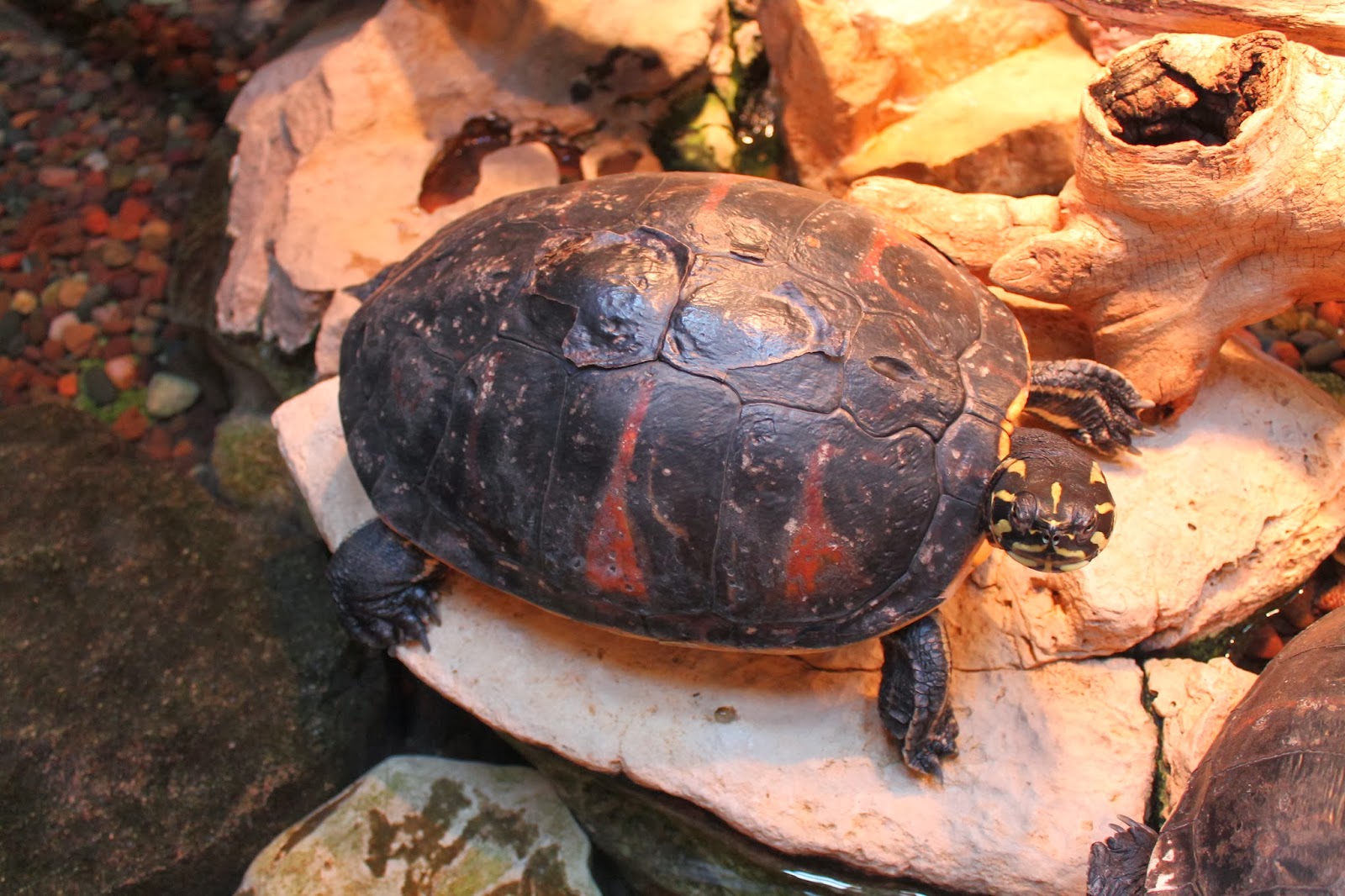
Red-eared slider (Trachemys scripta elegans)
Common map turtle (Graptemys geographica)
A ginormous female redbelly turtle (Pseudemys rubriventris)


Monday, January 13, 2014

Kids and Reptiles

Think your kid wants nothing to do with reptiles?  Kids seem to inherently gravitate toward these animals.  Most are too young to have been fed all the garbage about them being mean and nasty.  A child touching or holding a lizard or snake for the first time is one of the greatest sights, in my eyes.  Most kids are exposed to animals such as dogs and cats, and that is great.  Most, however, pause and gaze at reptiles.  They approach with a degree of caution but hardly hesitate to ask if they can pet it.  There is no coincidence that the reptile house of the zoo is typically the most popular, and why aquariums are adding more and more reptile exhibits (not that fish are not interesting, but there is a certain disconnect and perhaps perceived intangibility between people and fish).  Reptiles straddle the line between touchable/handleable and exotic/mysterious.  It's a great thing for kids to be able to safely come into contact with these animals, since the experiences often can lead to a better respect for all lifeforms and improved ERB (environmentally-responsible behavior).  At the very least, it's a cool experience they won't soon forget!

Jeffrey Peffers holding his first wild-caught brown snake.  I was proud!
Jeffrey Peffers and his first blue-spotted salamander.
Jeffrey Peffers long ago, delighted to be petting Bubu the boa.
Who wants to learn about snakes??
The kids were supposed to sit on the mat, but they mostly pushed to the front and some ended up off-limits.

Inspector Gadget

A young visitor to Fall Fest in 2012 (with a tiger salamander).
Girl posing with Dexstar, the water dragon, at summer festival.
 Girl with corn snake at church event.
 At the summer festival - my jungle carpet python absolutely made this kid's day!
Alli Calli (Jeffrey's sister) with Birdy, the Solomon Islands ground boa.