Monday, April 28, 2014

Snake Road!

I have been planning on my trip to Snake Road for months.  In the big picture, I've always dreamed of going to Snake Road.  I have heard stories of a road somewhere in southern Illinois where snakes cross without the risk of being run over by vehicles since automobiles are banned for four months of the year.  The place is literally crawling with snakes - over 35 species, as well as a myriad of other herp species, including frogs, salamanders, turtles, and more.  It is located at a unique crossroads, where the west meets the east and where the north meets the south.  This position allows southern species such as cottonmouths and green tree frogs to mingle with animals I commonly see up here in Chicago, such as redbelly and brownsnakes.  I knew that there was no way I would go and not witness something spectacular.  I have field herped in the Chicago area for years and have also spent a great deal of time in the southeastern United States, but something about Snake Road tantalized me - I had to get there and see for myself the amazing area.

Snake Road is located within the Shawnee area of extreme southern Illinois, along the Mississippi River.  A roughly 2.5-mile section of the road is blocked for two months each spring and again in the fall to allow migrating reptiles and amphibians safe travels to and from their hibernacula.  On one side of the road stands an imposing 350-foot cliff and on the other side, a rather expansive swamp.  Many of the reptiles and amphibians that call the swamp home during warm weather will make their way to the cliffs in the fall and wedge themselves in the many cracks and fissures.  And of course during the spring, they head back to the swamp.  Thankfully, in 1972, the Forest Service, responding to the reports of numerous dead snakes on the road during the migrations, outlawed vehicles on that stretch of road, although foot traffic is welcome.  The road is actually a gravel one-lane access to the swamp used primarily by hunters during the hunting season.  It never actually was a busy road.  If one didn't know better, it could be seen as a pedestrian path.

Enough of the site history, now for our experience!  I traveled with Aimee and after a six-hour drive, we finally made it to Snake Road.  The whole area is absolutely breathtaking - turkey vultures flying high at the cliffs, migratory waterfowl and songbirds abound, astounding variety of plant life, and the swamp water quality is impeccable.  Though I was there to witness reptiles, I simply could not help but be distracted by the other qualities of the area.  Also- this is my first time using my new macro lens with my DSLR.  So, photo quality suffered due to inexperience, but I think a few came out okay.  And on one occasion, I didn't have my camera handy, so I had to use my cell phone.

Day One

We arrived at Snake Road around 3:00 PM.  We parked the car and prepared for the outing.


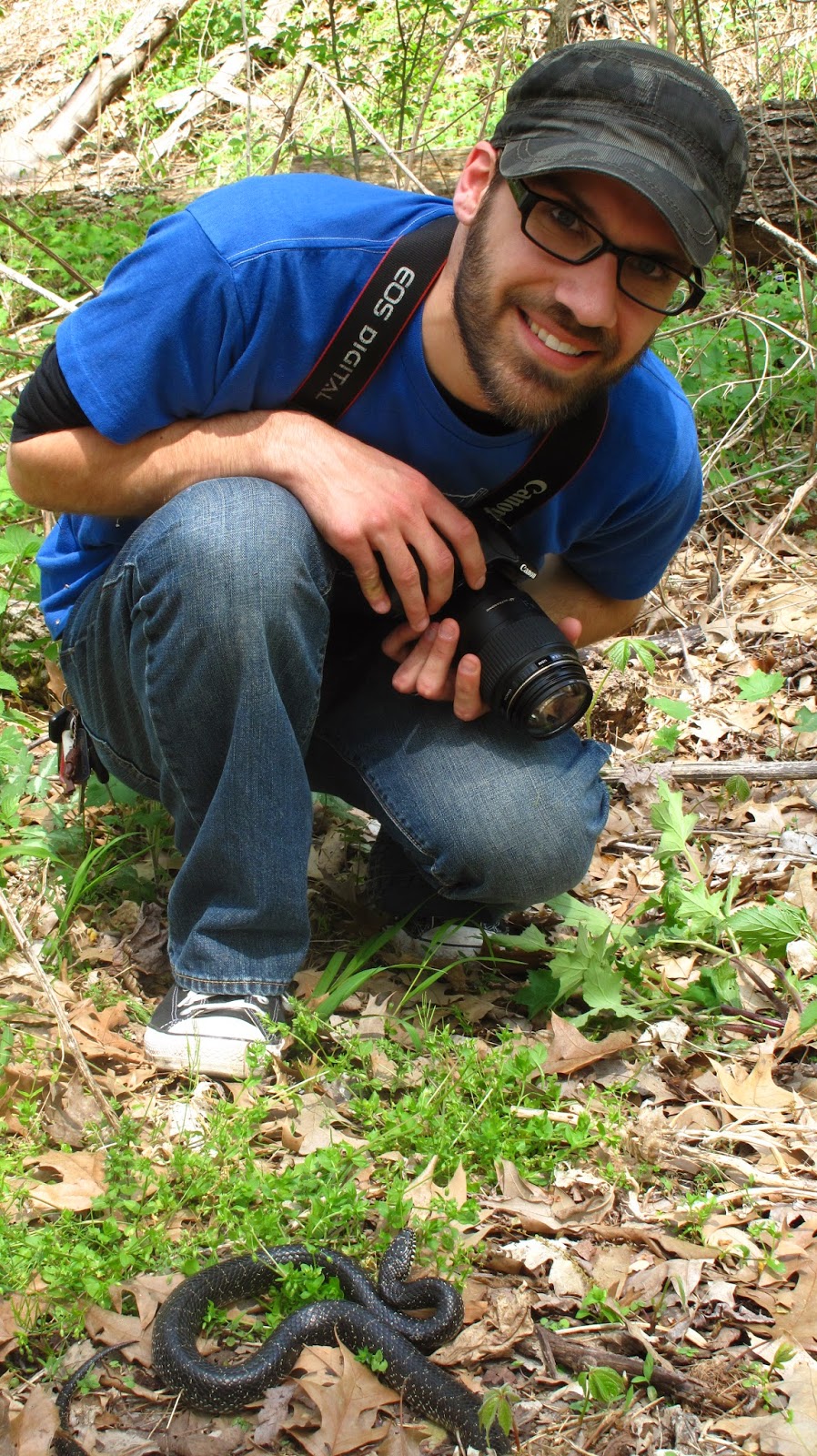
Within minutes, I was greeted by an angry four-foot possible black/speckled kingsnake intergrade (Lampropeltis getula nigra/holbrooki).  Big rush.


About two dozen photos of this gorgeous animal and then we let it on its way.  Good thing we did, for a very short stroll yielded another Snake Road favorite - the rough green snake (Opheodrys aestivus).


We then witnessed the first of many large millipedes on the road.  This one is Narceus americanus.  They are probably no big deal to folks who see them on a regular basis, but these dwarf the small brown millipedes I find at home.
Millipedes have interesting methods of self-defense.  If curling up doesn't work, this species releases a substance that can cause skin burns and discoloration.  Interestingly, no one mentions the biting and chewing - each one of these diplopods insisted on biting the palm of my hand.

As we approached the swamp, we began seeing Blanchard's cricket frogs (Acris crepitans blanchardi).  They were abundant.  At times we had to watch where we were stepping so that we didn't crush them.  They are very small - one can sit flush on a quarter - but are not always quick to hop away the way Lithobates do.

The array of plant life was stunning.  I'm no botanist but I do know there is a Trillium in this photo and some woodland phlox (Phlox divaricata).  I think there is some creeping poison ivy in this photo, too...poison ivy was a very, very common plant here.
Continuing down the road.
A six-spotted tiger beetle (Cicindela sexguttata).  I think that even if you don't like insects, you've got to admit that these are rather attractive.
This huge beetle was too fast for a photo unless held, which proved hard to do while taking a photo.  I think it is a Pasimachus depressus.  A type of ground beetle.
Then, the third snake of the day - a young Northern ringneck (Diadophis punctatus edwardsii) crossing the road.  The last time I saw these was during my time in Georgia, long ago.  These are very small, secretive snakes and are rear-fanged and slightly venomous, but pose no threat to people whatsoever.


Another large beetle - Odontotaenius disjunctus.  These shiny black beetles are denizens of dead rotting wood.  
The first of several bullfrogs (Lithobates catesbeianus).
A morel fungus - these are edible, but I don't like mushrooms.
We returned to the car and noticed a shallow puddle in the gravel "lot".  The puddle was teeming with Fowler's toad (Anaxyrus fowleri) larvae.  Many were restricted to a single tire rut.  I wondered if they would survive in this shallow depression long enough to morph into toadlets - IF the water remains long enough.


Day Two - We wanted to get an early start.  This idea turned out to work to our disadvantage.  See, I am very normally an early-bird go-getter when it comes to outdoor stuff.  But I did not take into consideration several factors, the biggest being a west-facing cliff that blocked the sun until near mid-day.  That meant the road remained fairly cool until roughly 3:00 PM.  Still, there is something about a cool, early morning stroll down a rural wooded lane that kept me going regardless of how many reptiles we'd see.

There was a healthy population of southern leopard frogs (Lithobates utricularia) in and around this small, flooded indentation at the lot.  I was photographed by Aimee in my fruitless attempt to capture one, but take a look at that backdrop!  Never a bad day at Snake Road.


Another interesting millipede species was encountered crossing the road on this trip.  Apheloria virginiensis is a boldly-marked millipede with the habit of releasing cyanide (yes, cyanide) as a defensive mechanism.  If handled, the toxin could be applied onto hands, which when transferred to the eyes can cause real discomfort.  

We walked past countless land snails crossing the road.  I also saw many of them on the cliff walls and underneath rotting logs.  It turns out there are dozens of species of snail here, and evidently one species is endemic to the area (can only be found here).  I don't know how to identify snails, but they are interesting, and Aimee enjoyed moving them off the road into the vegetation.  Her inspiration was the sight of several crushed snails due to (hopefully accidental) pedestrian activity.


Our first road herp of the day was this tiny central newt (Notophthalmus viridescens louisianensis).  It turned out to the the first of several over the next couple days.  All but one was found on the road.  It seems I cannot go anywhere this spring and not find this newt!
Shortly afterwards, we found the first of many Fowler's toads (Anaxyrus fowleri).  This first one was the smallest we'd see; it was about the size of a walnut.  One interesting note was the fact that all of the toads we saw were Fowler's, and not American toads (Anaxyrus americanus).
A short while later, out second Northern ringneck snake, out on the crawl...
...followed by another Fowler's toad.
Butterflies were abundant here too.  They were seen feeding around mud puddles for salt and animal droppings for other nutrients flowers don't produce.  I cannot even guess as to how many species were seen.  There were A LOT.  It was great to see.
Here are three different species feeding on feces of some smallish mammal - clockwise from left:  Eastern tiger swallowtail, zebra swallowtail, and black swallowtail.
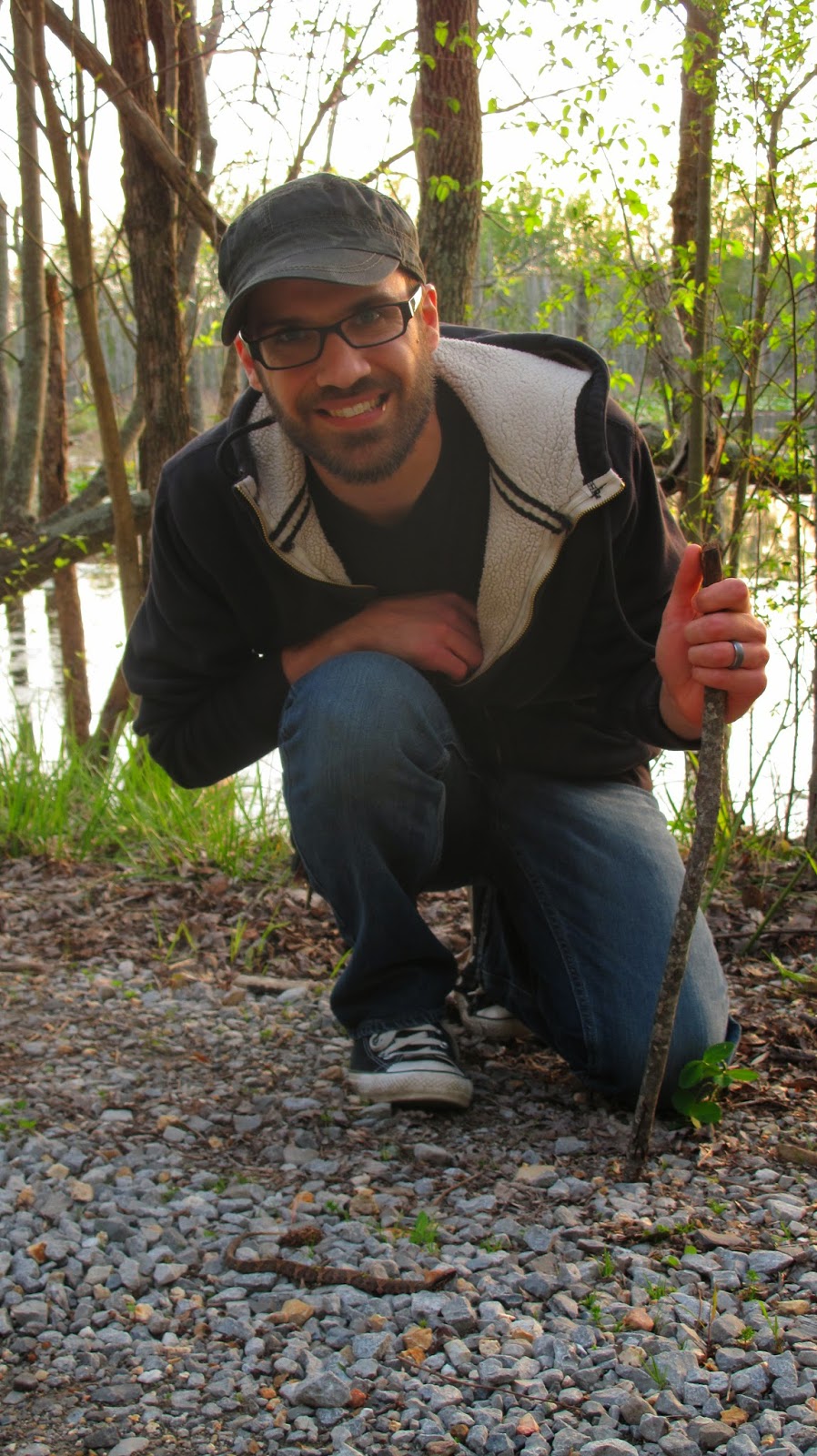
We decided to call it a day after walking the entire 2.5-mile road back to back without much herpetological life to write home about.  However, I wanted to check out an area of the swamp where the day before a group of teens had claimed to have found a cottonmouth.  A cottonmouth was very high on my list of snakes I'd love to find here, so Aimee reluctantly followed me as I made my way through the dense undergrowth of woodland on the other side of the lot, opposite of snake road.  Within about ten minutes I realized this wasn't going to happen - there was way too much poison ivy, and the ground was getting too swampy.  On out way back, imagine my surprise when Aimee saw a small snake that she claimed was "brown".  thinking it may be a cottonmouth, I grabbed a dead stick and poked at the leaves on the ground, where Aimee said the snake crawled under.  In seconds I saw it, but it was not the cottonmouth I hoped it would be, but instead another welcome species I was able to add to my Snake Road list - a  midland brownsnake (Storeria dekayi wrightorum).  Very common at home, but it was cool to find one out of my "home element".

Day 3 - We arrived at the road around 10:00 AM.  Since this was our final full day, I wanted to get as much time in as possible.  
A view of the levee road access to Snake Road.  Unbeknownst to us at the time, this road would play an integral part in shaping awesome memories later that evening.
Another shot of the parking lot puddle that housed tens of thousands of toad larvae (tadpoles).  Also in the pond were green frogs, southern leopard frogs, Blanchard's cricket frogs, and one fat Eastern garter snake that I managed to miss catching in two hapless attempts.
I've got to give Aimee credit.  For someone who isn't particularly fond of nature outings, in particular field herping expeditions, she was a real sport.  She went out of her way to get some good shots herself and braved tick and chigger-infested woods to follow me in my pursuits.  Not even the infamous poison ivy (Toxicodendron radicans) stopped her.  She quickly learned to identify and dodge the noxious vines that were so incredibly numerous all over the place.
Not long in our walk, I finally found a southern leopard frog (Lithobates utricularia) willing to sit still enough for a halfway decent few photos.
I also found what I believe to be a southern redback salamander (Plethodon serratus) under a piece of rotting tree bark on the ground.  When I checked my field guide, I saw that this species is not known from Illinois at all, though they are known in southeastern Missouri along the Mississippi River, very close to where we were.  So, without looking into this further, I am assuming this is of an isolated population east of the river.  I did attempt some photos, but due to the salamander's tiny size and very fast speed, the quality of photos is embarrassing to say the least, therefore I will leave them out.

Arrowhead plants
Another green frog 
A two-spotted stink bug (Perillus bioculatus)
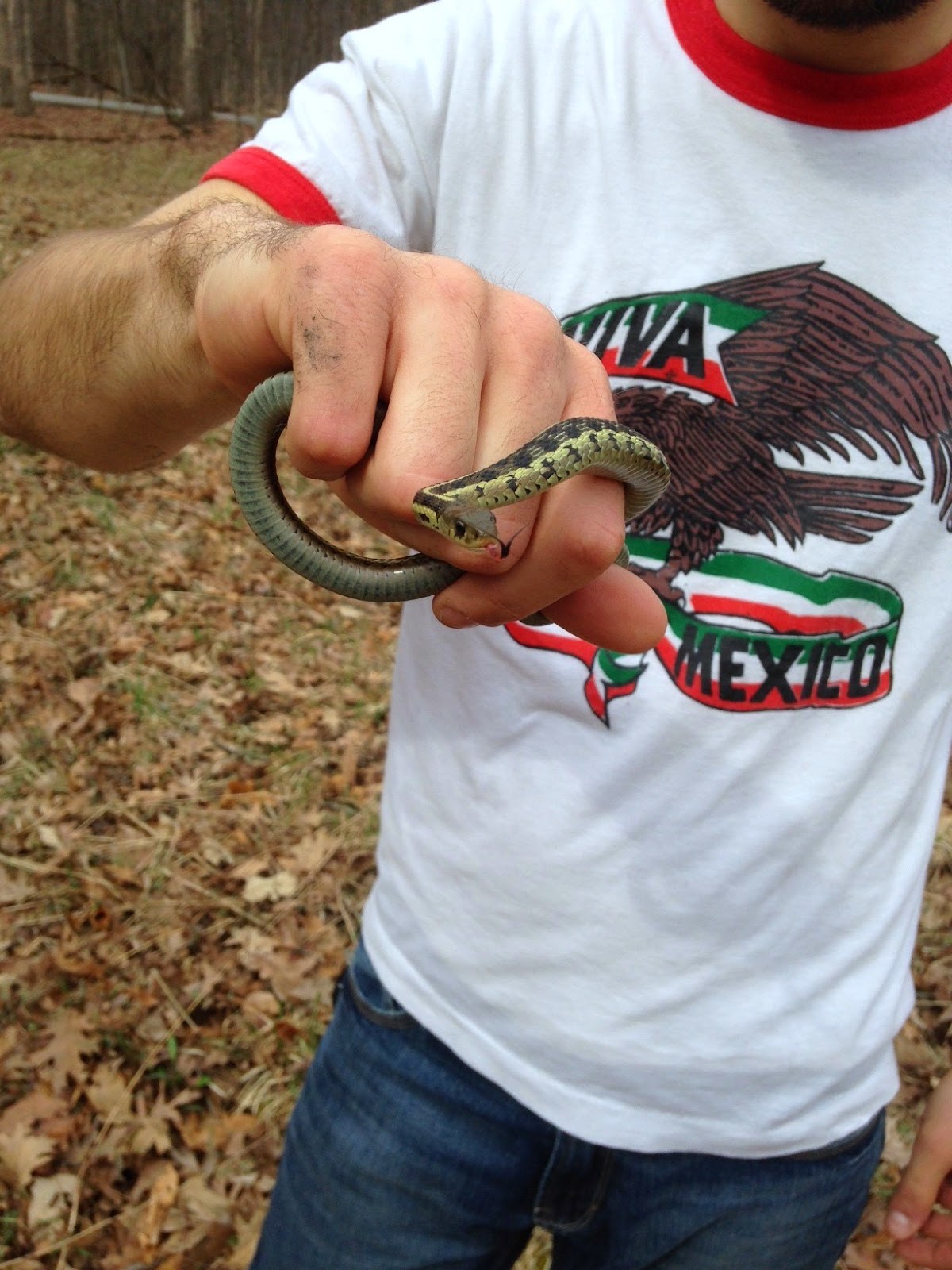
Walking with some kind folks all the way from Ontario, one of the group spotted a "garter snake" just off the path.  It was clear to me, even before I caught it, that it was in fact a Western ribbon snake (Thamnophis proximus proximus).  It can be identified as a ribbon snake mainly due to its thinner physique and as a Western ribbon since the two light colored spots on its head are enlarged and touching each other.

To close out the afternoon, a gorgeous summer tanager (Piranga rubra).
And, so that was to be the end of Snake Road for this trip.  We went out for dinner and were planning on going roller skating (that's right...).  As we were on our way to the town with the roller skating rink, Aimee suggested one last stop at Snake Road.  The sun was low in the western sky, but we were only ten minutes from Snake Road.  I did want to try our luck with a late day trek, since we had been most successful on our first day, when we arrived in the afternoon after the area had sufficiently warmed.  I decided one last quick stop just might do the trick.

It did.

When we arrived, I decided to limit our walk on the road in order to get back to the car before the sun set completely.  Our quick stroll would take us to where the big swamp reaches the road.  We joked about how cool it would be to find a cottonmouth.  Imagine my surprise, when sure enough, right at where I planned on heading no further, I saw a neonate western cottonmouth (Agkistrodon piscivorus leucostoma).  It was the the most giddy I had been in a long time!  Not only did I find my cottonmouth, but this was a very cute baby with a beautiful bold pattern and yellow tail.  Unfortunately, I did not have my camera, since I thought we were going roller skating.  But, I did have my phone, and Aimee had hers.  We took a ton of pictures, as this was clearly the highlight of the trip.  


What a rush!  My first ever Shawnee cottonmouth.  The only other cottonmouths I've experienced were in Georgia and Alabama, and it has been a while.

We HAD to get back to the car before it got dark, so we let the young cottonmouth be and quickly began walking back.  I was so amped that I'm surprised I saw the redbelly snake (Storeria occipitomaculata) making its way across the road in front of me!  How cool is that?
We got to the car as the sun was setting - perfect timing.  What a great end to this trip!  Fifteen species of herps were seen - not all were photographed - and that is more than I could say I could find in my area in the same timeframe.  I had that thought in mind as I pulled the car out of the lot and onto the levee road.  But wait - what is that on the road ahead?  A huge diamondback water snake (Nerodia rhombifer rhombifer)!  I quickly pulled over to get some crappy cell phone photos, and Aimee was there with the assist.  The water snake had flattened out but upon being approached, did not exhibit any threat displays.  It turned out to be the most docile water snake I've ever caught.  Our activity drew the attention of a couple locals, who stared in awe at the crazy city boy holding the water snake.


After this beast was released, we chatted with the two young locals for a few minutes, and then went our separate ways.  On the way back to the main road, we saw at least three more diamondback water snakes.  Then, one last species - I mean it this time - a beautiful copperbelly water snake (Nerodia erythrogaster neglecta).  The sun was long gone and we only managed one quick voucher shot using the headlights as a flash.

All in all, this was one of the greatest trips I have ever taken!  Aimee and I had a great time and I am already kinda sorta planning for the fall migration.  Until then, I plan to continue updating the blog with reports of  Chicago-area outings.  Stay tuned!

Sunday, April 20, 2014

Skunked by the "Queens of the Streams"

I've been holding queen snakes (Regina septemvittata) in high regard as of late.  I keep thinking about the first time I ever saw one.  I was probably about ten or eleven years old, and we were at our old campground, where we used to go for the weekends throughout spring, summer, and fall every year.  Walking along the narrow creek that wound through the campground, I'd gently brush my foot alongside the streamside vegetation in order to spook frogs and sometimes snakes into the water, where I'd step in to catch them.  This time, a strange looking striped brownish-yellow snake appeared from the bank of the creek and quickly slithered under a huge piece of submerged limestone.  It wasn't a Northern water snake nor was it a garter.  I knew it was probably a queen snake based on the habitat and the abundant crayfish in the area (the queen snake's primary food).  I suppose it could have been a Graham's crayfish snake, but for one reason or another I've always considered that a queen snake sighting.  It was one of many occasions where one split second sighting of something compelled me to pursue the matter further.

So today, I embarked on a road trip of moderate distance to a location where queen snakes have been sighted in recent years.  When I arrived, there was no doubt that the habitat was right - a long, wide, shallow rocky steam with plenty of flat pieces of limestone distributed everywhere.  The stream meandered through an old-growth woodland, sections of which haven't been managed and are overgrown in dense shrubbery and thorny brambles (unfortunately I can all too well attest to their effectiveness in diverting anything and anyone).  The stream was beautiful, but due to its proximity to a parking lot and a gravel path, it is the victim of careless exploitation by people over the years.  It is littered in trash, including a lot of broken glass bottles.  There were people picking up and heaving the limestone slabs into deeper parts of the stream, I suppose in order to make a big splash.  And the off-leash dogs, well, nothing sets the tone like two disobedient pit bulls running into and around the stream while their owners yell and scream at them to "get back here!".

I decided to walk along the stream as far as I could go.  The gravel path had turned back and I kept on walking.  Away from interpretive signs, away from the sounds of people and their barking dogs.  I traversed across an old but active railroad embankment and followed the stream past that.  There, the stream entered a fairy tale setting.  The stream banks were lush in green spring vegetation and not one human footprint could be seen.  The water was stunningly crystal clear and teeming with all kinds of small fish.  The sounds of woodland birds became more pronounced as the ambient noise transitioned to the sounds of a babbling brook.  Only twice did the sounds of a passing freight train disrupt the tranquil setting.  I made my way further into this amazing place.  Several frogs plopped into the water, and Northern brown snakes were seen on the crawl.  I sat on a log to process for a minute or two before heading back the way I came, keeping an eye out for suitable pieces of flat limestone to carefully flip.  I did not find any queen snakes today.  But, I was saved by a bunch of Northern brown snakes and some frogs, and found a new place to return to in the future when I feel the urge to reunite with one of the queens.

A section of the stream ravaged by unruly people and their off-leash dogs.  Though fairly degraded, it is still beautiful.
 And here we see an area downstream, well past the pathways and parking lots.  I doubt anyone goes here regularly; the journey is quite a daunting task.  However, the rewards are well worth it.
A dark, cooperative green frog (Lithobates clamitans)


While walking one of the gravel footpaths, I came across a number of Northern brownsnakes (Storeria dekayi) crossing the path.  I did assist in helping them meet their goal by moving them off.  There was a good amount of activity on the path, including cyclists, and no one else noticed the snakes.  This one was pretty big, as far as brownsnakes go. 


And then of course the thanks I get for helping.  A bad attitude, and a well-timed musking.

And one youngster.  Beware the cursed evil serpent!  Oh how this wretched creature strikes fear into the hearts of the innocent!!  How can we ever prosper among these vile beasts??
And finally, a few spiders to round things out.  This one is yet to be identified...
Some kind of wolf spider?
 I think, definitely,a wolf spider.

Sunday, April 13, 2014

Spring herpetological cornucopia!

My nephew (and frequent field herping partner) Jeffrey (Peffers) turned fourteen today.  Fourteen.  It's bad enough that he is now about two inches taller than me and has feet bigger than my size 11, but now he's finishing up junior high and is planning for high school.  Time flies.

We went to breakfast this morning with some family, but while driving there, Jeffrey and I passed a flooded field teeming with calling Western chorus frogs (Pseudacris triseriata).  That was a sound I've been dying to hear for a long time.  He expressed an interest in checking out the vernal ponds after breakfast, and he did not have to ask, since I too wanted to check out the ponds.  The only issue was that I did not have my camera handy - nor was I wearing proper attire, since I hadn't planned for the outing.  It turns out that didn't stop us from making our way toward the calling frogs once we finished our pancakes and French toast.

We ended up finding a number of vernal pools in the vicinity of the first pool we noticed while driving.  We did a little hiking around, but the area was very wet, and I tried to avoid ruining my good shoes.  We never actually saw any chorus frogs, but they were there - calling within several yards of where we were standing.  Most frogs will stop calling when they sense danger nearby, and will resume calling once the coast is clear.  I led Jeffrey across a huge fallen log to the center of one of the wooded vernal pools in order to get a better sense of where the frogs were.  The pond became silent.  We stood still for a few minutes, and then one by one the frogs began calling again, but this time with a hint of suspicion in their tones (don't ask, it's just something I've noticed over the years).  Still, we couldn't see any.  Those frogs are like tiny ventriloquists.  You think you're getting closer to one until you realize it's coming from the other direction.  It was still good to know they were active.

Since the weather was very fair (and had been the last few days) - almost 70 degrees to be exact, and overcast - we got back in the car and headed around the corner to one of my garter snake spots.  I figured these conditions would bring out the snakes - they did.  We walked the small opening in the woods and encountered a number of basking Chicago garter snakes and one redbelly snake.  The snakes were easy to spot, and most were coiled and resting right at the surface.  After a few captures, I came across a fairly large female being pursued by a male.  At that point, I was particularly disappointed that I didn't have my camera.  My iPhone takes decent photos close-up and mid-range, but capturing a decent-quality photo of two snakes from about 4 or 5 feet away proved to be futile.  Zeroing in one the pair only spooked the male, and he was off.  After about an hour at the glade, Jeffrey, who really likes the newts (as do I) asked if we could go back to the newt swamp, which was a short hike from where we were.  This is THE newt swamp, infamous for its ground hornets' nests but also famous for its stunning beauty and tranquility.  It is where I was last weekend (see Newtapalooza) and saw bald eagles.  So we trekked to the swamp, only to find that all the areas I found newts in before did not have newts.  I surmised that they had all moved to the swamp to breed or to complete their transformation to aquatic adults.  The only herp I saw at the swamp itself was a small bullfrog, and I didn't even notice it until it plopped into the water near the edge.  Very soon, the swamp will literally be jumping with frogs.

As we hiked back, we stopped every often to inspect deadwood for newts, to no avail.  We were very close to my car - I could see it from where we were - when I noticed a nice looking half-log off the path.  Jeffrey and I got to it, and when I lifted it, imagine my surprise when I found a nice fat little tiger salamander (Ambystoma tigrinum).  Jeffrey was delighted too!  I have been scouting this area for years and had all but given up on finding any Ambystoma.  It seemed that the newts had taken over and that perhaps the conditions weren't favorable for the tigers.  Well, it seems they are there and just remained elusive until today.  Interestingly enough, we ended up finding one more as we were leaving, hiding underneath a discarded chunk of asphalt on the side of the access road, of all places.

How can we conclude this adventure without finding any newts?  This is the newt swamp, by the way.  Answer?  We don't!  One little patch of deadwood about fifty meters from my car housed a whole bunch of central newt efts.  These were among the smallest efts I'd seen here.  One log gave up six efts, but we felt there were even more because there were many subterranean chambers under and around the log that we didn't want to poke and prod in.  The surrounding logs and some of the bark produced even more newts.  I don't remember how many there were and I'm not sure we were keeping count, but let's just say that as of now, the newts are doing fine there.

Here are a few images of today's bounty.  Sorry for the poor quality.

A crayfish found early in the hunt.  It was hiding near the entrance to its burrow under a log.
 The first snake of 2014, and the first of several Chicago garter snakes (Thamnophis sirtalis semifasciatus) to be found today.  In situ.

 One other garter, in situ.

 These are some of my favorite snakes (though the same could be said about any species).


 Here we see a male in hot pursuit of a female.  These snakes often look for mates and breed very soon after emerging from their dens in the early spring.  It is as high a priority as finding food (and oftentimes higher).  Sometimes, during actual copulation, these snakes cannot easily be distracted by potential predators, or people.  The male, however, wanted nothing to do with this female once I approached a little too closely.
A beautiful redbelly snake (Storeria occipitomaculata) Jeffrey spotted on the crawl
A tiger salamander (Ambystoma tigrinum)  Some people jokingly refer to salamanders as "gummy lizards".  It certainly is easy to see why people who normally are scared of or dislike reptiles and amphibians usually have few issues with these "gummy lizards".  They even have big smiles on their faces.


 I often come across an insect I've never seen before that intrigues me.  Sometimes I'm lucky enough to get a photo.  This time it was a bumble flower beetle (Euphoria inda).  It flew like a bumblebee and not until it crash-landed onto the forest floor did I realize it in fact was a beetle.  Very interesting colors and morphology.
Six central newts (Notophthalmus viridescens louisianensis) as found under a log.  These are in the eft stage.


Saturday, April 5, 2014

Newtapalooza

The Eastern newt (Notophthalmus viridescens) is an interesting amphibian.  One particularly fascinating aspect of its life is its 4-stage life cycle - egg, aquatic larva, terrestrial eft, then aquatic adult.  Most other woodland salamanders will hatch from an egg, live as an aquatic larva, and then metamorphose into a terrestrial adult.  Examples of such species are our very own blue-spotted, spotted, and tiger salamanders.  Other interesting characteristics of the Eastern newt, and newts in general, are its rough skin and toxicity.

Here in northern Illinois, the newts are of the central newt subspecies (Notophthalmus viridescens louisianensis).  Their natural range is spotty, and their numbers in the Chicago region are rather low.  Like other amphibians, they are particularly vulnerable due to their delicate nature and the fact that they require multiple environments in order to reproduce and survive.  If a population of newts are found in a pristine woodland habitat but are forced to live and breed in water that has been polluted by runoff, then it doesn't matter a whole lot how good of quality the woodland is.  The same can be said of the opposite - If the newts have access to clean water but the surrounding landscape has been compromised, it is just a matter of time before the newts are gone.  Most local wetlands, ponds, and streams have either been filled, channelized, or drained since the arrival of Europeans.  Many others still exist but have been so heavily engineered that only the most hardy amphibians could survive (bullfrogs, etc).  A lot of these kinds of water bodies are now the selling point for brand new, sprawling subdivisons.  Some artificial ponds, such as suburban overflow basins or stormwater retention ponds, create suitable habitat, but again for species such as bullfrogs, and not so much for other amphibians.  It would seem that central newts in the Chicago region are only found where the appropriate habitat is protected - forest preserves.  And even there, some populations are vulnerable to heavy human activity, introduced game fish such as bluegill, pollution, and invasive species (to name a few).

Few things make me happier than witnessing uncommon species persisting in the right habitat near my home.  There is one preserve I go to to find central newts, and I am never skunked.  I find them when it is 42 degrees outside in April like today, and I find them when it is in the 90's in July or August.  They are a joy to find and to learn about.  I only worry that since these animals are in fact so restricted to relatively small parcels of protected land, they are all the more susceptible to human impacts or even "acts of God" such as an unusually harsh drought.  That's why I am a huge advocate of natural habitat conservation.  Setting aside large plots of land to remain undeveloped is key.  Then, coordinating restoration efforts if and when necessary.  Limiting human intrusion is ideal.  Banning practices such as off-roading, campfires and grilling, and off-leash dogs is important.  All of these activities put extra pressure on the plants and animals living there.  Many people are more than satisfied with the amount of undeveloped natural space that is available in the area.  But I would implore you to look at an aerial map such as Google maps.  Scan over the Chicago suburbs and exurbs.  Notice the wide, irregular blotches of new subdivisions, many of which creep along or into wooded areas and ponds/streams.  Many of those ponds' and streams' denizens are marked for death by developers looking to make a quick buck selling huge, crudely-constructed McMansions.

Off on a tangent much?  Yeah, I know.

I am happy to report a total of five central newts were found today, all underneath logs, having recently risen from their subterranean lairs.  Another highlight were the bald eagles - three of them.  I have never seen bald eagles this close to Chicago.  They were being harassed by gulls way up in the sky, too far up for me to get a good photo, so I just stood and watched.

Flooded woodland depression.  Multiple newt efts were found in this area.
Detail of oak leaves under water.

 The first newt I encountered.  Without hesitation, it assumed the unken reflex - a position used to ward off predators by revealing the colorful belly.  In many cases in nature, bright colors mean bad tasting or toxic.  Such is the case with these newts!
More of the famous "Don't you dare eat me" pose.
Notice the rough skin texture of the newt.
These newts have beautiful yellow (or orange) ventrals (undersides) with small black spots.
A group of three TINY efts, all found together in a cluster under a big log.
These three were returned unscathed to their depression under the log.
A big black ash - at least it used to be.  A victim of the emerald ash borer beetle.
 One of many tufts of green sphagnum moss.  Spring is here.