Wednesday, December 31, 2014

Stick a fork in it

What a year 2014 has been.  Between all the work, the play, the traveling, and everything else life threw at me, it's been one awesome ride.  I've never been one to sit and be retrospective on any particular year, but I can't help but think back on all the experiences I've had, and all the people that have helped and inspired me along the way.  Likewise, I'm not much for New Year's resolutions.  But I feel 2015 will be as great or better than 2014, because there is so much passion I have and so much I want to do (so much, in fact, that I doubt I'll do all of it, but we'll see).

I love documenting life's happenings through photography, but many times it is impractical to do that.  I wish I had photos of the great people I've met, worked with, and learned from.  I wish I had photos of all the great places I've visited and worked.  Since I don't have a lot of those, I'll try to work my way a little through the year and reconnect with some of the better highlights on 2014.

The year started off in the middle of the worst winter I can remember.  The season began early, and the cold and snow wouldn't let up until the middle of April.  Frigid temperatures and a lot of snow led to one of the most depressing landscapes I can recall.  Fortunately, I kept my cool (no pun intended) long enough to maintain my sanity, and before I knew it, spring finally arrived.

One great activity I was fortunate to be involved in was working on a historical research project with some colleagues of mine.  The goal of this project is still hush-hush, so mum's the word.  But spending time at some of Chicago's best resources for research (Chicago History Museum, Harold Washington Library, and a slew of historical society headquarters) opened my eyes to the vast body of information available to practically anyone, if you were so inclined.

Buzz, Dan, and Ursula at the Chicago History Museum in January.
The untold indignities this bear had to endure by our group shall remain so - untold.  Let's just say we laughed a lot at the expense of this bear (at the Schiller Park Historical Society).
If there was any consolation to the cold weather and snow, Cassius seemed unfazed by it.  
Winter Lark

In February and March, I traveled to the Greenbelt Cultural Center in Waukegan for four weeks to attend a course in interpretation.  It was demanding and sometimes brutal, but not in a bad way.  Just a ton of information in a short time.  I became a certified interpretive guide along with the rest of my class - an experience I won't forget!
 Can't forget the customary goofy group photo...

In March, I finally found the first herp of the year, appropriately, a blue-spotted salamander.  What a relief to see such an animal after that long, terrible winter.  It was the first of many great discoveries I'd make this year.
An old oak tree near where I found the year's first amphibian.

Among the many home improvement projects we undertook, installing a deck to the back of our house was one of the more rewarding.  We had to create an access to the deck, of course.  So, we made some modifications to the wall and windows in order to do that.  

Before
 After

We also put in new flooring upstairs, put up a new wooden fence, planted a garden, installed a new roof on the garage, removed all three trees from the yard (for good reason, believe me), re-sided the back of the house, and carried out several repairs to our furnace.  One of our furnace issues was caused by squirrels, my constant nemeses. 

In April, Aimee and I went to Snake Road.  It was a great trip!

At the starting line.
 Photographing a Shawnee King.
 Aimee looking over the bluffs near sundown.
 She overestimated her own strength in this futile attempt to slam the door of the floodgates at the river.
In May, I took this photograph of a plains garter snake in northern Cook County.  It was entered into a photo contest by the Forest Preserve District of Cook County, and won an honorable mention appearance (one other photo I entered, of a tree taken last year, won as a top 12 and is featured for the month of March, 2015).
Sadly, the summer of 2014 saw the passing of both Saki and Dinky, Cassius' dog cousins.  Cassius misses them to this day.
Jeffrey Peffers graduated from grade school!
Summertime was also a time for family BBQs and birthdays.

Our garden was a complete success - in fact, too successful.  Our acorn squash became so invasive, it killed off the green leaf lettuce, and most of the cucumbers and green beans.  We now know to avoid those next time.  We also grew bell peppers, two types of tomatoes, and herbs in cinder blocks (including basil, thyme, oregano, sage, cilantro, dill, rosemary, and several varieties of mint).
This male three-toed box turtle arrived in my care in July.  He joined my already sizable menagerie of reptiles and amphibians.
Aimee and Cassius enjoying a warm summer day at Waterfall Glen in DuPage County.
The acorn squash starting to become a nuisance...

 A baby corn snake hatching in July.

In August, we went to Louisville.  We saw Colonel Sanders' grave site, took in a baseball game, and stayed in a great B&B.  We also stayed at the former Waverly Sanitarium, which wasn't very scary by my account.  Interesting, but not scary.
On the way home, we stopped at Muscatatuck National Wildlife Refuge, where I tried but failed to find snakes, though I did see a lot of cricket frogs.
Back at home, we helped document and coordinate one of the many events the Norwood Park Historical Society holds each year - this time, a movie on the expansive front lawn of the Noble-Seymour-Crippen House, Chicago's oldest building.
The acorn squash in mid-August.  By the time the growing season ended on October, it had taken over more than one-third of our backyard.
My sporadic volunteer work with Friends of the Parks ended in 2014, following the departure of basically all the people I worked with there.  However, the DRCA is still a place I visited from time to time, in particular, to check the snake boards I placed out there in the summer of 2013.  Remember?
 Grasshoppers and Queen Anne's lace are two very common species at DRCA.
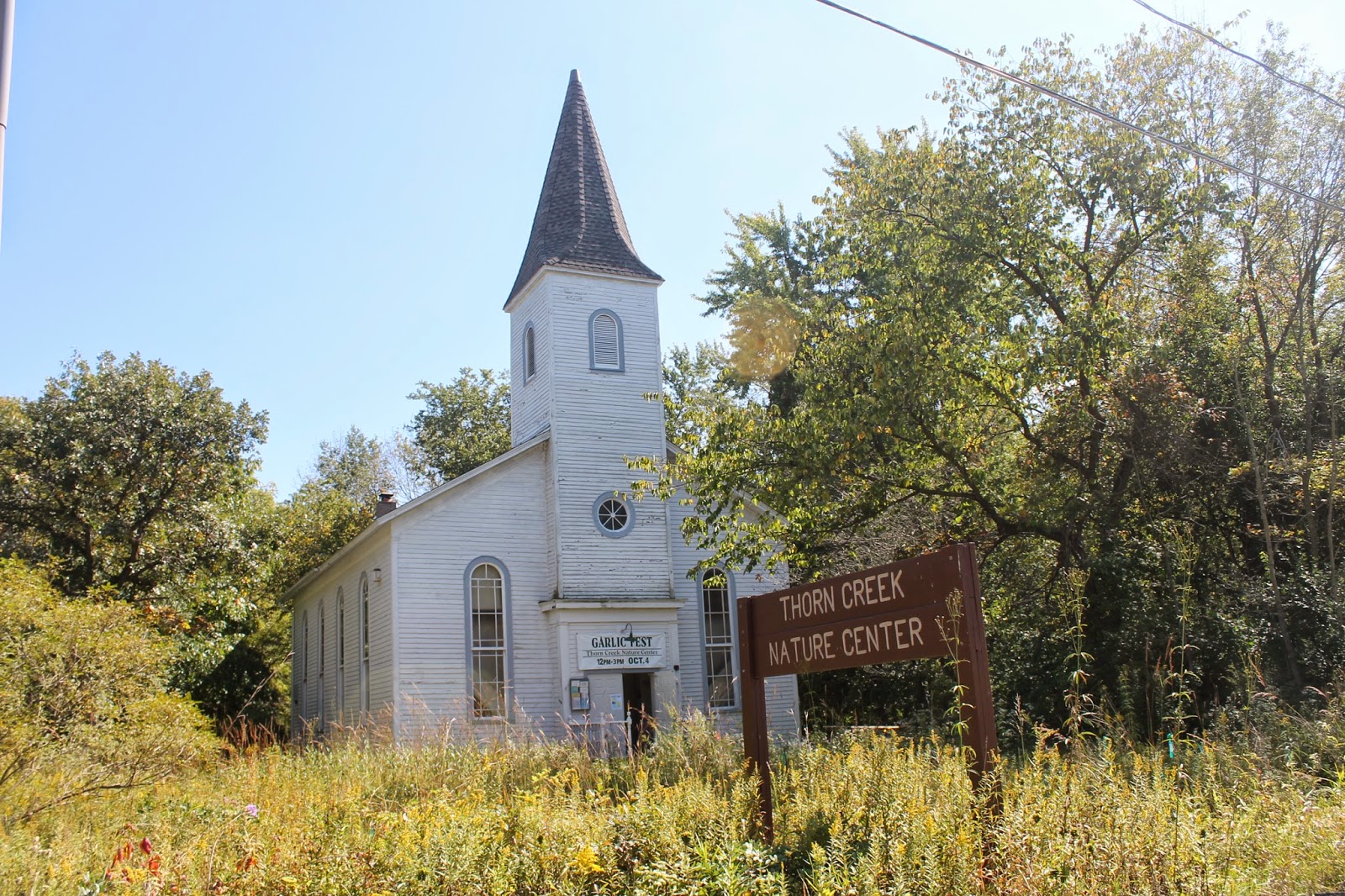
Thorn Creek Nature Center in Will County is a remarkable facility.  It was born out of a mid-19th century church.  I visited in late September.

I returned to Snake Road in October with Jeffrey.  The experience was everything we imagined it would be - nothing short of exhilarating!

Our quarters.
 Jeffrey with a couple of hatchling common snapping turtles.

I arrived to work at the Grove one Sunday, only to find out that our event had been cancelled.  I stopped at a local forest preserve for a quick hike, and discovered this old abandoned pump in the middle of the woods.

November was very, very cold.  December was actually a nice respite from the bitter cold.

Cassius in November.

Aimee and I went to Nachusa Grasslands on the last day of November.  Afterwards, we stopped by my old stomping grounds - White Pines Deer Park, White Pines State Park, and Lake LaDonna Campground.  Lake LaDonna itself was so instrumental to my upbringing, that some day I will compose a post dedicated to that place.

The Deer Park - closed and abandoned for nearly twenty years.
 When I was a child, this section of creek yielded countless specimens of aquatic life - arthropods, molluscs, fishes, and amphibians.  Of course, this was many years ago.  I wonder how bountiful this stream is today.
 We have an old home video somewhere of my sister and I standing next to this sign, but it was in 1991.  

And finally, one last shot of THE LAST herp of the year (I promise!) - this very cold, very tiny blue-spotted salamander.  As if my last post about the hardiness of blue-spotted salamanders wasn't convincing enough, this little one was found under a log two days after a very cold period - and the temperature under the log was still in the 20s.  Found December 23rd.

Well, that's it for 2014.  A great year, but what's to come will be nothing short of great.  I've got goals in mind.  We will be doing more traveling in 2015 than we did in 2014, and I hope to come back with field herping reports.  In any case, I hope to build on the great year that, in seven hours, will be history.  Until next time...

Monday, December 8, 2014

Nachusa Grasslands bison

Ever since I first heard that bison (Bison bison) were scheduled to be added to list of fauna at Nachusa Grasslands, I anticipated visiting to see the majestic ungulates grazing in herds in a natural habitat.  Visions of these enormous animals filled my thoughts; I imagined them feeding among the tall prairie grass during the summer, or exhaling clouds of steam from their nostrils in the cold winter months just as I had seen them do on TV.  I had no reservations about driving two hours west to the outskirts of Franklin Grove, a tiny town with a dwindling human population, just for the chance to see the bison.  The only bison I had ever really seen were contained in small pastures on farms, grazing alongside (and clashing with) domestic cattle, and even then I couldn't help but rubberneck as I drove by.

Nachusa Grasslands is a 3500 acre tallgrass prairie in Lee County.  Owned and managed by the Nature Conservancy since 1986, Nachusa has been the site of many cutting-edge restoration techniques and practices.  It boasts over 700 species of plants and animals, including a number of state- and federally-endangered or threatened species such as the ornate box turtle (Terrapene ornata), Henslow's sparrow (Ammodramus henslowii), and prairie bush clover (Lespedeza leptostachya).  I'm sure that a comprehensive list of species could be found somewhere online.  It has been spared the plow due to its sandstone outcrops and gently rolling landscape, and had previously used primarily for grazing (much of the surrounding landscape is the same and is still being grazed upon by cattle).

A few years ago, land managers toyed with the idea of using bison as part of the ongoing restoration process.  Previously, virtually all restoration techniques involved people directly.  But bison are known for shaping the prairie landscape in a much different way than fire.  As a herd grazes, they open up patches of prairie, allowing other kinds of plants to grow in those spaces.  Flowers and other sun-loving plants sprout and attract pollinators, which of course benefits the prairie immensely.  As long as the bison number is kept in check and closely monitored, a balance can be achieved in a prairie, allowing for the right amount of grassy expanse and open gaps.

Once the addition of bison to Nachusa was given the green light, I was stoked.  I kept up with all the news and updates from the Nature Conservancy - they were to be brought in in October, and, following some time in a holding pen, were released into a large portion of Nachusa in mid-November.  I wanted to get there as soon as I possibly could to see these bison.  Even though they are not technically wild (fences do keep them from straying off the property), they enjoy a relatively vast area to roam and act as though they were wild.  Aimee and I drove there on Sunday, November 30th.  After a very surreal drive through a dense fog (think Silent Hill), we made it to the main entrance to the preserve, which currently does not have bison.

 As in-touch with the natural world as I am and always have been, I in fact do live in a big city.  Seldom am I in an environment this open and vast.  There is no discomfort or even unfamiliarity in this element, yet still, there is a brief acclimation period I must go through when I walk an area like this.  The raw, cold weather and the wind, blowing across the blank late-fall prairie makes for a certain feeling of loneliness.  Maybe it's because I'm a reptile guy and I have no company.  Maybe it's because the sky was painted a monotone grey, lacking birds aside from a few cackling crows off in the distance. Maybe it's all of the above.  Whatever the case, in spite of the feeling of emptiness, there was an unexplainable feeling of tranquility and a sense that I belonged there.  
 I stopped here and stared at everything and nothing at the same time.


We then decided to head over to where the bison were.  I was really really hoping we'd get to see them.  There is no parking where the bison currently are being kept, and a sign at the main entrance mentioned that the bison could be viewed from the road.  So we drove around a few muddy, gravely back roads, hoping to spot the bison herd.


After tracing the prairie they were in without a single sight of bison, I surmised that the animals were most likely in the heart of the prairie, far from the roads and out of our visual range.  Bummer.  I mean, it was cool that we were there - we were in bison territory.  We were so close, I could smell them (ok, maybe I just imagined it).  We knew where they were, so that if we had time, we could re-visit the area at a later date and hopefully catch them then.  Complacent that we at least took advantage of a rare day off together, Aimee and I decided to head back to civilization. 

Back on the main road, I glanced out to my right to see a bunch of cows milling about in a farm pasture.  I thought about how humans created these animals from their ancestors long ago. About how long it took humans to tame the prairie, and how long it took to essentially transform a wild landscape into a neat patchwork of farms, villages, towns, cities, roads, highways, and skyscrapers.  I let out a little sigh, and then, turned to my left.  And that's when I saw them.

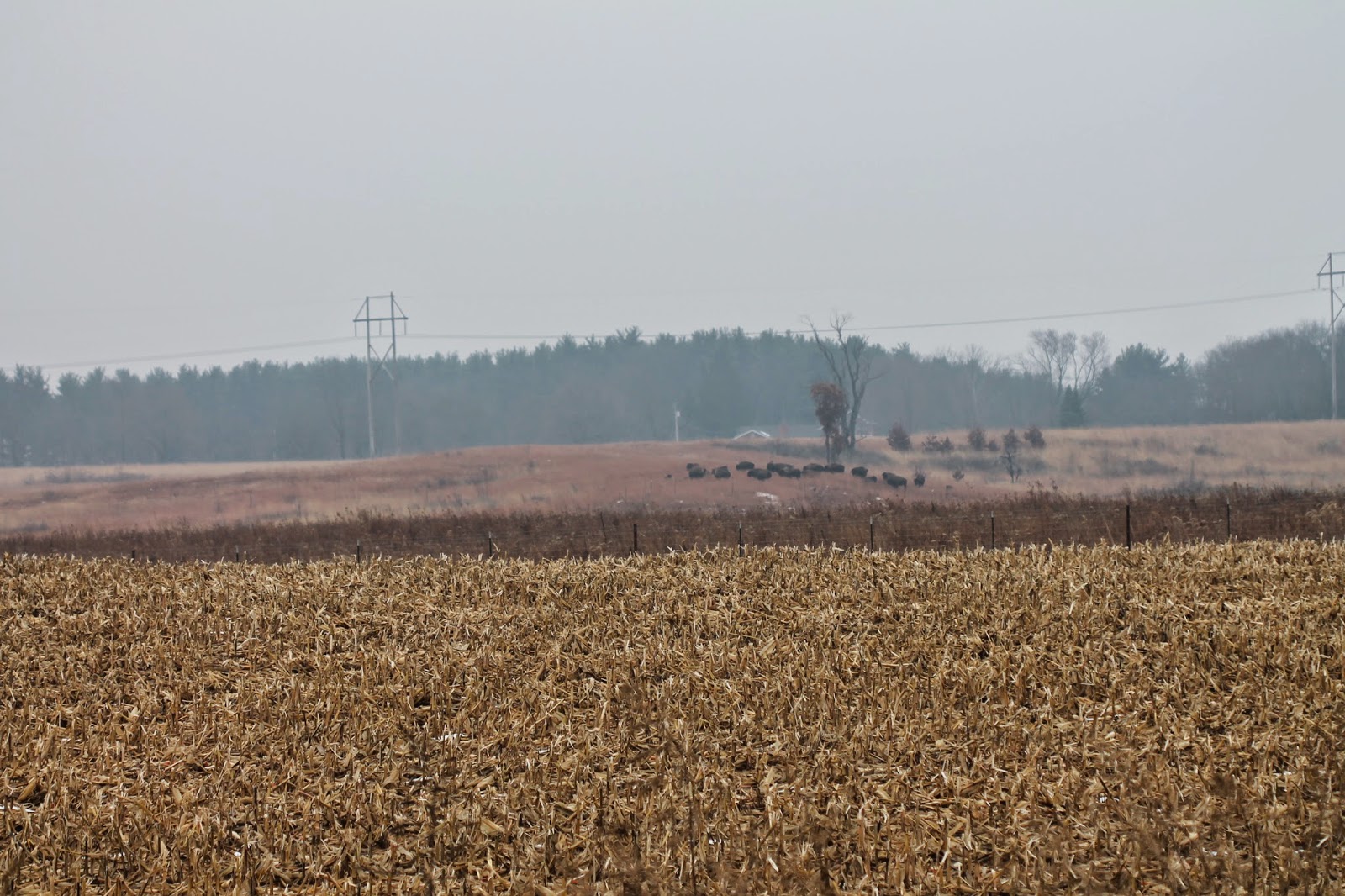
Off in the distance, cloaked in fog, was the herd of twenty bison, grazing in the middle of the field!  Immediately I braked and pulled off to the side of the paved road.  As I exited the car with my camera, a car approaching in the opposite lane also stopped so the riders could see the bison.  I ran across the road, jumped over a ditch overgrown with tall dead grass, and got as close to the fence as I could.  Look!

 Here's a closeup of the herd.  It's blurry, but I don't really care, because I was actually there to see them first-hand, and it was awesome!  I was absolutely geeking out over it. 

I guess, more than just the thrill of seeing the bison, what excited me was the idea that there are people out there dedicated to not only preserving natural spaces but also to improve them through various means.  Adding bison is a huge step in helping to educate people about Illinois' natural history.  I imagined a day when this and other restoration practices become better understood and implemented on a more, dare I say "mainstream" level.  Because, I truly feel that living intertwined with nature benefits mankind.  I'll be back for sure, hopefully sooner than later.  Stay tuned...

Sunday, November 30, 2014

Full circle

Following my jaunt to Will and Kankakee Counties earlier this month, the weather took a turn for the worse and I wasn't sure there would be any field herping left this year.  Temperatures reached record lows, with wind chills dipping to well below zero on some days.  Mind you, this was EARLY November - almost a full month and a half before winter solstice.  I crossed my arms and snarled like a madman.  Yes, nature will do as she pleases, but that doesn't mean I have to like it.

As luck would have it, I was able to secure a little bit of field time in mid-month.  And by little, I mean two very brief stints in between errands.  I was able to conjure up two blue-spotted salamanders (Ambystoma laterale), one on each walk (November 8 and 15).  And since I cannot ever talk about blue-spotted salamanders too much, I'd like to expound a bit on this amazing little amphibian.

First off, these guys are extremely cold-hearty.  Very often, a salamander, black with blue spots throughout, is the first herptile to be found in the spring (as was the case this year).  Other local herps are early risers - chorus frogs, spring peepers, etc.  But in my time, I've found that the zealous blue-spotted salamander has them beat by as much as several weeks.  I have flipped logs in early March - logs that were fused to the ground by frost - and found blue-spotteds, chilled to the bone and lethargic, but invested in waiting for the first heavy spring rains to lull them away from their decomposing abodes.  In the fall, they again can be found underneath logs, milking every last tolerable day.  As most or all of their kin are settled in deep underground, ready to turn off for the brutal cold season, the hearty blue-spotted wouldn't think twice about snatching an equally cold-tolerant centipede foolish enough to scamper by.

But it's not just cold weather the blue-spotted salamander is adapted to.  More than any other ambystomid in the area (in my studies), the blue-spotted salamander is easily procured during the summer months as well.  Tiger salamanders (Ambystoma tigrinum) can also easily be found during the warm months, whereas spotted salamanders (Ambystoma maculatum) generally avoid heat and dry weather and will disappear into the nether regions of the woodlands they live in once conditions become unfavorable.  I have found blue-spotted salamanders in almost every month of the year, even in July and August, where Chicago weather can peak at or above 100 degrees.  As temperatures approach 80s or higher, the blue-spotted salamanders will often burrow down under leaves or logs, but can still be found under really big logs that are able to maintain a reasonably-cool microclimate.

The heartiness of the blue spotted salamander intrigues me but does not surprise me.  This species' southern terminus appears to be the Great Lakes region (things get kind of confusing and long-winded south of here; the Tremblay's salamander (Ambystoma tremblayi), Silvery salamander (Ambystoma platineum), and Jefferson's salamander (Ambystoma jeffersonianum) replace it in a crazy soap opera kind of way - trust me, it's worth its own post).  As this animal extends far North as northern Quebec and Newfoundland, it has to contend with even colder and longer-lasting winters.  The ones here have it easy, so to speak.

Here is a vernal pool in extreme northern Cook County that supports a cacophonous population of Western chorus frogs (Pseudacris triseriata) during the early spring. It is difficult to access any time of the year due to invasive thorny plants that grow all around its perimeter.  You can see that the water is frozen by this time of year already.  I focused on looking for blue-spotted salamanders in the vicinity of this pool.

A bend of the Middle Fork of the North Branch of the Chicago River, sporting surface ice.
And sure enough, there's a blue-spotted salamander.  Found under a log surrounded by patches of ice and snow, this salamander was joined by an array of invertebrates - numerous woodlice, a big hornet that was alive but barely twitched, beetles, earthworms, and slugs.  Some of these animals can be seen in the photo.  Note - the temperature was in the upper 20s Farenheit.
Details of a beautiful paper wasp nest also found nearby.

Monday, November 3, 2014

It ain't over til it's over.

There was no lack of excitement during the month of October.  With the weather fluctuating wildly day to day, it was difficult to plan any surveys/outings.  And then of course my decision to leave the nature museum for a position at the Grove in Glenview.  While I loved being at the nature museum, the Grove offered additional opportunities to help people connect with nature.  The backdrop is noticeable less urban and the clientele is slightly less diverse, but I'm able to be much more involved with program development, and that matters a lot to me.  I'm still on call at the nature museum, though - I do plan on working all pertinent special events, including Tea with the Turtles, Bugapalooza, and Supper with the Snakes.

With what few opportunities I've had to field herp, I have found some common urban species, but nothing groundbreaking.  I thought I'd share a few photos from the past month.


Following this year's North American Reptile Breeder's Conference (NARBC) in Tinley Park, I headed north to Bachelor's Grove Cemetery to take notes on tree species for a friend's research project.  While there, I noticed some of the resident bullfrogs (Lithobates catesbeianus) peeking out through the mat of algae and duckweed.  Funny, but I was only aiming at one frog but I got three in the photo.
 The well-traveled Patrick monument 
 A quick stroll through the local urban forest preserve I refer to as "The Trestle".  Here is a cool jumping spider.
 A praying (preying?) mantis.
 Young adult plains garter snake (Thamnophis radix).
 Wary deer.
Peak maple.
 Aimee and Cassius were enjoying the fall weather as well.
We also took a walk along the Des Plaines River near Park Ridge for a leaf walk with my nephews Mason and Luke.

Halloween may not have been very scary but the weather was - temperatures in the 30s with snow and wind.  Miserable trick-or-treating conditions.  The cold continued for several days.  Today, it warmed up to about 60 degrees for just long enough to get out to look for Southern two-lined salamanders (Eurycea cirrigera) where they occur in Northeastern Illinois.  This species is considered common throughout most of its core range (eastern states), but there exists one interesting relict population about an hour south of Chicago.  Cut off from its core population by several hundred miles, and encompassing one small segment of preserve in Will and Kankakee Counties, this population thrives within the rocky stream beds and seeps in the woods.  I traveled down there with herpetologist Tom Anton.  Following breakfast in a small town diner, we drove about fifteen minutes from the town to find the salamanders throughout this fragmented habitat.  It was great to see numerous larval forms as well as adults of the species, as well as a good supply of copepods and amphipods (scuds), upon which they feed.  I also found a chunky male green frog, but tricky circumstances dictated my inability to photograph it.

Here is a larval two-lined salamander.  
 This is typical habitat for the two-lined salamanders.
 They hide underneath rocks and detritus.  This is what they typically look like when flipped.
 Tom holding a large adult.
 These salamanders are very fast-moving, much like other members of its genus.  I have a ton of respect for people who can photograph them.  They never sit still long enough for a good photo.  This one isn't as sharp as I'd have liked it to have been because the animal was on the move.
 Tom looking for salamanders.

 I couldn't help but notice all of these funky-looking (and smelling) fruits lying around everywhere.  I had never seen anything like these before.  Tom said they were osage oranges and that they are not native.  And no, they are not edible (I asked); though they are not poisonous, they are very hard and dense.  And they probably taste as funky as they smell and look.  Really cool either way!

Were these salamanders the last herps of the year?  Time will tell!