I traveled with Aimee this time, and it was going to be her first time ever camping. She was sort of reluctant to go, but she also is adventurous at heart and thought she'd at least try it out once. We packed the tent, some supplies, and we were off for three nights along the sandstone cliffs and bottomlands of southern Illinois. The ride down there was mostly uneventful, save for a near-death experience on the road. A big rig's tire blew out in front of a car that was in front of us. It all happened so fast - the strip of rubber somehow hurdled over the car and directly into our path. There was nowhere to go - swerving to avoid it was not an option with cars all around at at a speed of 70 MPH. Aimee and I both braced for impact, but fortunately the rubber was too heavy to remain airborne and instead it impacted the front bumper. The extent of damage wasn't evident until we later pulled over to investigate it. The front bumper was basically totaled. Ultimately, it was replaced when we arrived back at home. We remind ourselves, that it was just a stupid bumper that can be replaced, unlike our lives, so we were quite thankful.
When we arrived in the vicinity of our campground and Snake Road, we drove through small farming communities dotting the Shawnee Hills in Jackson County. It had rained prior to our arrival, and the sky was overcast and grey. Perfect conditions for Eastern box turtles (Terrapene carolina carolina) to be out and about. In fact, a few were, and I stopped to assist them off the road.


A first for me, this DOR nine-banded armadillo (Dasypus novemcinctus). These animals have been moving northward from their southern range for a long time now - a belief is that a lack of predators is aiding them.

Finally, at the famous Snake Road! And what a welcoming party - this large copperhead (Agkistrodon contortrix) was crossing the road outside the gates of the closed-off road. That meant I had to move it off to the side so that it wouldn't become road bacon. In my opinion, the copperhead possesses the most cryptically beautiful pattern and colors of all the area's snakes. Because they are fairly common in many parts of their range, they are often overlooked. Copperheads love wooded areas and rocky bluffs and ledges. They are very passive and are not particularly dangerously venomous.


One of the first herps we saw after parking was this green frog (Lithobates clamitans). Some might actually refer to this frog as a "bronze" frog based on its color and location. The bronze frog is a controversial subspecies of the green frog. I tend to lump the two since the differences between the two are rather inconsequential.

No trip to Snake Road is complete without the official welcoming party - Blanchard's cricket frogs (Acris crepitans blanchrdi). They are abundant in the region. They used to be considered the most abundant frog in the state, but they've mysteriously disappeared over a huge swath of northern Illinois. However, they are slowly beginning to creep back in some areas. Most visitors to Snake Road are casual fanciers of herptiles and walk right past these guys, but I watch each one and look for odd color distributions. The one shown here is pretty typically plain.

Off to the side, I spotted this large southern black racer (Coluber constrictor priapus) foraging atop a pile of dead branches covered in dead grasses. I actually rushed toward it for the grab, but between the snake's speed and agility and the numerous obstacles in front of me, it was all for naught. It disappeared quicker than I could even consider the possibility that there could have been venomous snakes where I planned to blindly dash.

An intergrade ringneck snake (Diadophis punctatus). The range of several subspecies of this small, fossorial snake all converge here, so it is sometimes difficult, if not impossible, to determine what exactly you've got.

While hiking, I found this blister beetle (family Meloidae) bumbling around along the gravelly road. Long ago, blister beetles were ground and used for medicinal purposes, but today that practice is mostly discontinued. They are more known today as beetles that can bleed an oil that can cause blisters on your skin. Hence, our handling of this big-butted bug by stick.

One of my most heart-warming sights - Snake Road in all of its spring glory.

A redbelly snake (Storeria occipitomaculata). I'm good for one or two of these on each trip.

Another Snake Road mainstay, the western cottonmouth (Agkistrodon piscivorus leucostoma). This was a strongly-patterned juvenile.


We didn't see too many large adult cottonmouths, but this big brute was found in neighboring Johnson County, on its way from a muddy river, over a tall bank, and toward a flooded forest where frogs were abundant.

The business end of another big cottonmouth. This one was in the way of our car as we were exiting a preserve in Johnson County. I moved it to a ditch on the side of the road.


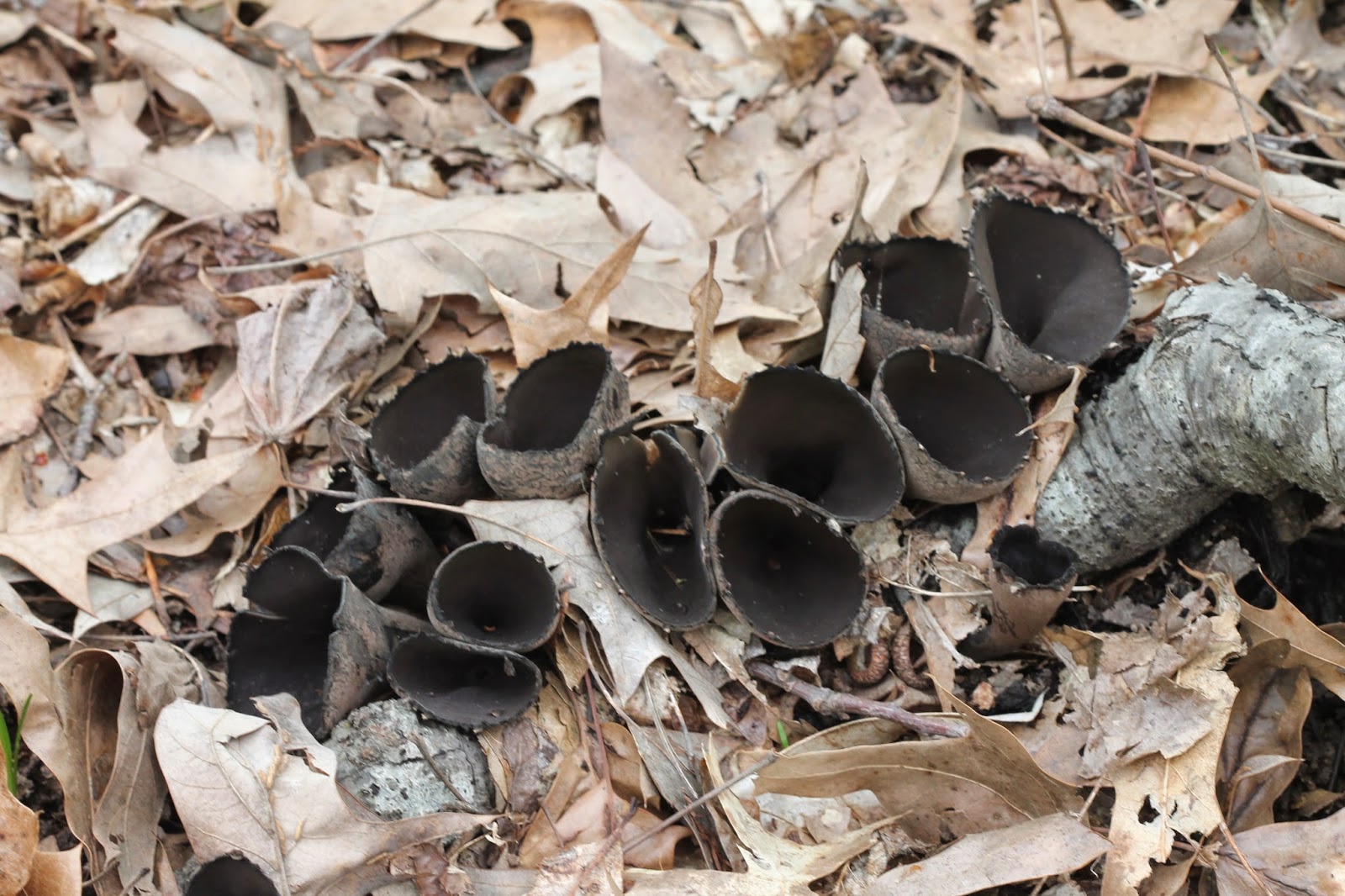
We saw a lot of these (what I think are) black tulip fungi (Urnula craterium).
A female black swallowtail butterfly (Papilio polyxenes).

Juvenal's duskywing (Erynnis juvenalis).

I paused to take a photo of this nice-looking Fowler's toad (Anaxyrus fowleri).

As Aimee pointed out, "This is how baby railroad crossings are made".

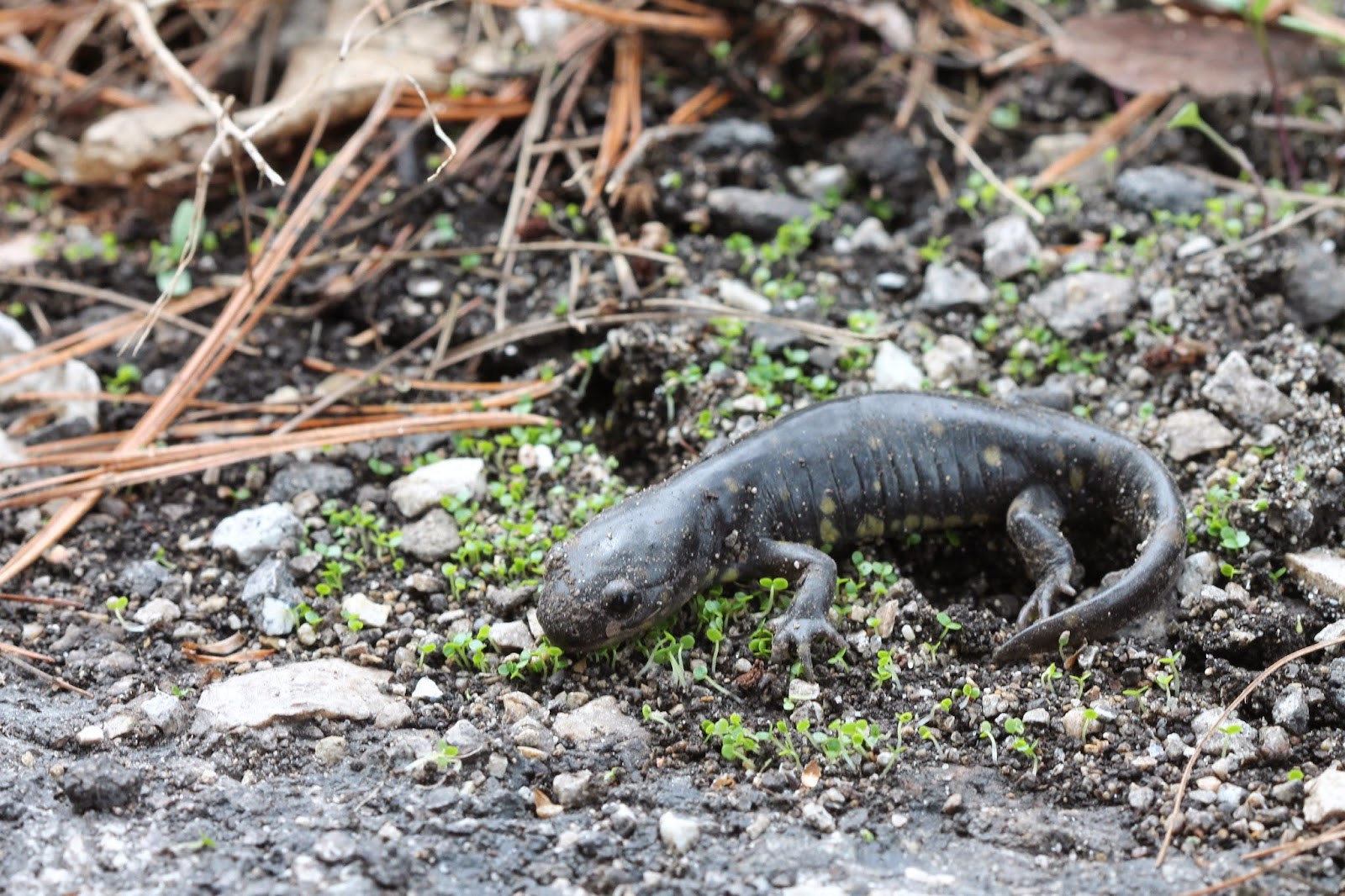
I found this cave salamander (Eurycea lucifuga) along an active railroad embankment. These are so fast, and I was so invested in trying to manually focus my macro lens while kneeling on a rocky sloped embankment, that this is the best I could get before this guy scattered off underneath some dead leaves.

A young five-lined skink (Plestiodon fasciatus), found in almost exactly the same spot I found one of these last fall - under a pile of trash at the side of railroad tracks.

An OLD Pepsi can in all its rusty glory.

This eastern garter snake (Thamnophis sirtalis) was found off to the side of a "rails to trails" pathway connecting a gravel parking area to a set of active railroad tracks. Another example of a widespread species and something I'd see at home in Chicago, though the pattern differs slightly.

We were driving along a very narrow, winding road up to the top of a bluff, when I spotted a familiar lime green ropey-thing in the road ahead. I slammed on my brakes, but ended up coming to a stop directly over the green thing - a rough green snake (Opheodrys aestivus). THAT was close. I took a few pictures, and then placed it into a shrub along the side of the road.


A few minutes later, while still on the winding road, I saw a kinked form ahead. I knew immediately, what kind of local snake makes the kinky shape - the grey ratsnake (Pantherophis spiloides). I again got out of the car and picked the gentle serpent up off the road. What a rush it was to find this snake. It had a good-sized food bolus (meal in its belly), so I kept handling to a minimum and moved it to woods. Aimee took the following photos of this handsome snake.


And you wonder why they call this vantage point, Inspiration Point. There's something about being above soaring turkey vultures as the sun begins to set, while a southwestern breeze brings with it a sense of peace and tranquility.

A batch of toad (Anaxyrus) larvae feed on a deceased frog (Lithobates) larva in a parking lot puddle.

The night is this Cope's grey treefrog's (Hyla chrysoscelis) friend. His home is the inside of this hollow metal signpost at the entrance to Snake Road.

With the fading sunlight comes an onslaught of mosquitoes. Still, it's worth looking up at the right moment.

The next morning, this central newt (Notophthalmus viridescens louisianensis) was one of several seen in the area.

We met two herpers from Wisconsin on this day, Matt Heeter and Allen Blake Sheldon. Matt found this great little Midwest worm snake (Carphophis amoenus helenae) underneath a small slab of talus rock.


Matt and Allen checking out the worm snake.

Allen and I photographing the worm snake (thanks Aimee for the picture!)

Field herping is like a box of chocolates - you never know what you're going to get. In this case, immediately following the worm snake, one of last year's timber rattlesnakes (Crotalus horridus) made a cameo appearance. It was found casually crossing the road, and though I took a ton of photos, not many made the cut. This little snake garnered a lot of attention, with three guys all wanting photos before the snake made it across the road (we really didn't want to stress it out by moving it since it was so young and a little thin). This little timber rattler is the first "wild" timber I've seen (last years's timber was a long-term captive owned by the IDNR).


A young southern leopard frog (Lithobates sphenocephalus).

One more cottonmouth for the trip...

A big male bullfrog (Lithobates catesbeianus) looking for his jug-o-rum.

A really cool red-colored Fowler's toad.

The last snake of the trip was this most interesting plainbelly water snake (Nerodia erythrogaster). Interesting, in the sense that it had at some point in its life, sustained a bite or some other serious injury that has since completely healed over. Perhaps a snapping turtle took a bite. Whatever the case, the chunk taken out was about one-third the circumference of the snake's mid-body. The animal was feisty and healthy (and in shed), so I had little compassion but a ton of respect for it.


To close out a great trip, this Cope's treefrog which was located by its spotty calls. It took three seasoned herpers to locate it among the branches and vines of a tree, about seven feet up.