Saturday, December 19, 2015

Snake Road, Fall 2015

It was that time of year - early October, a time for trekking down to the Shawnee region of southern Illinois, for the fall snake migration.  Having made this trip numerous times, I always plan to explore new areas as well as hike Snake Road.  The entire region has captured my soul.  I dream about camping under the stars, warming my tired feet at the fire pit.  Hearing the sounds of the deep, dark woods at night - the coyotes, the barred owls, the frogs.  By day, walking miles and miles up and down roads, woods, cliff slopes, swamps.  All the while, looking for the reptiles, amphibians, and other interesting animals and plants that fascinate.  And I do just that, all while seeing old faces and meeting new enthusiasts.  It's just a great, great experience overall.

On each trip I've ever made to Snake Road, I've been welcomed by an impressive example of large-bodied snake at or near the north gate.  This time was no different.  Here we have an adult western cottonmouth (Agkistrodon piscivorous leucostoma).
Another cottonmouth, coincidentally, hanging out in white snakeroot (Ageratina altissima).
Nearby, this plainbelly (yellowbelly) water snake (Nerodia erythrogaster flavigaster).
A hiker noticed this large insect crawling on a plant and made a scene.  I approached it and was curious - I've never seen one of these before.  Looked like an armored bug with a mohawk.  I transferred it to my hand and inspected it closely.  How cool!  When I got home, I went through my books and the Internet and discovered that it was a wheel bug (Arilus cristatus), and that its bite is extremely painful.  The University of Florida's website claims, "When disturbed, the wheel bug can inflict a painful bite. The bite has been described variously as worse than stings from bees, wasps, or hornets. Barber (1919) and Hall (1924) described in detail the effects of such bites. In general, initial pain often is followed by numbness for several days. The afflicted area often becomes reddened and hot to the touch, but later may become white and hardened at the puncture area. Occasionally, a hard core may slough off, leaving a small hole at the puncture site. Healing time varies but usually takes two weeks...".  Do NOT try this at home!
Young cottonmouth savoring the last of the afternoon sun.
This cottonmouth has gotten an early start at brumation.  It was wedged in fairly tightly, along with bunch of its friends, in a crack along the cliffs.

The road.
Shortly before sunset, we began seeing many treefrogs along the road near the swamp.  While looking for them, I found this young western ribbon snake (Thamnophis proximus) emerging from underneath some peeling bark in a tree about five feet off the ground.
A big green treefrog (Hyla cinerea).
Another greeny.
Day two found us bouncing around from spot to spot.  I had a list of goal species, but I didn't find any of them.  I did find some other cool species though.  Here is a young bronze frog (Lithobates clamitans clamitans) I saw while looking for copperbelly water snakes in Johnson County.
A bird-voiced treefrog (Hyla avivoca) I saw while looking for eastern ribbon snakes in Johnson County.
Back at Snake Road, another green treefrog.
And a grey treefrog (Hyla chrysoscelis).
Day three began with a trip to the dolomite glades of eastern Missouri to look for, well, anything we could find!  I was previously invited to an outing by Peter Paplanus, one of the most remarkable field herpers I know.  Also joining us was Edward Prenzler.  I was very excited about visiting the glades and observing some of the unique features of this rare habitat.  After a two-hour drive, we got started early, and it was quite chilly out.  We flipped a few rocks before we found our first cool find, this striped bark scorpion (Centruroides vittatus).  It was the first of many.
A prairie ringneck snake (Diadophis punctatus arnyi).
An early morning view of the glades.
Peter turns over a rock while Aimee contemplates why she's here this early.
The first of a few lined snakes (Tropidoclonion lineatum) we found.  I've never found these in Illinois, but they are pretty common right across the Mississippi River in Missouri.
A familiar face, though I was told these are not a common find in the glades - a midland brown snake (Storeria dekayi wrightorum).
Peter casually picked up this three-toed box turtle (Terrapene carolina triunguis) and handed it to me without taking his eyes off the ground in search of more rocks to flip.  I'm not sure he understood how cool it was for me, since I had never photographed this subspecies in the wild before.  I didn't wait for this one to "come out of its shell", so this boring photograph will have to do.  Self-preservation trumps satisfying humans.
What's this under this rock?
Eastern hognose snake (Heterodon platirhinos).
Feigning death...
...and three idiots joining in.
A rocky hillside in the glades.
Following the leaders.
A southern black widow (Latrodectus mactans).
A male/female pair of brown/Missouri tarantula (Aphonopelma hentzi).  Really cool find.
A couple lizards we found - here is a fence lizard (Sceloporus undulatus) Peter and I chased down.
Six-lined racerunner (Aspidoscelis sexlineata).
The glades are characterized partly by their stunted trees.  Trees that grow on the glades themselves can't get their roots down far enough to support further growth due to the underlying layer of dolomite, and so they mature at a much smaller size.  Also, because their roots are not as extensive, the trees lose strength and tend to fall easily.  The deadwood provides great habitat for coachwhips, which we hoped to see, but didn't.  Hopefully, next year.
One more pass at Snake Road...
Photographing some treefrogs as Nick Asher stands there and regrets ever meeting me.
Two green treefrogs.
A zig-zag salamander (Plethodon dorsalis) found behind out campsite, in a dry wash.
In the same wash, this longtail salamander (Eurycea longicauda)
And this small green or bronze frog (Lithobates clamitans).
 Another trip in the books.  More memories forged.  More next time.


Friday, December 18, 2015

Ryerson Woods

A few photos from an October 4th hike at Ryerson Woods in Lake County, IL, where I was joined by Dan Melone.  The area is comprised largely of northern flatwoods and most of it appears as it did pre-settlement.


 This maple tree is massive.  Probably the biggest I've ever seen.
 One of six blue-spotted salamanders (Ambystoma laterale) seen.
 We chased a few green frogs (Lithobates clamitans) in the creek.
 One of several extant historic cabins in the woods, the Ryerson cabin has become derelict due to years of neglect.  Some details...


Thursday, December 10, 2015

Along the iron veins

I've often thought about how prevalent railroad tracks are as they relate to field herping.  At least in the Northeastern Illinois region, where I conduct most of my field outings, railroad tracks very often indicate potential herp habitat.  Usually, the less the tracks are used, the better the chances that you'll find snakes.  And usually, abandoned right-of-ways (ROWs) provide the best chances.  But why is this?  Why are snake aficionados drawn to railroad tracks, at times risking persecution, to find snakes?

It all boils down to a lack of disturbance.  When the majority of the local railroad tracks were laid down in the late 19th-early 20th century, the landscape was very different from how it is today.  The railroad tracks were installed across prairies and through woodlands.  Over time, communities sprang up along railroad tracks as the railroad became a primary mode of transportation.  Farms replaced the natural landscapes, destroying habitat for so many species of plants and animals.  However, a thin strip of land on either side of the railroad tracks was usually left as a buffer.  And for a long time, no one paid any mind to what happened in those areas.  They were left to grow wild and became the last strongholds for many species.  Later on, much of those lush areas were subjected to herbicides in order to clear the way.  But not all - some were left alone, and today, many biologists credit those "green corridors" with providing habitat for some critically imperiled species of plants that may not have survived had the railroad tracks not been built.

To this day, the edges of railroad tracks can provide crucial habitat for a number of plants and animals.  When the tracks bisect or border a preserve, you're generally going to find a greater diversity of species.  The open nature of a ROW provides habitat for species typically associated with savanna or prairie ecosystems, particularly if the ROW is located in or along a wooded preserve.  In some cases, tracks were installed while the surrounding area was open, but then over time, circumstances (including suppression of fire) allowed the area to become overgrown and wooded, relegating the open-habitat species to the narrow railroad corridor.

Sometimes, snakes frequent railroad tracks located away from preserves, sometimes very far away from preserves in built-up, highly urban areas.  In these areas, the railroad tracks and the exceedingly narrow strip of junk habitat offer the bare minimum of what a few species require to survive.  Plains garter snakes (Thamnophis radix) and brown snakes (Storeria dekayi), both small, rugged, live-bearing generalists, are prime examples of such snakes that can withstand truly urban environments.  Those two species are the most common snakes in Chicago, and by far the most common snakes I see.  And of course, the more cover they have access to, the better chances they have of properly thermoregulating, finding food, and staying concealed from predators.

If you know where to look, you might find other species of snakes along railroad tracks in or just outside of Chicago, such as redbelly snakes (Storeria occipitomaculata) and smooth green snakes (Opheodrys vernalis).  On September 13th, I explored a long-abandoned ROW in northern Cook County that was reported to support smooth green snakes.  Of course, the reports were from the late 1990s, and a lot can happen in almost twenty years.  Turns out that although there are still a few tiny patches of prairie remnant along the ROW, the tracks are now being taken over by all kinds of pioneer species such as teasel, milkweed, thistle, and goldenrod - most of which are invasive.  I walked about four miles, two in each direction, and surprisingly, I did not find one snake - not even a brown or garter.  Very unusual.

Looking down the tracks.  
 Sights like this make field herpers salivate.  Though I came across a number of these piles of old railroad ties and other trash, I didn't find any snakes.
 Between the tracks and this electrical substation lie a thin strip of relatively undisturbed prairie "remnant"; as far as I can tell, based on old aerial maps and plat maps, this area hasn't been touched much.
I swear, I didn't notice these signs until I was on my way out...

Wednesday, November 25, 2015

Fermilab Herp Blitz

Once upon a time, there was a small farming town outside of Chicago called Weston.  Weston was a quiet town, and small enough that most of the residents knew each other.  Some of the farms were multigenerational; well-established families had deep roots in the area.  In the mid-1960s, not long before planned developments would have turned Weston from a sleepy farming community to booming suburban powerhouse, the federal government claimed 6,800 acres of land which included all of Weston and its farms for the development of a high-energy particle physics laboratory (I'd like to make it clear that this is some serious rocket science stuff, stuff that is so beyond my scope of comprehension that I'm not even going to pretend that I understand what goes on inside those thick walls).  The lab, today known as Fermi National Accelerator Laboratory (Fermilab), makes up a small percentage of the actual acreage; there are relatively vast expanses of land surrounding the lab in all directions.  This, to my understanding, was to provide a sort of "buffer", considering the nature of experiments that take place there.  Today, the land is used for various purposes, including agriculture (the lab leases out sections of the property to soybean farmers).  A substantial percentage of the land, however, has been or is being restored to its natural state.  There are prairies, savannas, woodlands, wetlands, streams, ponds, and lakes.  And still in place since pre-Fermilab days are the old country roads that criss-cross the property, along with houses, barns, and outbuildings that seem frozen in time.  In many ways, entering Fermilab is like entering a time warp.  The property clashes with nearby suburbs that have long been "de-farmed".  Respecting the area's history, Fermilab maintains the old properties and uses them for various uses today.

Tristan Schramer is a fellow field herper who, when not attending college, volunteers his time with Fermilab's ecology program under head ecologist Ryan Campbell.  Tristan is well-trained in ecology but like me, his primary interest is herpetology.  A project he has been heavily involved in is surveying the entire accessible portion of the site for reptiles and amphibians.  He collects data on distribution patterns of various species and is hopeful that his efforts can prove the existence of one or several uncommon species.  As Fermilab provides a lot of habitat (or potential habitat) for native species, it is important to understand what species are present, where they occur, and how past developments have impacted their existence on the site.  The more data Tristan has, the more prepared Ryan is in writing up land management plans and conducting restoration practices such as prescribed burns.  With the exception of a few small and isolated preserves, the vast majority of the land surrounding Fermilab has been developed into housing subdivisions, malls, industrial parks, an airport, and golf courses.  Tristan would like to see Fermilab remain a safe haven for herps and actually help improve the site with the help of other volunteers and of course, Ryan.

Tristan & crew organized a herp blitz that took place on September 19th and he was kind enough to invite me to help out.  It was be a day-long affair - we'd meet in the morning, go over the plans, break into groups, and head out in search of herps.  It ended up being a true "dream team" of very knowledgeable, respected, and experienced field herpers, the likes of which I like to work with since I can pull from those people to improve my own methods.  Tom Anton, Tristan and Ryan, Matt Bordeaux and his wife Shannon (and their young daughter, a pro field herper in the making), Matt Ignoffo and his two kids, Doug Mills, Yatin Kalki, Sam Brolley, and Stephen Spanos, as well as others who remained at the "home base" office throughout the day. 

My group (Ryan, Doug, sometimes Sam, and myself) explored the site by truck.  We used a map and GPS coordinates to locate cover board arrays throughout the north portion of the site.  

Here's Doug with a great find, a Western fox snake (Pantherophis vulpina) we found under a cover board in a wetland.
 A plant that distracted us for a few minutes - nodding ladies' tresses (Spiranthus cernua), a not-super-common species that is an indicator of a healthy ecosystem.
 This active railroad embankment is the eastern border of Fermilab.  Just east of here are a few parks and subdivisions.  Immediately to the west (right of the tracks in this photo) is where a thick stand of buckthorn (Rhamnus cathartica) had just been removed (note the bare ground).  West of that is a thin strip of true remnant prairie, itself bordered by hundreds of acres of soybeans and a buzzing powerline.
 Not surprisingly, the tracks gave up a good amount of herps, mostly garter snakes of two species (Thamnophis sirtalis and T. radix).  Here, I explain to Ryan the difference between a male and a female (photo by Doug Mills).
 Toward the end of the day, all the groups coalesced and searched for smooth green snakes (Opheodrys vernalis) in an area where one was found last year.  No smooth greens were found, but a whole bunch of garters and brown snakes (Storeria dekayi) were.  This particular cover board produced a bunch of young brown snakes (photo by Tristan Schramer).
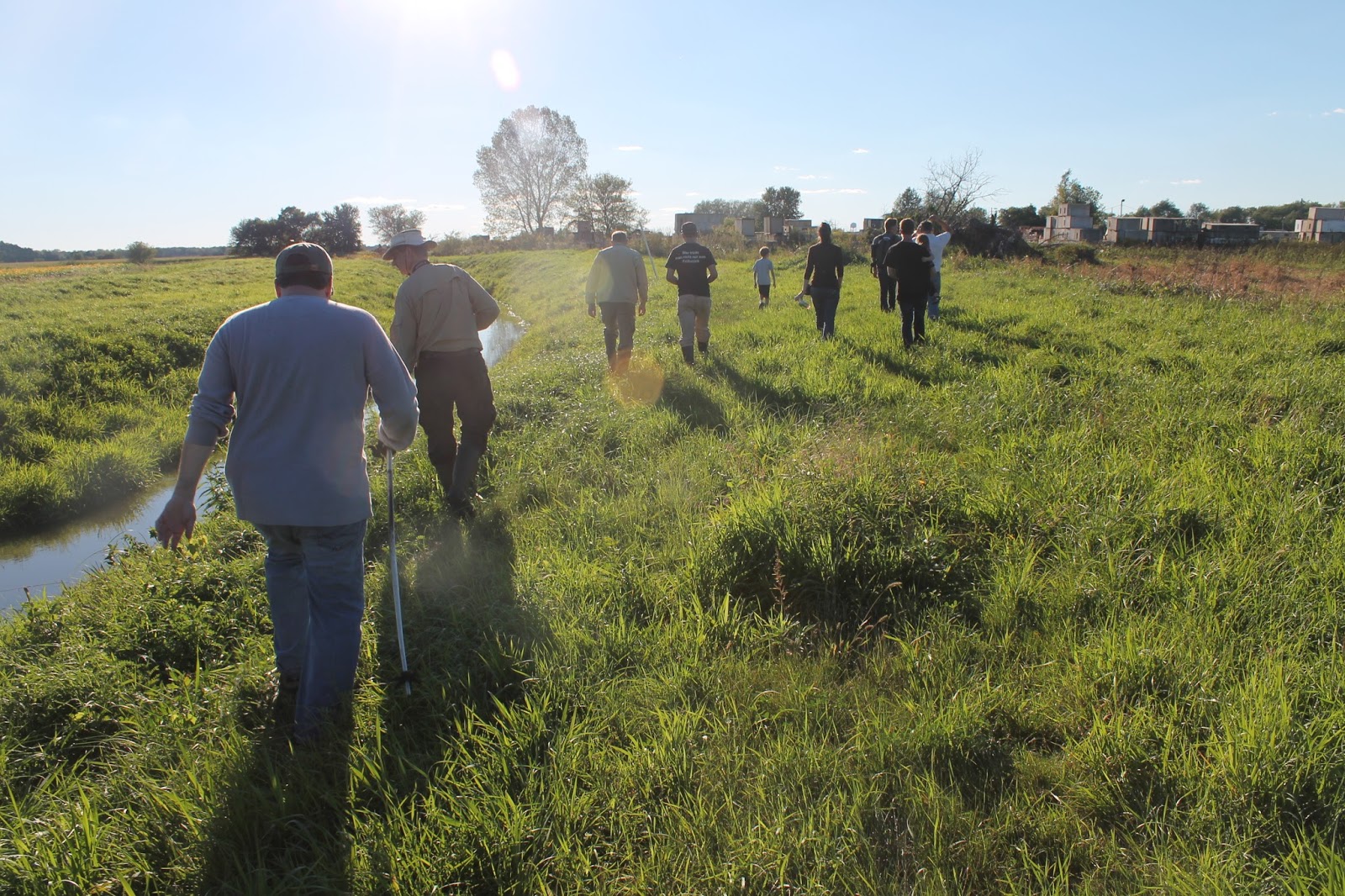
 Here we are, heading to an old gravel lot where disused equipment rots and disintegrates.
 One of our last finds of the day was a chunky tiger salamander (Ambystoma tigrinum) I found under a piece of junk behind some abandoned truck trailers.  It, along with every other find, was photographed as a voucher specimen and submitted to HerpMapper.
 The team!

At the end of the day, we collected enough data to sort over for weeks.  We all had a ton of fun, and I learned a lot from my blitz mates.  Here's to Fermilab and its herp diversity - and hopefully, there is a lot more to discover for next year.

Saturday, November 21, 2015

Clonophis

The lone representative of the genus Clonophis, the Kirtland's snake (Clonophis kirtlandi), is a rare species that is seldom seen.  Listed as near threatened by the IUCN Red List of Threatened Species, the diminutive Kirtland's snake is found only in parts of Illinois, Indiana, Michigan, Ohio, and Kentucky.  Historically it was found as far east as Pennsylvania (currently listed as "possibly extirpated") and as far west as northeastern Missouri (a single record in 1964 [Jones, 1967, Johnson, 1987]).  It is listed as endangered in Michigan, Indiana, and Pennsylvania, and as threatened in Illinois and Ohio.  Range maps can often be misleading - in the case of the Kirtland's snake, they are especially so.  Its range, represented in field guides as encompassing a fairly wide swath of the north-central Midwest, is highly fragmented, and though it isn't likely all populations have been recorded, the number of known populations is relatively small.  Their secretive nature doesn't make it easy for herpetologists to accurately survey them.

Kirtland's snakes are highly fossorial, living a secretive and subterranean lifestyle.  They are very much associated with crayfish, since they utilize their burrows as refugia in all seasons.  Because of their dependence on crayfish, Kirtland's snakes are never found far from wet areas such as mesic prairies, meadows, fens, open woodland, and similar environments.  Living in holes underground, it isn't very difficult for the Kirtland's snake to find its food - chiefly worms.  During heavy rains, Kirtland's snakes will surface, but usually avoid exposure.  Sometimes they can be found underneath logs or artificial cover such as discarded boards, roofing shingles, or sheet metal.

Long ago, prior to the draining of wetlands and the destruction of prairies for agriculture, the Kirtland's snake was much more common than it is today.  Nowadays, their occurrence is very sporadic.  In the Chicago area, they are restricted to a few tiny patches of habitat - a mere fraction of what they once enjoyed.  Not very long ago, it wasn't unusual to find them in empty lots in Chicago, as well as smaller cities and towns in the region.  Kirtland's snakes were known for persisting in less-than-ideal habitat, that is, until degradation become so severe that one of several things happened - the water table sank, the crayfish died, or in some cases, all the snakes were captured or killed off.  Though some Kirtland's snakes today can be found in degraded habitat, the habitat must include at the very least fair enough conditions to allow crayfish to survive, and must be large enough to ensure a viable population of snakes.  The smaller the population, the less variety of genetic material to pass on to the next generation.

In my opinion, with the exception of perhaps the plains garter snake (Thamnophis radix), no other snake best embodies the spirit of Chicago area herpetology as it pertains to natural history as the Kirtland's snake.  The Kirtland's snake's storied beginnings as we know it all started with famous naturalist and explorer Robert Kennicott, who collected the type specimen in what is today Glenview, IL, and described it in 1856.  He named it in honor of Dr. Jared Potter Kirtland, a mentor of Kennicott.  As Kennicott became famous as both a naturalist and explorer, so did the Kirtland's snake, to leagues of herpetologists and amateur field herpers who sought out the elusive denizen of swampy areas and wet fields.  To this day, the Kirtland's snake remains a target for many who have an interest in local snakes.  Many have never seen one.  Their unwillingness to appear during searches, coupled with their rarity, has turned the Kirtland's snake into a sort of "white whale" for many.  Ideally, the last few strongholds for the Kirtland's snake in the Chicago region should be restricted to all but the most appropriate personnel - land managers, researchers, herpetologists - both they aren't.  Some populations have been stomped down by well-intentioned (or sometimes, not so well-intentioned) folks who seek the snakes for photographs or for the pet trade.  As Kirtland's snakes make poor captives, there doesn't seem to be any rhyme or reason for capturing Kirtland's snakes to sell in the black market pet trade.  People will still do it for status or ego boosting.  Each Kirtland's snake that is harmed is another hit to the already perilous wild population (remember that natural predation doesn't go away just because the Kirtland's snake is rare; though there are less to be seen and therefore eaten, a heron or raccoon would not hesitate to take one as a snack if the opportunity arose).

In my field excursions, I always look for telltale signs of Kirtland's snake habitat when the opportunity arises.  It would be very surprising if any additional populations were discovered in the Chicago area.  As early as the 1940s, the species was known to be rare in the Chicago area (Pope, 1947).  Pentecost and Vogt (1976) also noted its rarity.  A population in northern Cook County that once persisted in a power line cut hasn't been observed since 1986 (Anton, 1999).  A population in southern Cook County persists in a small, well-managed restored prairie (this could represent the final stronghold for the species in Cook County).  Other known populations have been exterminated due to development in the area (T. Anton, M. Ignoffo 2014, pers. comm.), and any possible remaining populations would be under heavy threat of extirpation due to development or invasive species. (An ongoing study I've headed up over the last few years, and particularly this past year, is the survey of an urban scrap of undeveloped land [DRCA] for any proof of the existence of Kirtland's snakes.)

Without a doubt, the best population of Kirtland's snakes in the Chicago area occurs in Will County.  With two known localities located on Forest Preserve District of Will County (FPDWC) property (Anton, 2007), it is imperative that the snake's habitat not only remains protected, but properly managed.  The snakes in Will County are consistently found during cover board surveys, but low rates of recapture along with other variables ensure that monitoring will remain challenging (Mauger and Anton, 2015).

In early September, I went down to the Will County habitat to observe the snakes' habitat, in part to learn more about how I might find Kirtland's snakes in my own surveys of urban plots.  I met once again with Tom Anton, who is one of the top minds when it comes to the species' status and distribution in the area (and the state).  First, we walked around a pond carpeted in duckweed that was chock-full of young bullfrogs (Lithobates catesbeiana) while looking for Northern water snakes (Nerodia sipedon).  We then headed toward one of the areas where the Kirtland's snakes have been found.  I noticed that the area in general contained perched wetlands, a component of the DRCA that I know Kirtland's snakes can be associated with.  Numerous prairie crayfish burrows and chimneys dotted the mini-landscape.  This locality was very small and provided hope that maybe there could be Kirtland's snakes at the DRCA, which is small itself but larger than this particular locality.

Next, Tom and I drove to an area off-site, where he had laid out cover boards over a decade ago.  It had been a long time since he checked them, and so even finding them proved to be a minor challenge.  But Tom is a human GPS and he found them in short order; together we ripped them up from under tall vegetation that had established itself in the intervening years since he was last here.  No snakes were found.  And so then we were off to another site located on FPDWC property where we hiked through very tall grass, saw a couple of Northern leopard frogs (Lithobates pipiens) and a single midland brown snake (Storeria dekayi).  As the temperature rose to a sufficient level, we decided to road cruise a few back roads in the area.  A few DOR Eastern garter snakes (Thamnophis sirtalis) were found, along with a single live specimen.  It was a particularly attractive garter snake.  A few more scattered snakes and frogs were observed, live and dead, including a fresh large DOR fox snake (Pantherophis vulpina) that was collected as a voucher, and a neonate of the same species found live on the crawl.  Following lunch, we ended our day, both having collected some data and me with a better understanding of Clonophis.  

A few final thoughts I had on the way home:  What is to become of the Kirtland's snake?  Will the species be around in 50 years?  100 years?  How practical would it be to attempt a translocation of the species to suitable habitat in the region?  Would a captive breeding program work for this species?  How will population increase affect the snakes?  These kinds of thoughts plague my mind all the time.  Tom is confident that the Kirtland's snake is "doing okay" in the state.  If anyone else assured me of that with any degree of confidence, I'd be critical of that perspective, but I do trust Tom's outlook.  Still, I can't help think about how much we've reduced the species in the Chicago area, the state, and in its entire historic range altogether.  We are content that most of the Kirtland's snakes in the state occur in protected areas, but is what's out there enough in the long term?  All we can really do is try our best to right the wrongs we've committed, and that means to protect as much suitable habitat we can, make sure that land remains in good condition, and educate others about why these things are being done, and maybe help others understand why Clonophis is such an iconic symbol of our region's heritage.

The Kirtland's snake remained unseen, but this beautiful garter snake provided some excitement on the trip.