Sunday, January 1, 2023

2022 Potpourri

I figured that I should put together another year-end summary of a few herpetological highlights.  2022 was a terrific year despite a few health-related setbacks, but I'm doing better than ever now and I can't wait to see what 2023 has in store (I already have some really exciting plans).  My big writing project is still in progress, and though I do not have an ETA on it, I am planning on setting some goals really soon that will hopefully get things rolling in that area.  Family is always first, though, so it's going to be an interesting process.

In early March, Matt and I headed down to Vermilion County.  Matt wanted to see some salamanders and my goal was to watch wood frogs (Rana sylvatica) call (it's been awhile).  Winters in the Chicago area are tough, and usually by February, people like me (and Matt) are so freakin' fed up with cabin fever that we will do just about anything to experience a wild herp and its habitat.  At this time, the Chicago area was behind central IL by at least a couple of weeks.

A vernal pool used by Ambystoma platineum, the hybrid species commonly known as the silvery salamander.
  
This one was found under a log in the vicinity and photographed very briefly before being returned to its home.
Middle Fork of the Vermilion River.  It was very cold; that didn't stop Matt's son Alan from rolling up his pant legs and dip-netting for fish.

We found this southern two-lined salamander (Eurycea cirrigera) in what looked like a fen or otherwise some sort of seep-fed wetland.  I had only ever found them in shallow wooded seeps or rocky streams in Will and Kankakee Counties.  Earlier in the day we did find a few adult and larval cirrigera along a stream near the platineum site.

Hiking along, we discovered a number of four-toed salamanders (Hemidactylium scutatum) underneath logs.  We were looking for Ambystomatids and did not expect to see these, let alone hundreds.  It was a nice surprise.  

One of many redback salamanders (Plethodon cinereus), and I believe all were of the "leadback" variety.

Later in March, Lumen and I searched this marsh near Elgin for signs of salamander reproductive activity.  Nothing, but still a fun time.

At West DuPage Woods in West Chicago, a nice place near home.

Over the last decade or so, I've become a big fan of spring ephemerals.  This is Dutchman's breeches (Dicentra cucullaria) in a wooded preserve near Yorkville.

Mid-April also produces smooth green snakes (Opheodrys vernalis) under the right conditions, and in only a few places.

A marsh at West Branch Forest Preserve.  I live across the street from here and not a day goes by where I'm not consciously thankful for the privilege. I was out scouting for grey treefrogs (Hyla versicolor).  I last heard a couple of frogs calling in 2018, but 2022 produced approximately 8-12 individuals calling.  Locally, this is one of the more exciting projects.

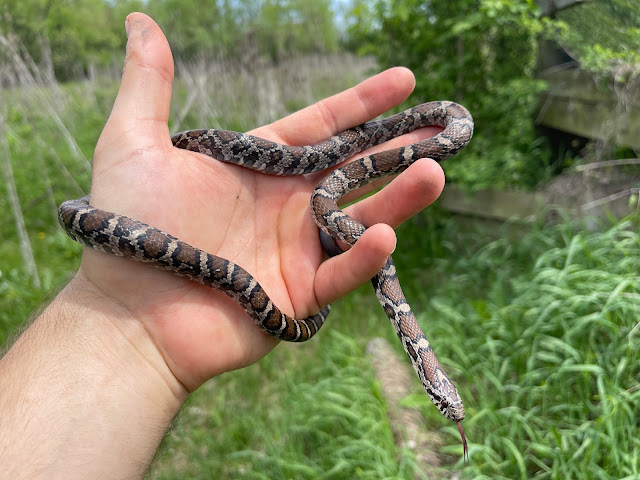
May is the best time to find milksnakes (Lampropeltis triangulum) where they occur in the area.  This little neonate born last fall provided Lumen with her first snake bite (it was bound to happen eventually).  As you can see, she is terrified.

Here is Lumen with a chunky tiger salamander (Ambystoma tigrinum) we found under an old discarded board.

An adult milksnake at the same site.

One night shortly afterward, it rained really hard and Matt texted me telling me that they had passed a roadside ditch near Elgin full of calling frogs.  I headed out and was treated to quite a frog orgy - grey treefrogs, chorus frogs (Pseudacris borealis), and toads (Anaxyrus americanus) calling their little hearts out.  Lots of eggs masses too.  

One of the grey treefrogs 

As part of the bigger project I'm working on, I needed to beef up my familiarity with the lizards of the region.  In 2020 and 2021 I was nearly obsessed with five-lined skinks (Plestiodon fasciatus).  If we're being honest, I still think about them a lot, but my obsession has been tempered by the fact that I've pretty much wrapped up what I was working on, skink-wise - even though I'm all ears when it comes to new information.  

Toward the end of May, I sought a Cook County racerunner (Aspidoscelis sexlineatus) but instead we found lots of skinks.  I documented each one -well, each we were able to catch.  They are fast little buggers.

This is prime skink habitat in Cook County (Matt and Alan pictured).

Here is an adult skink.
Matt examining the first skink we caught.

Me with a skink I found underneath this piece of discarded trash.  

I took the family on a trip to Maquoketa Caves State Park in Iowa in June, where Lumen found this grey treefrog.  

2021 was a horrible year for amphibians.  Prolonged drought really put a dent in observations and probably in actual numbers.  I think I may have seen two toads in my yard all year.  2022 was a far better year!  Toads and other anurans throughout the summer and into early fall after every refreshing rain event.  

Here is just one of the many toads who filled their rotund bellies at night underneath the porch light.

In the heat of midsummer, we guide ourselves toward water.  And we've been visiting this site near our home for a few years now, cooling off in the river and enjoying all of its aquatic life.  

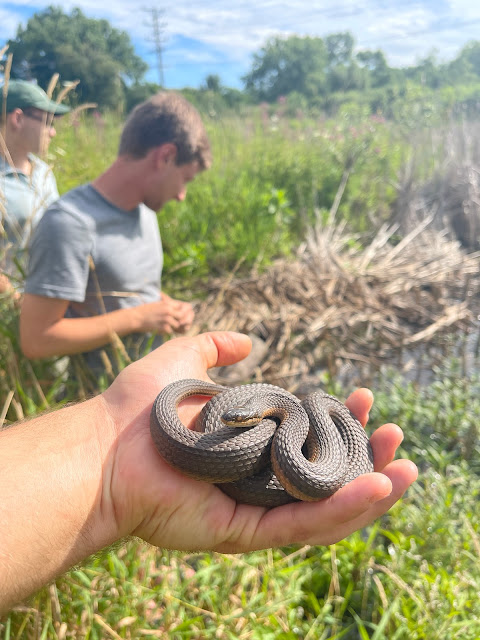
Queensnake (Regina septemvittata)

Crayfish

A female painted turtle (Chryemys picta) on her way to lay eggs at the Grove in early July.

A few big mulberry trees grace a park in town and I drove over there late one morning in mid-July to pick some.  I was surprised to spot this adult fox snake (Pantherophis vulpinus) there, stalking birds also attracted to the tree for its berries.  I usually only see this species on the ground but I know they do climb - they certainly are built for it.  On a side note, it was nice to pick and eat the mulberries here (not a forest preserve).  A couple of years ago, I was scolded by a DuPage County forest preserve law enforcement official for picking and eating mulberries - an invasive species, mind you - along a roadside while I was with my daughter.  All he could say was, "No collecting".  I respectfully explained what these were and again, "...no collecting".  Rules are rules, I get that.  I just think there ought to be some flexibility.  We are constantly encouraged to do things that are good for the earth - grow native plants, discover the nature around us.  But our laws are outdated and many of the people enforcing them are of a different mindset.  You can still be ticketed for fostering your own little prairie because the grass is longer than what the municipality allows.  Can we get with the times already?  

Ok, sorry.  Onward.

Churchill Prairie, a beautiful and precious remnant, right here in DuPage County.

Back in 2020, a Graham's crayfish snake (Regina grahamii) was discovered in DuPage County for the first time in a quarter century (we wrote that one up for the Bulletin of the Chicago Herpetological Society).  Following the dry lull that was 2021, we were exceptionally elated to discover not one but an additional TWO crayfish snakes.  The first was a young male I found on July 23rd, after a night of heavy rain.  The second was a gravid female found four days later.  It is so great to see this species doing well at at least one site.  

Nathan with the male found on the 23rd.


Here we are, releasing the female after taking some measurements.

Early August saw up visiting Door County for the first time since 2015 (there's a post from that trip here in the archives).  We always talked about taking one more trip with our dog Cassius and so this was it.  He's getting up there in years - he turns eleven this March.  And though he is healthy, it was clear to us that he just isn't cut out for these types of trips anymore.  But we did have a good time.

Here is one of a few metamorph wood frogs we found while hiking White Cedar Forest Natural Area.

From Washington Island

Lumen hopped aboard the fox snake train with her first ever in late August.

Again, the frogs were out in full force, especially later in the summer.  

We traveled east for a wedding but we enjoyed so much of what the area had to offer in terms of natural areas.  I hoped to find copperheads (Agkistrodon contortrix) at Sleeping Giant State Park in Connecticut, and it sure looked like I would.  But they were not on the menu that day, just a handful of viciously defensive eastern garter snakes (Thamnophis sirtalis).
Does this not look copperheady?

Garter

Back home, more frogs in the yard.

A high-contrast chorus frog.

A nice northern leopard frog (Rana pipiens)

And a green frog (Rana clamitans) with a foot fetish.

Nathan graciously invited me up to the Midwest Partners in Amphibian and Reptile Conservation (PARC) meeting in Grand Rapids to see the poster he put together which distills all of the queensnake data we collected throughout 2019 and 2020.  In some ways the meeting was nerve-wracking because not only was I the only non-herpetologist (or herpetology student) present but I'm also pretty introverted.  But I met some really nice people including a few I was well familiar with otherwise.

In October I headed down to southern Illinois for a few days.  I actually had an agenda, but the area had not seen measurable rainfall in months and it was bone-dry.  The trip produced fewer herps than the previous worst trip, but unlike that trip (which was cold and rainy), it was warm and sunny and I got to do a lot of hiking and exploring.  Here is a scene from Garden of the Gods.

A cottonmouth (Agkistrodon piscivorus) heading toward the bluffs.

A timber rattlesnake (Crotalus horridus) taking a crack at this crack in the sandstone wall.

More to come in '23!

Friday, December 23, 2022

The last of the Illinois swamp rattlers

 Back in April, I was invited to assist University of Illinois researchers in searching for eastern massasauga rattlesnakes down in Clinton County (IL) for continued demography research.  Never in a million years did I ever think I'd get the opportunity to see one of these incredible animals in Illinois - not just because they are exceedingly rare but because those in charge of managing the population are understandably tight-lipped about location specifics and whatnot.  I was legitimately geeking out.  My sole experience with a "wild" Illinois massasauga previous to this entailed seeing a recently-caught captive at the Grove when I was a kid back in the late 80s or early 90s (in fact there may have been two animals in the same enclosure but my memories are a bit fuzzy).  That one was one of the last of the Cook County ratters.

Two weeks later I was down at the research base and tech housing with a couple of other invitees, meeting all of the young researchers and getting prepped to hit the fields.  What struck me most was just how little habitat these snakes have available to them.  Years ago when there were multiple massasauga populations in the state, the Clinton County population was regarded as the best.  But that's relative to populations that were so small and threatened that they consequently disappeared.  In Clinton County, the population has been widely split apart into mini-populations by roads, agricultural fields, and a big lake.  In fact it was stunning to know that these animals could persist in these tiny shards of habitat.  

Carefully transecting the first locale, we all stepped very gingerly, keeping our eyes peeled for massasaugas as they emerged from the crayfish burrows they utilized to bask in the late morning sun.  At this time of year, the vegetation consisted mostly of dried prairie grasses, sometimes in thick clusters.  A few bits of greenery were poking through, including rattlesnake master.  We were all spread apart (as spread apart as we could be at such a small site) when one of the techs announced that he had found a massasauga.  Everyone made their way over - the other techs in a careful and deliberate fashion, and me nearly tripping and falling into the mud.  I was ecstatic.  When I reached the tech, he pointed down at the snake.  

I didn't see it.

Scanning the tangled mass of dried grasses below me, I thought and may have even asked out loud, "Where?"  The tech pointed his snake hook down in the direction of the snake.  A few more seconds of looking, and...THERE IT IS!  Barely visible was a two to three inch section of massasauga showing through the dried brown grass.  The tech was good.  I would have walked right over it, I think.  I now had the picture etched in my head to improve my approach at finding massasaugas.  This first snake was carefully collected for processing at a later time.

There is a massasauga here
Convening at a sauga spotting

Not long later, another massasauga - a large adult female.   A healthy, husky animal, coiled on a raised berm in the dappled sunlight.  It was stunning.  In the frontier years, this animal would have been killed immediately.  Now, one of a very few left in the state, it was being handled very carefully.  A minute or two later, and an announcement that an eastern box turtle was caught rang out.  And maybe ten minutes later, I passed a tech double-fisting box turtles.  I guess this was a good site for those too!  As it turns out, box turtle research is also occurring here so these too were collected for processing before being released on-site.

Large female
Young adult female boxie

Later, we moved on to another site nearby.  This second site was decidedly more "remote" and difficult to access, and it supplied us with even more massasaugas.  The first or second snake found here turned out to be especially light colored and clean, perhaps freshly shed.  It was the only snake I saw in situ here, as the others were found as I was off on the other end of the field, searching.  I did stumble upon a couple of box turtles and a bald eagle skull (no, I did not take it).  I ended up losing contact with the others until I wandered toward the sounds of a pair of techs chatting.  A few hours later, we convened at the rendezvous spot and moved on to the final location, which was located very close to a busy public park.  It seemed doubtful that a rattlesnake could find peace in a place like this, and as it turns out very few are actually documented here.  One of the last ones seen here was killed by a park goer a few years prior.  Yet we did find a couple more box turtles here, before heading back to our vehicles and then to base.
An easier in situ massasauga 
A particularly light colored animal, in situ

In situ box turtle
In-hand
Another box turtle

The real work took place back at the base.  As part of the ongoing study, each massasauga is PIT-tagged, measured, and swabbed for possible Ophidiomyces infection (snake fungal disease).  There were eight snakes total!  Not a bad day for 2022.

A Fowler's toad at base camp
Two techs measure a massasauga's length
Measuring a box turtle
Implanting a PIT tag
It is an atrocity that these beautiful animals are mostly gone.

I'll be completely honest in saying that the entire process looked to be pretty stressful on the animals.  Between being caught and carried around for a few hours, each snake is (carefully) handled as briefly as possible although it still seems significant.  BUT I'm not a herpetologist and this was my first rodeo.  The head of the project has been carrying out this study for decades and I should trust his method.  Ultimately the animals are placed back into the exact same spot they were found in, hopefully to reproduce and make more massasaugas.  

The overall consensus is that the massasauga isn't doing well.  There simply isn't enough space allocated for them.  Snake fungal disease has taken its toll on the population, and people still kill them when they see them.  Factor in natural predation, winter kills, and other uncontrollable factors, and you have an estimated expiration date for the Illinois animals (possibly during my lifetime but hopefully not).  In my opinion, the loss of the massasauga throughout mostly all of the state and Midwest is one of the most devastating losses in the natural world, up there with the passenger pigeon and American elm.  To me, no other snake better embodies the spirit of the prairie than the eastern massasauga.  I was honored to be in their presence and humbled by the experience.

Not a massasauga!  Bycatch - a common garter snake, and yours truly.  Photo by Jeremy Schumacher.

Tuesday, May 10, 2022

Flortoises

 At the tail end of March (and into the first week of April), my family and I took a vacation to northern Florida.  It was not a herping trip, but invariably some herping took place.  Being in that part of Florida at that time of year was really great.  Though this past winter wasn't really THAT bad, they are always too long, at least by my standards.  So just being somewhere warm was a welcome departure from a part of the country that was trying to shake winter's grasp.


As expected, lots of anoles.  Both the native green anoles (Anolis carolinensis) and the non-native brown anoles (Anolis sagrei) were observed, but the browns outnumbered the greens 100:1 (give or take a few).
We hiked this seaside park consisting of ocean scrub habitat.  It looked good for gopher tortoises (Gopherus polyphemus) so as we walked we kept our eyes peeled.  I spotted a couple of burrows before chatting with another visitor who said she'd seen a tortoise the day before.  About ten minutes later I caught my first glimpse of a gopher tortoise's rear end as it ducked into its burrow underneath dense vegetation.  I wanted my daughter to see a tortoise so we kept on looking. 

Tortoise burrow

Then, right near the parking lot, I spotted this tortoise.  It had just emerged from its burrow, the entrance of which is obscured by vegetation in this photo.  

With a slight approach, I zoomed in and got a few shots as the tortoise spun around and retreated back toward its burrow.  Lumen was able to see the tortoise before it disappeared and she was happy, but I couldn't help but feel concern for the tortoises.  The preserve was dismally small, surrounded on three sides by huge resorts, with roads cutting through every which way.  A mere decade ago this natural area was much larger.  People like to build and build and build some more and then as a sort of compromise, they set aside tiny fragments of natural lands for all to enjoy.  And I think most visitors don't ever see a problem with this model.  To most people this is like a safe little Jurassic Park.  The problem is that it is not sustainable.  The tortoises, boxed in and stressed from the barrage of humans, are at risk of being struck by vehicles or fading away due to inbreeding.  I can go on, but instead I'll end it with this:  support conservation efforts.  However you can, just do something.  

A view of the adjacent beach

An eggshell from what I believe to be a tortoise (as opposed to a sea turtle), but I really don't know. 

We had an unforgettable time at the St. Augustine Alligator Farm Zoological Park. The zoo is one of the best kept - and best represented - zoos I've visited.  I had wanted to visit since I was a young kid so I was particularly excited.  The highlight of our trip was an exclusive, up close and personal experience with the zoo's entire group of adult Galapagos tortoises.  There is an extra cost involved but it goes toward conservation so to me it's a win-win.  


The family with Dirk, a 111-year old male tortoise.

This is the historic poured-cement alligator pond at the zoo.  In it are a group of impressive, well-fed (understatement) American alligators (Alligator mississippiensis).

A trip to Blue Spring State Park netted these images.  Highly recommended natural area.  And home to overwintering manatees.  Though, by the time we arrived, only one lonely manatee remained at the spring head.  The spring was beautiful - dare I say breathtaking, but I couldn't help but notice dozens, or maybe hundreds, of really big plecostemus in the water.  These armored catfish, native to South America and popular in the aquarium trade, are known to harass the delicate manatees.  I also saw lots of other non-native fish including tilapia (native to Africa and Middle East).  According to a 2021 fish count conducted by the Howard T. Odum Florida Springs Institute, the tilapia now make up 86% of the total fish biomass at that site.  The only native fish I observed were a few gar.  If you're wondering why I can't just enjoy the scenery, it's because I suffer from a bad case of "That doesn't belong here".  

A pretty lichen iNaturalist tells me is Christmas lichen

Toward the end of our self-guided tour of the park, we rehydrated at the picnic tables and were straight-up harassed by a couple of squirrels who had - ZERO - fear of humans.  While we tried to eat our snacks, these little hellions tried to grab our food away from us.  

Yeah it was kind of funny, but I didn't want to spend our vacation in a hospital, so we got the heck out of there.  Overall, it was a wonderful trip - a snapshot of northern Florida that in all likelihood, will continue to lose its natural integrity.