Tuesday, April 23, 2024

Ozarks: Lizards, snakes, and Jesus

 Conveniently located along the Bible Belt (pause added for effect), the Ozarks is one of the most awe inspiring physiographic regions in the United States.  It contains some of the oldest landforms in the country and is home to an astounding number of plant and animal species.  Its rocky glades and cool forests beckon the adventurer.  I was fortunate to spend a weekend exploring the southern portion of the Salem Plateau in Missouri with Peter Paplanus and the experience was nothing short of revitalizing.

An Ozark glade

I agreed to meet Peter at his house but hiked a local trail while waiting for him to arrive.  Carefully scrambling along a steep riverbank lined in discarded slabs of concrete, I found a common gartersnake (Thamnophis sirtalis) here.  When I saw Peter minutes later, I jokingly bid him adieu as I had met my quota.  In all seriousness, the trip had only begun.


We headed southwest from St. Louis toward our destination and figured that since we had a couple of hours’ worth of daylight left, we’d stop at a glade to search for snakes before continuing our journey under the cover of darkness.  It was a good decision on Peter’s part as the view from atop the glade was amazing.  We also found a few nice snakes. On the way there, while driving up a curved narrow road through some open woodlands, a dead carcass fell out of the sky about ten feet in front of my car, followed by the large golden eagle that dropped it. Apparently the bird was having some difficulty gaining altitude with what Peter thought was a large rabbit. It flew to a tree and perched there, likely waiting for the coast to clear before returning to its victim.


Yellow-bellied racer (Coluber constrictor)

Large rock with rich crystal deposits throughout


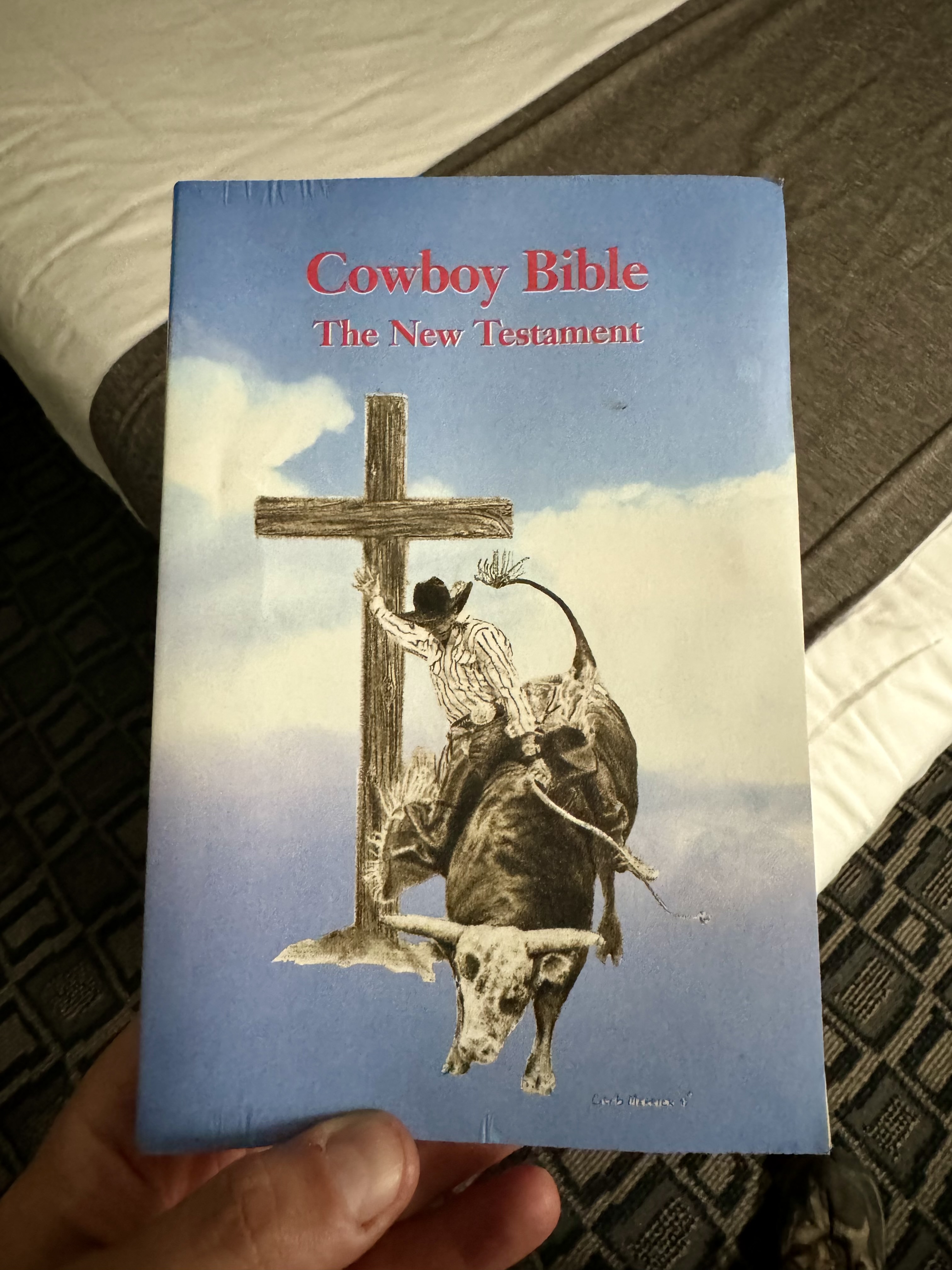
After being turned away from a couple of hotels in the area, I found a locally owned place that had room for two rough looking scoundrels.  Walking into the lobby, we were surrounded in Biblical quotes, crucifixes, and lots of other symbols both from the Old and the New Testament.  It’s important to note that we were the youngest tenants by at least several decades.  Our room was fairly nondescript except for a well-used and proudly propped copy of the “Cowboy Bible”. 


We got up very early the next morning and made our way to the first site.  With temperatures in the mid forties I was not hopeful, but Peter assured me we’d be successful.  We were joined by Peter’s friend Greg, a local who had years of experience in these areas.  Pete was right - it didn’t take long before we began finding reptiles here.  A good variety of lizards and snakes were represented.


Scarlet paintbrush
Rough earth snake (Virginia striatula)
Speckled kingsnake (Lampropeltis getula)
The same spec
Looking east across the Ozarks


Greg and Peter suggested that we move to a nearby site for a chance at finding the variable ground snake (Sonora episcopa).  A long hike through a mature deciduous woodland brought us to an isolated glade teeming with reptiles.  By now the temperature had risen to about sixty-four degrees F.


Young racer
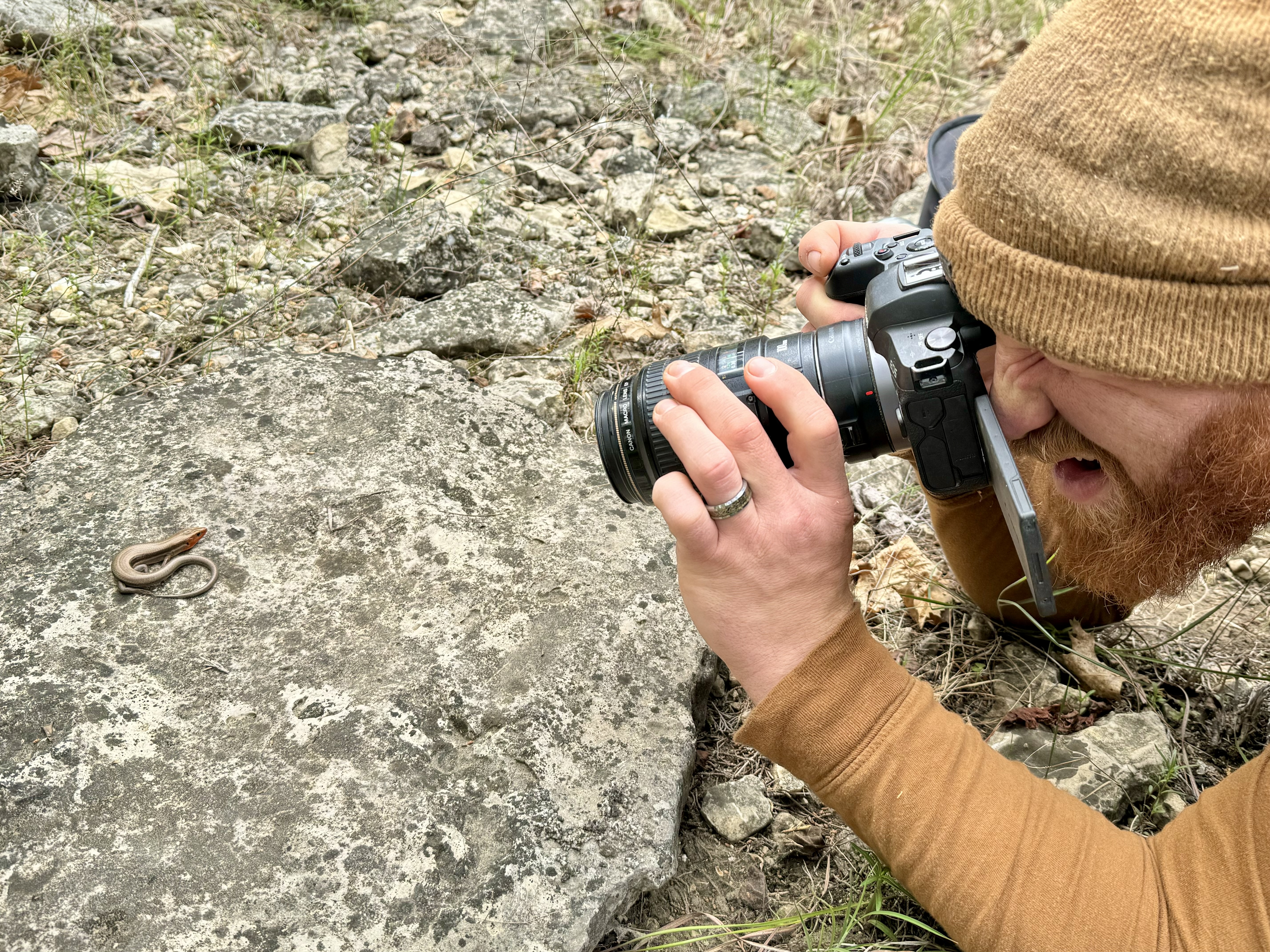
Peter photographing a coal skink (Plestiodon anthacinus)
Coal skink

Three-toed box turtle (Terrapene carolina)
Last year's hatchling speckled kingsnake


Young tarantula
Variable ground snake (Sonora episcopa)


Our next and final location was about a thirty minute drive away.  A small but intact section of glades that produced even more species and a vista complete with a waning westerly sun and a cool breeze to signal an end to the trip.

Wild hyacinth
One of many super duper little flathead snakes (Tantilla gracilis)
Greg and I after we found two western wormsnakes (Carphophis vermis)
One of several milksnakes (Lampropeltis triangulum)
Another ground snake
While taking a break (I am getting old), I found this beautiful American toad (Anaxyrus americanus) and had a nice little chat.  The conversation was rather one-sided.
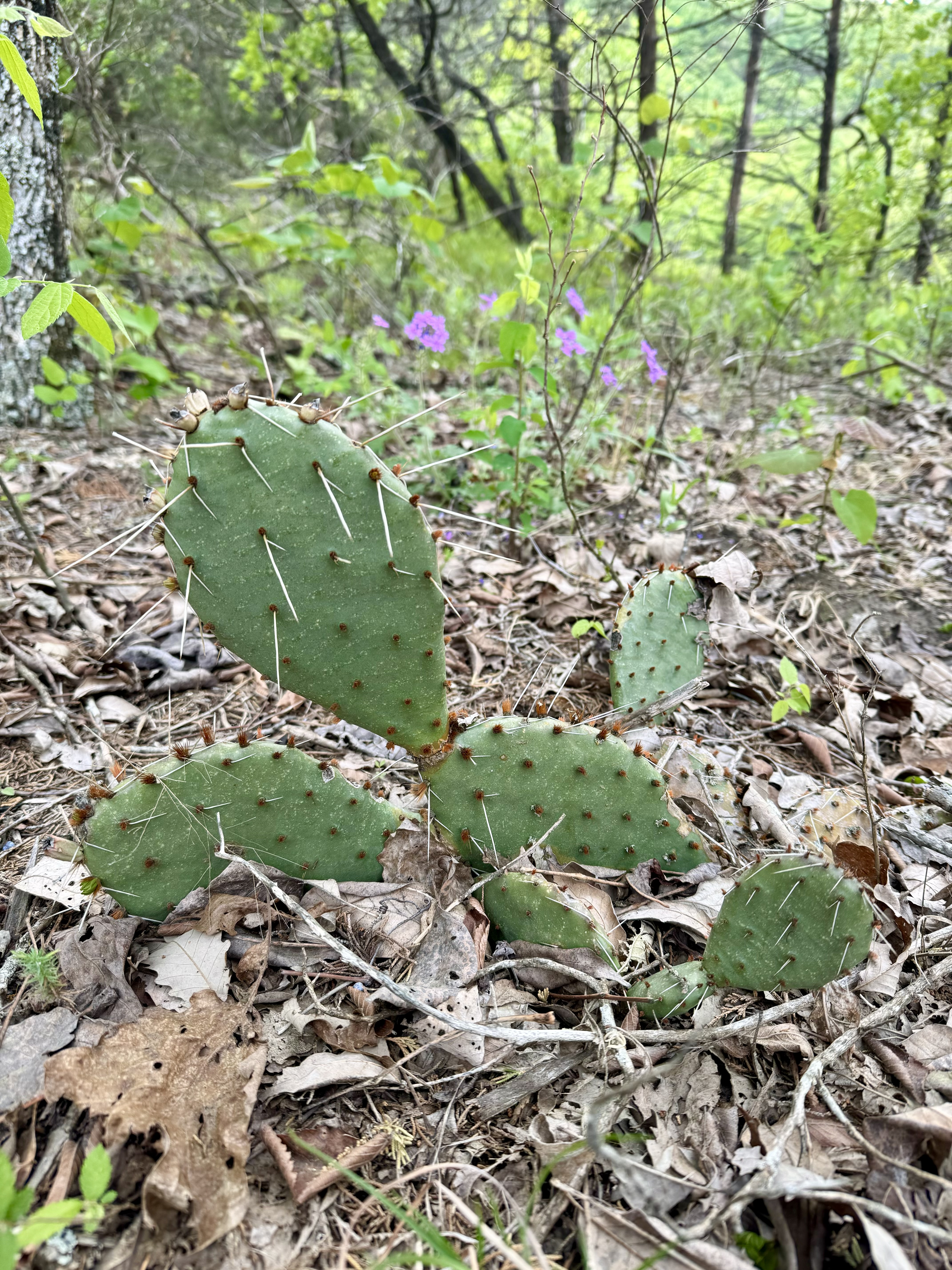
Opuntia
Pete, Greg, and me as we were wrapping up our very long outing.


Wednesday, April 3, 2024

Arizona: When life hands you lemons

 Cool air, stiff winds, and frequent rain accompanied my latest trip to southern Arizona.  Look, when you book a trip in advance, you can’t choose the weather.  You take what you get.  That said, it was a bit insulting when the weather was warm and sunny leading up to the trip, and then warm and sunny the day after we left.  So, lots of comfortable hiking and scenic views but very little wildlife.

The first stop of our trip was to the Arizona-Sonora Desert Museum.  As the name implies, it is a museum celebrating the Sonora Desert and all of its natural splendor.  Much of the museum is actually an outdoor walkway through various reconstructed desert biomes.  Among several species of lizards seen was the famous introduced hybrid spinytail iguana (Ctenosaura conspicuous X C. hemilopha macrolopha).  These impressive lizards were introduced to the grounds of the museum back in the 1970s for one reason or another and appear to be restricted to these grounds despite being adapted to live in the desert.  A docent I spoke to believes that the iguanas stay put because of the endless resources on hand (lots of water, fresh vegetation, and abundant artificial rock structure).  In spite of this, the museum has (or had) plans to sterilize these iguanas in order to curtail reproduction and eventually to eradicate them.  That was ten years ago so either they failed to catch all of the iguanas or they just decided that the lizards were too big a draw for visitors.

A majestic spinytail
Two iconic birds of the Sonoran Desert - white-winged dove (foreground) and Gambel's quail

We then hiked Madera Canyon.  This is about when the temperatures took a nosedive.  Madera Canyon is famous for its biodiversity, but little of that was apparent that day.  Still, the views are breathtaking and the little creeks are fun to play around, especially if you’re a seven year old kid.


Our hotel was located in the Catalina foothills near Sabino Canyon.  A short walk outside the hotel led to a desert wonderland complete with an eighty-foot waterfall and towering saguaros.  From here, the sunset is well worth the short hike.


We hiked several miles of the Ventana Canyon trail in intermittent drizzle.  The habitat looked so good for garter snakes - and I looked - but none were found. 


Arizona lupine
What a dreamy rock. I mean, look at it.

One particular cactus attracted us from the foothills to way out in the low desert.  “Shiva”, as it is known, is a saguaro with at least 78 arms, located outside of Tucson.  As a family we love saguaros but this one takes the cake. Within the vicinity of Shiva (and other saguaros impressive in their own right) we saw and flipped lots of dry cow pies.  As a kid, I’d flip cow pies in northwestern Georgia and find ringneck snakes, narrowmouth toads, and cool bugs.  Though stinky, the cow pies hold in a lot of moisture which can be hard to find during certain times of the year (especially in the desert).  After flipping about two hundred cow pies, and marveling at the cacti, we got back in the car to head to Mt. Lemmon.  Before too long, I spotted a wooden board along the side of the road.  I pulled off and flipped it, finding my first and only snake of the entire trip (?!?!), a young Sonoran nightsnake (Hypsiglena chlorophaea).

Shiva


Onward toward Mt. Lemmon.  The drive up the mountain is surreal.  For the first 5000 or so feet, the mountain is generally desert-like, but as you ascend further, the familiar agaves and prickly pears give way to pines, and before long, small patches of snow were seen along the roadside.  Around 6000 or 7000 feet, you’ve entered winter (in March).  Postcard images of families sledding down the snowy wooded hillsides and spectacular views of the valley below flashed before our eyes as we approached the village of Summerhaven, roughly 8000 feet in elevation.  We exited the Jeep as a gentle heavy snow began to fall and made our way to a couple of shops.  

I wanted to check out a trailhead that I had noticed on the way in, so after our snacks at a local snack shop, I drove a short distance north of town to the Oracle Ridge Trailhead.  This is an exposed area, prone to high winds, and boy did we get it.  I insisted on getting a view northwest into the canyon and climbed atop a pile of dirt at the edge of the small loop parking area.  A huge gust of wind hit all three of us, knocking my hat off of my head and chilling us to the bone.  Even though the temperature stood at twenty nine degrees F, the wind chill was a bone-chilling zero degrees F.  With only hoodies protecting our bodies, we quickly turned back toward the Jeep, and made our way back to the desert, which by then had reached sixty degrees.  For a lot of people this kind of experience is mundane but for us it was pretty stinkin’ wild.


Molino Canyon


Another memorable highlight was a visit to Colossal Cave Mountain Park.  All three of us love caves to varying degrees.  My wife loves big, showy, and easily accessible caves.  While I too enjoy these, I really like getting wet and dirty.  Colossal Cave offers both opportunities, but we opted for the shorter guided tour.  The cave is steeped in history and is still used by bats and other wildlife.


Our final adventure was a trip through a pretty well-known canyon north of Madera.  

Kind of a well-known spot
John and Kathie's new pup, Aripo.  He and Lumen bonded in no time and she still talks about him every day.

It was a fun trip, but I feel a little like we need a do-over with warmer weather.  Maybe in August - we’ll see.


Friday, March 8, 2024

The Illinois chorus frog

 The unseasonably mild wind whipped across the barren soybean field as we trudged our way toward what we thought was the location of a calling Illinois chorus frog (Pseudacris illinoensis). A mild sense of paranoia had befallen me.  After all, we were four suspicious individuals trespassing across someone else’s property in the dead of night, and my limited experiences with rural landowners has shown that they can be fiercely protective.  Guided only by the dim moonlight, Matt took the lead.  Following a three hour drive and fueled by adrenaline, the youthful fifty-year-old had his sights set for what looked like a small marsh on the other side of the ag field.  His kids, son Alan and daughter Anya, followed - Alan with a somewhat more enthusiastic gait than his sister.  And then there I was, trailing the caravan of hopeful frogophiles, using Google maps on my phone to help guide the group.  Each time I unlocked my phone I was a little worried that an adjacent landowner was going to spot us from a mile away.  But all of that concern quickly dissipated as we arrived at a deep, man-made pond along a dark tree line - the origin of the frog we had heard calling a quarter of a mile or so away.


There are a handful of Illinois anurans that can motivate me to go through such measures to find them.  Crawfish frogs, for which I am 0 for 2.  Narrowmouth toads and spadefoot toads round out the rest of the group of rare, secretive frogs that are only “easily” observed during their brief breeding seasons.  The Illinois chorus frog might be the least known of the group.  Much of what is known of the species in Illinois (where the bulk of their occurrences is) comes from Ellen Beltz’s “Distribution and status of the Illinois chorus frog, Pseudacris streckeri illinoensis, in Cass, Menard, Morgan, and Scott Counties of West-central Illinois” (1993).  In this paper, Beltz states that the frog was found in only nine Illinois counties, with the core metapopulation situated along the Illinois River.  During the last glacial period (about 14,000 years ago but possibly even more recent), retreating glaciers formed sandy ridges and other similar features in the Illinois valley.  Later, the gradually warming climate spurred northerly and easterly migrations of many plant and animal species from the south and west.  But, very recently in a geologic sense, the climate cooled and became wetter, causing major changes to the landscape.  Some isolated sandy areas remained, and with them a collection of unique xeric-adapted species such as the prickly pear cactus, the western hognose snake, and the Illinois chorus frog.  


Unfortunately, much of the original sand areas in Illinois have been destroyed.  River channelization and row crop agriculture are to blame.  Only small, disjunct fragments of intact sand areas remain in central Illinois, threatening the long term survival of this species as well as several others.


Morphologically, the Illinois chorus frog stands out among its peers.  Unlike the western (or boreal, whichever you want to run with) chorus frog and spring peeper with which it shares its habitat with, the Illinois chorus frog is robust.  Meaty, as I like to say.  At only an inch to an inch and half in length, it is a small frog.  However, it boasts the most impressive Popeye forearms.  It uses these guns to burrow down into the sand, where it spends most of its life.  During the 1970s, the late Lauren Brown (RIP) discovered that the Illinois chorus frog even feeds underground, which is a fascinating adaptation to living a fossorial lifestyle.  Most frogs burrow or create divots using their muscular hind legs, and feed above ground.  What a rebel!

Illinois chorus frog

The call of the Illinois chorus frog is distinctive.  It’s kind of like a deflated spring peeper.  It is unmistakable among the other species of Psuedacris it shares its breeding ponds with. 


Amphibian aficionados can hardly wait until March, when the first frogs emerge from their winter dormancy and congregate in breeding pools to ensure the future of their own kind.  Pseudacris are early breeders, although some species can remain reproductively active for months (I have recorded chorus frogs near Chicago calling well through June).   As the Illinois chorus frog is very selective about its habitat, more effort is required to locate them within their range.  This usually involves driving around at night with the windows down, trying to pinpoint the frogs’ locations and then figuring out how to actually get to them on foot.

Spring peeper

Illinois chorus frogs occur on protected land, but many of them breed in livestock ponds, low areas around ag fields, and roadside ditches.  It is in these latter locations we like to document them.  But hearing the frogs is one thing - circumventing their ventriloquy is another.  These things can make you nuts. Sometimes it feels like a snipe hunt.  You hear a few frogs and you are confident that you are approaching them.  Then, the wind shifts and now they sound like they are behind you.  You turn back with a puzzled look on your face (don’t worry, it’s really dark and no one can see), only to realize you’re being bamboozled by an animal smaller than your thumb.  Eventually you’ll figure it out and you’ll reach their pond, or ditch, or whatever it is they have decided to procreate in.  And then all of the effort will have been worth it.

Western (or boreal) chorus frog I nearly stepped on
Plains leopard frog

When Matt, Alan, Anya, and I finally reached the pond, we could hear a few frogs calling - a single Illinois chorus frog along with western (or boreal) chorus frogs and spring peepers.  A lone plains leopard frog that had been floating around submerged and worked itself down into the sandy muck at the bottom of the pond.  Within minutes we spotted one of the Illinois chorus frogs, a beautiful male clinging to a bit of floating vegetation.  I marked its exact coordinates for an ongoing study and took notes of its surroundings.  Then we were all able to photograph the frog in-situ.  A lot of herp enthusiasts like to reposition or pose their subjects, and while I’ve been guilty of this at times, most often there is no need to do this with frogs.  Besides, disturbing these frogs is looked upon poorly.  As a state-threatened species, it’s technically illegal.  So kids, if you ever find a Illinois chorus frog, or any listed species, kindly keep your paws off.

Alan with a found cow skull

After we zig-zagged our way back to the car, we did visit a few other nearby ditches, and heard a couple more frogs.  But the breeding season is just gearing up - more rain is really going to get these guys going.  As I write this five days after the jaunt, it’s raining pretty steadily throughout the state and I imagine that tonight, the sandy ditches and ponds in central Illinois are going to erupt.

Wilson's snipe

Wednesday, February 14, 2024

My origin story

Last week I had the pleasure of speaking to a great group of folks about the history of the eastern massasauga in the Chicago region.  Organized by the Lake County Audubon Society, the presentation went well (I hope) and I was really happy to hear the many questions asked of me afterward.  As usual, someone asked me to explain how exactly I developed an interest in snakes.  I think people are genuinely curious about how such an unlikely passion is cultivated, versus, say, an interest in birds or flowers.  And I get that - culturally, snakes have long been maligned and persecuted, probably as long as humans and our ancestors have walked the earth.  I have long struggled with a straight answer to that question.  I have to put myself in the shoes of someone who has limited experience and understanding of snakes, and that can be difficult for me to do.  Snakes have been a fixture in my life for as long as I can remember, and therefore as familiar to me as anything else.  My answer to this person was brief and probably somewhat comical; something about being interested in snakes as a boy, as most kids are, but then never growing up.  Most “snake people” can probably attest to that.  However, my fascination with snakes transcends the snakes themselves.  It is how snakes have shaped my conception of the world that is perhaps the most compelling.  

As far as I can remember, the first wild snake I ever saw (and in all likelihood, first snake ever) was a plains garter snake in my backyard when I was about five or six years old.  I grew up on a relatively quiet street in Jefferson Park, not unlike dozens of others in the neighborhood.  Our street dead-ended at a fenced-off, overgrown railroad embankment, and an abundance of large trees and old broken sidewalks along the block indicated that there was some age to the neighborhood.  We lived in an old, modest frame bungalow, and every summer, my Sicilian immigrant dad would plant an impressive vegetable garden in any spot the yard could spare, leaving a square of turf for me and my sisters to recreate in.  The garden itself provided a place for a young kid like me to explore.  I recall the rough sensation of the cucumber plant’s stems and leaves, and the glossiness of the deep purple eggplants in the fading sunlight.  Most persistent, though, are the memories of crawling through the dense jungle of tomato plants.  The pungent aroma is as classic a summertime experience as freshly cut grass.

One day, probably in late summer, I was quietly making my way through the labyrinth of tomato plants along the west side of the backyard when I was stunned to find a snake intertwined along some of the stems and the old wiry fence.  I spent what felt like an hour processing what I was seeing but in reality it was probably minutes.  This snake was plump, and dark in color, with a pale orange stripe down its back.  Its face looked menacing.  I could see its body gently expand and contract as I moved closer, and I took notice of the skin showing between its keeled scales.  It looked warm and content resting there in the dappled sunlight.  Even if I wanted to say something, I’m not sure I’d have been able to.  It was a real live reptile in my backyard in Chicago.  Admittedly a little bit intimidated, I backed up slowly and let it be.  I went inside and told my mom, who responded in a mildly favorable fashion while my dad was incredulous.  No snake was going to be found in HIS garden (ironically I find snakes in his garden every time I visit him, the last one being a beautiful rat snake at his home in South Carolina).  

The image of that big, likely pregnant female plains garter snake was to be forever burned in my mind.  But why?  I am not the only person who has discovered a garter snake in Chicago.  They are not exactly rare in most areas.  Why did I have an epiphany when others might have developed at best a short-lived interest and at worst a crippling fear?


While I’m not exactly sure why and may never know, I think that my discovery of and consequent obsession with that snake (and ultimately all snakes and reptiles) was rooted in my experiences leading to that point.  I was a middle child (Alfred Adler nailed it when he considered middle children to be more “cooperative and independent”), free of supervision for most of my childhood.  I had a ton of time to explore the bits of nature in my neighborhood and figured things out pretty easily.  Like most young kids, I started out with an interest in bugs, catching and studying ants, beetles, and worms (my mom talks of “worm trains” I’d make as a toddler).  But I was never scolded for doing this the way a lot of parents do - at least in an urban setting.  My dad considered virtually any living thing a threat to his well being and never allowed any pets, even pillbugs or caterpillars, into the house.  But he was largely absent throughout my childhood, spending many nights at the Sicilian clubs or who knows where.  At home, he was unapologetically critical of the choices I’d make, seemingly never satisfied with the person I was shaping up to be. 

Keenly aware of my family situation, my grandpa stepped up to the plate.  My mom’s dad was the best.  He would pick up my sisters and I on the weekends and take us to the park or to a nature center.  Usually, it was River Trail Nature Center or the Grove.  While my grandpa had no real invested interest in nature or science, it was hard to deny the appeal of free activities.  He fed my enthusiasm and never questioned my motives.  

So naturally, I found more enjoyment with my grandpa.  I learned to be more patient, more considerate, and more of myself.  I cannot overestimate the importance of a father figure, or mentor, or just someone who accepts you as you are and encourages positivity.  As a result of imprinting on my grandpa, I felt no trepidation about my love for snakes.  And maybe, in a way, my attraction to snakes was further fueled by the persistent discord between my dad and me.  The day my parents separated for good in 1993, I moved my collection of garter snakes from the back patio to my bedroom.  

However, even with my grandpa’s support, it was tough growing up.  Snakes and reptiles were a welcome distraction from the rigors of everyday life - bullies, poor grades, and at various times, bouts of low self esteem.  When I felt misunderstood, I knew I was in good company. I would wander through the weedy railroad embankment, turning over discarded railroad ties and pieces of trash looking for snakes.  And sometimes after finding one, I’d catch it, sit down, and marvel at this creature that has eked out an existence in its own sliver of nature.  Unless you are a snake lover, it is a feeling that is very difficult to describe - best I can do is call it cathartic.  Mike Pingleton considers this “tactile experience” to be unique among many natural pursuits.  Bird enthusiasts must admire their loves from a distance and through the lenses of binoculars.  Snakes can be sought and often handled, bridging the gap between human and target.

Back in those days, this wasn’t as much of a “thing” as it is now.  As far as I was concerned, I was the only weirdo doing this.  But there were others.  Social media would later help connect me with like-minded souls who continually inspire me (I recently wrote about this).  Different people love snakes and reptiles for different reasons, but if I had to guess, I’d say that empathy is a huge factor.  Amid the masses of humans on this planet, a tiny fraction have bypassed society’s tendency to demonize snakes and I just happen to be one of those.  It is a blessing and a curse.  I am privileged to be in the presence of these animals either in my house, where I keep a very small collection, or in the wild, where thankfully many can still be found.  But boy, is it hard to defend snakes - and myself for loving them.

Because of snakes, I’m a pretty hardened skeptic and critical thinker.  It’s hard not to be when virtually everything on the news about snakes is categorically false.  In the US, I find that people generally believe what they are told - or what they want to believe.  And snakes are steeped in centuries of folk tales and mythological nonsense, the basis of which is arguably rooted in biblical writings.  Those who are disseminating snake information too often have little to no first hand experience with or knowledge of snakes, but fear sells and at the end of the day, that’s what matters.  So I approach media output with a grain of salt in all areas because that same principle applies across the board.


So, in some ways, I truly haven’t “grown up”.  I still experience that same sense of wonder that I felt that warm, late summer day in the tomato plants each time I find a wild snake.  I still admire a snake’s build, its strength, and its spirit.  But in many ways, snakes (as well as a handful of people) have helped me grow as a person immensely, and for that I’m eternally grateful.

Saturday, October 14, 2023

Renaissance men


"Associate with people who are likely to improve you" - Seneca

There is an undeniable bond shared between those who are innately fascinated with natural history. The drive to explore the natural world around us and to better understand our connection with nature transcends virtually every classification by which we categorize ourselves. This is especially true with herpetology, the red-headed stepchild among the more "esteemed" biological disciplines. If you've been stricken with a healthy obsession with amphibians and reptiles, you'll soon find out that the pool of compatible cohorts is regrettably small.

But, as the adage goes, "quality over quantity". I've been enormously privileged to know a handful of local people that are at least as passionate as I am about herpetology. I can best describe these people as "renaissance men" as they convey a classical approach to natural history without eschewing modern techniques. Curiosity runs through their veins, and it's refreshingly contagious.

Tom Anton is one of these guys. He first popped up on my radar while I was wrapping up high school in the late 90's. He had just authored an inventory of the amphibians and reptiles of Cook County, which I found fascinating at the time (as I do nearly a quarter century later). A bit of irony - I was in the school library being taught how to use InfoTrac, a subscription-based database available on CD-ROM (before we could find all of this stuff on the internet). I performed poorly all throughout high school, and barely made my way through, but finding Tom's document and printing it out to bring home gave me a reason to be enthused. But I digress.

Fast forward to 2013 when I finally wrapped up my long, fragmented, and oftentimes arduous college career. I wanted to learn more and write about the Chicago region's herps, and Tom's name was the very first that came to mind. I sent Tom an email and asked some questions that by today's standards sounded really dumb. He invited me to the Field Museum of Natural History, where he worked. At the museum, he led me through the herp collections, the library, and the lab (where I got to see but unfortunately not meet the late, great Bob Inger). Then, after leading me to the food court, we sat down and he opened up for questions. I hoped that he would see that I was a serious student of natural history and not just some guy with a passing interest. And I think he did because over the course of the next year he didn't avoid my emails.

We finally got into the field a year later in November of 2014. We had talked a bit about the southern two-lined salamander in Will and Kankakee Counties and he agreed to meet down there. But first he wanted to rendezvous at Wilmington House restaurant, a place where "all the herpetologists meet in the area". Was I in the club?

We spent a few hours looking for and finding salamanders, which was cool, but mainly, I really hoped that the experience was the beginning of a process of trust building. I knew Tom was a valuable asset. What I didn't expect then was how much of a friend he'd become.

Today, over ten years and many adventures later, I know him only as a friend who happens to be a herpetologist. While I am twenty years his junior, we share many perspectives. We are both kind of stoic; we tend to focus on things that are within our control and not so much on extraneous nonsense. Life is better that way for us at least. His enthusiasm toward fieldwork is unsurpassed. You'd think he never caught a plains garter snake when he catches a plains garter snake even though he has probably found more plains garter snakes than anyone in the history of northeastern Illinois. He carries a beat up notebook in which he jots down all pertinent field data as it relates to herps, and he's known to pull his car over from time to time in rural areas to unfold a large paper map of Illinois. Tom's willingness to allow me to join him in the field and his timely support have been transformative. His recommendation to always "herp with purpose" resonates with me to this day.

Tom and me with a pygmy rattlesnake, ANF, Florida, March 2023.  Photo by Nathan Kutok

As I became more comfortable networking within the herpetological sphere, I began meeting other locals interested in the subject. While I maintain relationships with just about all of them to this day, a few really stand out. Matt Ignoffo is one of those guys. I'm not sure exactly how I came to know of him - it was either through his participation in an outing documented by someone else on the field herp forum website or through his Flickr account. Either way, his photos are what drew me in and made me super envious. It was clear that Matt had an outstanding eye for herp photography. His field guide-style of photography produced stunning images. His familiarity with the local herps, fishes, and mussels was unsurpassed. A few photos really stood out. One was of a mussel in a dire situation - receding waters in a local stream exposed the mussel to the atmosphere and it really captured the plight of mussels everywhere. Another photo featured his then young son just as a large fox snake was biting his face. Simply perfect timing.

Photo by Matt Ignoffo

I noticed that Matt shared a fair number of queen snake photos. After he accepted my friend request on Facebook in 2014, I began asking him about queen snakes. He had some really great shots and at that time I was really struggling to find them in the area (there are at least a couple of related posts on this blog). I sent him messages hoping he might lead me directly to a good queen snake locale. He didn't do that. Instead, he provided me with a summary of the species' range in northeastern Illinois, complete with watersheds. I like to think he was challenging me - to do the work he did when he first sought the queen snake. After way too much time searching for the queen snake, I found one and felt this great rush of dopamine I wouldn't have felt had someone simply told me where to go. And I thought that was pretty badass of him. I think he knew exactly what he was doing.

Matt and I first met in person during the early spring of 2015.  We agreed to meet to find salamanders in the Palos region of Cook County.  I was a bit star struck.  He brought his two young children and together we hiked to some marshes where we flipped some logs.  At one point, as we hiked from one marsh to another, a spring peeper jumped from some place unknown right into Matt's hand.  He joked that he always lucked out, but as far as I was concerned, it wasn't luck but instead the work of some herpetological deity bestowing Matt a unique form of herp magnetism.

Matt showing his children the spring peeper that jumped into his hand.  April, 2015

In all seriousness, Matt is an excellent herper but beyond that probably the best and most well-rounded naturalist I've ever met.  You might not get that impression if you met him and that's because he is very modest.  But his obsession with needing to know the answer to a question is akin to that of history's most regarded natural historians.  His focus is admirable.  In his quest to better understand something, he will not rest until he is satisfied.  It's a blessing and a curse.  

Matt looking for spring peepers in an urban marsh.  April, 2023

Similar to the duality of Batman and Bruce Wayne, there are two sides to Matt - there is a very gentle and deliberate and empathetic aspect most often witnessed as he carefully moves a turtle from the road, or brings himself to the level of children to share the wonders of a salamander, or re-positions a log to the exact position it was before it was turned.  But, under the same circumstances, he won't hesitate to criticize rules put in place to limit or restrict access to natural areas.   He is a true vigilante in the best way possible.  I'm not going to go into details, but I'll assert that Matt's passion and knowledge wasn't born from staying on the paved path.  Professional land managers and biologists could gain a lot of wisdom from Matt - wisdom that wasn't accrued using statistics and modeling, just good old fashioned common sense and boots-on-the-ground experience.

Matt doing the Robot with a young Graham's crayfish snake.  July, 2022

I wanted to use "boots on the ground" as a segue to introduce the third and final individual I wanted to cover today, but "sandals on the ground" might be a more accurate idiom.  That's because in the seven-ish years I've known him, Nathan Kutok has almost never sported a pair of boots or really any footwear suited for the kind of field activities he does.  It's a bit of a running joke, but it's in good spirit.  

I've never known anyone like Nathan before.  He truly embodies the term "renaissance man" out of his passion for herpetology and for his body of work amassed at such a young age.  At sixteen years old, he had more book smarts and enthusiasm than many twice or even three times his age.  In early 2016, he sent me a private message on Facebook asking if I were aware of any herpetologically-oriented volunteer opportunities in the area.  I suggested the Calling Frog Survey, but something told me that wasn't going to be enough.  His online activities leading up to that message indicated that he was not willing to settle for casual "citizen science".  He sought complete immersion into a project and he wanted to work closely with professionals.

Nathan with Ken Mierzwa, July 2021
Nathan, Tom, me.  February, 2022

I first met Nathan in person during the spring of 2018.  We would initially meet up in Lake or McHenry Counties - more or less his neck of the woods.  He struck me as a soft-spoken introvert with a vocabulary beyond his years (that's still the case, by the way).  One particularly memorable outing took place near my home in West Chicago.  We were walking a set of railroad tracks when a railroad security truck spotted us and hastily advanced toward us.  Nathan and I reacted by making a mad dash straight into an otherwise impenetrable thicket of buckthorn to escape persecution.  Once we were satisfied that we had outrun our nemesis, we caught our breaths and collected ourselves.  Nathan seemed unfazed by the incident and continued on as if nothing had happened.  There wasn't much if anything that was going to stop this guy.  I liked that.

Matt and Nathan on the day Matt and I first met Nathan.  May 2018

Nathan became serious about contributing to the body of herpetological knowledge and wanted to incorporate the queen snake into those plans.  Together, with the help of another exceptional local (-turned-migrant) Tristan Schramer, we compiled a ton of information about the biogeography of the queen snake along the middle Fox River drainage in McHenry, Kane, and Kendall Counties (we also looped in data provided by Matt).  Ultimately this turned into a poster for a symposium.  We also published a paper on the rediscovery of the Graham's crayfish snake in DuPage County following a gap of twenty five years.  To this day we collaborate on various projects or projects we wish we could tackle if we had a lot more hours in a day and days in a week.

Make no mistake, I am no scholar nor do I pretend to be one.  I do have a lot of friends in academic circles and I love and cherish them all, but at the end of the day I am at BEST an avocational enthusiast.  Nathan on the other hand IS a bona fide herpetological made man. He has built connections throughout the field and has been generous enough to bring me into the fold many times, which I very much deeply appreciate.  The experiences I've had as a result of accepting Nathan's invitations, the people I've met, the knowledge I've gained, are immeasurable.  The long, late night phone calls Nathan is known for pull me out of the daily grind for awhile and we just talk about our hopes and ambitions as they relate to herpetology.  On a road trip, the guy can talk herpetology for hours without coming up for air.  I don't know anyone else this invested in what they love.

Nathan and Matt, June 2023

Maybe most importantly, these three guys have really good senses of humor.  As a man of science, I find that humor is sorely lacking among the ranks.  At least, the kind of absurd, left-field humor that I live by.  I often get the side eye reaction from others, if they haven't already walked off and written me off as a lunatic.  No, Tom, Matt, and Nathan have largely accepted my condition and they are occasionally known to reciprocate much to my pleasure.  

Whether we believe it or not, we are ALL the products of where are from and those we associate with.  While we cannot choose family, we can choose our friends and I'm fortunate to know people that stimulate curiosity and enthusiasm.  We are not alone in this world.  No matter what you're into, there are others that can and will decorate your life with unforgettable experiences and camaraderie.  I've just been lucky.

Matt and Nathan, June 2023