Monday, February 24, 2014

Garfield Park Conservatory

The best way to escape multiple consecutive polar vortexes is by visiting the Garfield Park Conservatory.  It's like stepping off an airplane in the Amazon.  This is one of Chicago's great hidden (and free) wonders.

From www.garfieldconservatory.org:

"The Garfield Park Conservatory in Chicago, Illinois is one of the largest and most stunning conservatories in the nation.  Often referred to as “landscape art under glass”, the Garfield Park Conservatory occupies approximately 4.5 acres inside and out, and includes cold frames and propagating where thousands of plants are grown each year for displays in city parks and spaces.  Garfield Park Conservatory is located in Garfield Park – a 184-acre site located on Chicago’s redeveloping Westside designed as a pleasure ground by William LeBaron Jenney – and is the oldest of the three great Westside parks (Humboldt, Garfield, and Douglas)."


Banana palm
Papayas
Aimee spying on ferns.
Desert echinoderms
The beautiful desert room.

"Who loves a garden, loves a green-house too.
Unconscious of a less propitious clime
There blooms exotic beauty, warm and snug,
While the winds whistle and the snows descend."
-William Cowper
The Task,
1785

Schiller Park Historical Society

Saturday, I attended a centennial celebration thrown by the Schiller Park Historical Society, for Schiller Park.  I was invited by a colleague of mine, Dan Melone, who works as an archaeologist in Lake County but who has been a full member of the Schiller Park Historical Society for nearly a decade.  He and fellow colleague Buzz Spreeman were exhibiting local Native American artifacts, including arrowheads and other stone points (he knows the technical terms, me, not so much).  Buzz Spreeman, a descendant of Chief Alexander Robinson, aka Che Che Pin Qua (a key figure in the formation of the city of Chicago), was on hand to speak to visitors about local Native American history.  He also demonstrated the art of flint knapping.  It was great seeing so many great historical items and meeting a lot of great people.

This post may not come across as "naturey", but I think of it this way - prior to European settlement, the Chicago area was settled by natives for thousands of years.  They lived primitive lifestyles and hardly ever squandered.  They respected the land, the animals, the seasonal cycles.  Some might be inclined to believe that they left a negligible ecological footprint, but I view them as having been part of the ecology of the area.  Many were hunters & gatherers and those that did grow their own food did it to such a small extent that it seldom put a dent in the appearance or functionality of the landscape.  They worked with nature, not against it.  Seeing the benefits natural fire provided to the land, they replicated the effects of fire by strategically burning land in order to increase yield and accessibility to their crops.  They hunted out of necessity and used every part of the animal.  In many ways, they were the poster children for "green" living, and yet many people still think of Native Americans as having been savages.

All of what I've learned from Dan and Buzz over the last year or two has reminded me about the idea that we are all inherently part of nature, though many consider themselves separate from nature.  Research shows that excluding one's self from nature can lead one to view nature as something we can fear, something we can exploit, and something we can destroy.  All humans are still and always will be very much tied to nature in every way imaginable, even if some never leave the cities.  Living a life deprived of exposure to natural places will create people who have no clue how the world works outside the big box - where our food, water, and natural resources come from.  When these things are taken for granted, it leads to consumption on a disastrous scale and a materialistic culture.  Just ask Madonna.  The natives had the right mindset - learn to appreciate the little things, be resourceful, prudent, and most of all, respectful.

Anyway.  I thought I'd share a few photos of Saturday's fun event.  The historical society is located in the lower level (fancy term for basement) of the local library, and they have an assortment of relics related to Schiller Park, including a neat mid-century typewriter.


Buzz, a member of the Menominee Nation, showing off his flint knapping skills for the visitors.  If you ask me, this was the coolest part of the whole day.  

Dan with his collection of local Native American points and pottery fragments.
This one is especially beautiful.

Group shot (Buzz, Dan, author/historian/parapsychologist/colleague Ursula Bielski, and me) - I'm in good company.


Saturday, February 15, 2014

The Grove & Robert Kennicott

As a young child, my grandparents acknowledged my love for animals and the outdoors.  They knew there were few things I loved more than going to one of the nature centers near their home.  Plus, it was good for them because it was totally free.  We used to go to River Trail Nature Center in Northbrook and look at all the animals in the big cages outside.  Indoors, there was a working beehive with an observation window, where we were encouraged to find the queen.  My favorite part, though, were all the reptiles, amphibians, and fish on display.  They had a blue racer that seemed to live forever, although when you're five or six, time doesn't move as fast as it seems to as an adult.

 There was also the Grove in Glenview.  The Grove is a historic site that began as the homestead for John A. Kennicott, a prominent physician and horticulturist from New Orleans.  In 1836, he moved with his family to what is now Glenview.  He built a large home and studied, among other things, plants.  His son, Robert, grew up loving nature.  Surrounded by endless rural landscapes, his entire world consisted of woods, prairies, and ponds.  Not far to the west, the Des Plaines River flowed southward.  His fascination with living things, in particular, reptiles, amphibians, and fish, led him to eventually help found the Chicago Academy of Sciences in 1857 at the age of about 22.  Between 1859 and 1862, he spent his time exploring Northwestern Canada, collecting specimens in order to bring back and catalogue.  Upon his return, he joined the Megatherium Club, a group of fellow naturalists based in Washington D.C. that also included, among others, Spencer Fullerton Baird, William Stimpson, and Edward Drinker Cope (who all have reptiles or amphibians named after them).  The club members worked hard during the day, looking over notes and classifying species.  At night, they turned to "revelry", and let go of all professional inhibition.  They drank, partied, and held sack races in the Great Hall of the Smithsonian Institution, that is, until they were expelled from the premises for flirting with the daughter of the Smithsonian's secretary.

Kennicott, Henry Ulke, William Stimpson, and Henry Bryant.


In May of 1866, Robert Kennicott died at age 31 from what is believed to have been congestive heart failure, following an expedition to Canada and Alaska, an expedition that helped persuade the United States to purchase Alaska.  In his short time, Robert Kennicott published a huge volume of information, explored places no other explorer had seen before, and left a legacy that continues to this day.  In addition to the Grove, which has become a National Historic Landmark, the Chicago Academy of Sciences flourished, and today, the Peggy Notebaert Nature Museum exists as the top interactive nature museum geared towards kids and not as much for research (the Field Museum of Natural History still steals much of the limelight).  I often pause and think about how amazing it is that he managed to do everything he did into a mere 31 years - less time than I've been alive.  Granted, there was much more to discover back then.  One of my favorite and certainly my most coveted local species of snake, the Kirtland's snake (Clonophis kirtlandii), was discovered and described by Kennicott.  This species continues to elude me to this day.


The Peggy Notebaert Nature Museum

Over the past few years, I've been particularly fascinated by the life and times of Robert Kennicott.  Had my grandparents not taken me to the Grove as a child, I'm not so sure I'd have as strong a connection to the site.  In 2011, I was married there, steps from the home his father John built in 1856.  And having been involved with programs run by the Peggy Notebaert Nature Museum, it's clear that the connection between myself and the legacy of Robert Kennicott has strengthened.  Of course, much more gratitude is owed to my grandparents, who deserve a blog post of greater length and recognition.  That will come.  For now, I'll leave you with some photos from my morning trip to the Grove, including some from the interpretive center, one of my favorite places on Earth.


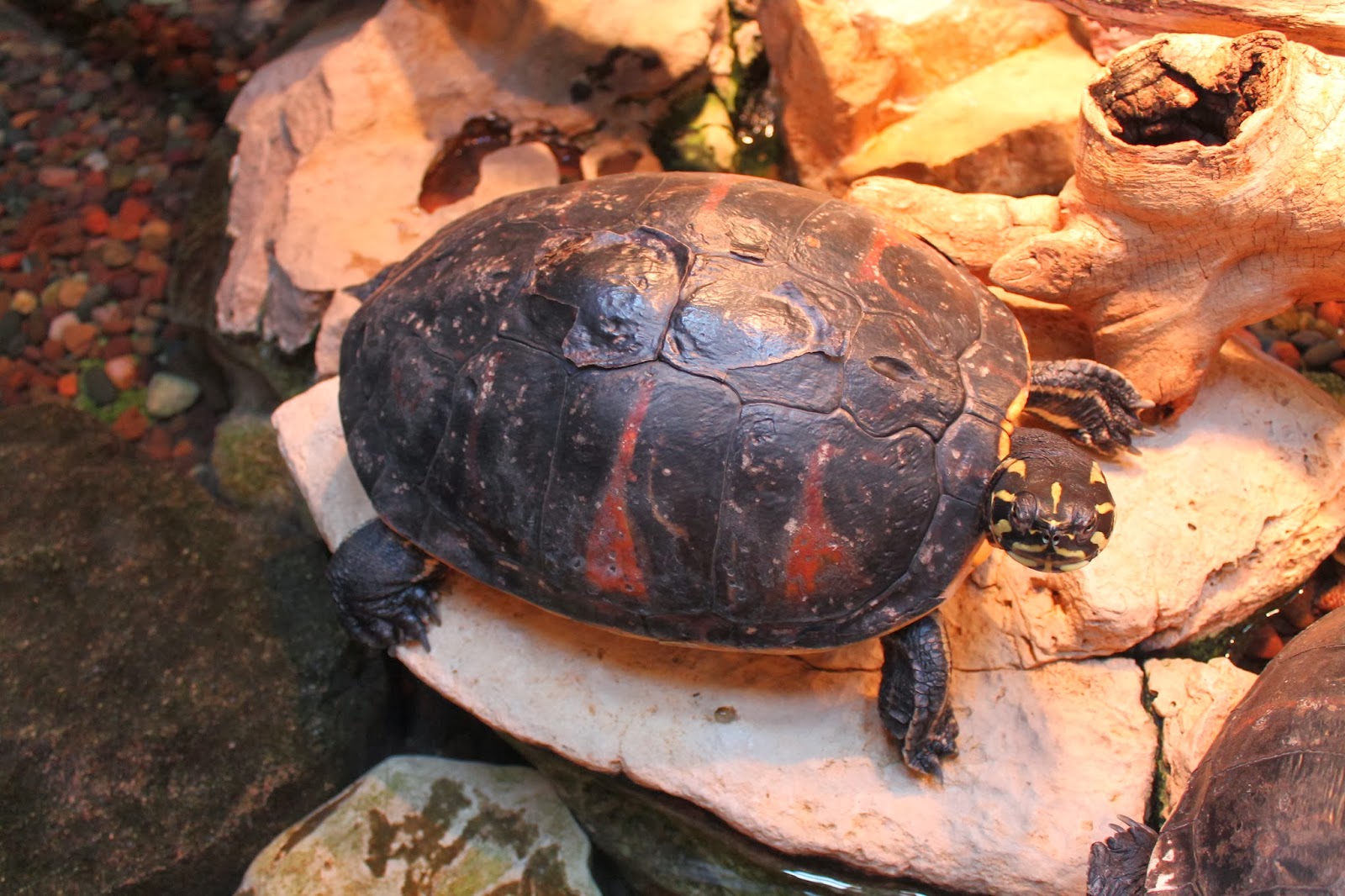
The Grove's interpretive center contains a good assortment of reptiles, amphibians, and fish.  Most are local species, but some, such as the sheltopusik and the massive alligator snapping turtle, are not.  I especially like viewing their open turtle pool.

Red-eared slider (Trachemys scripta elegans)
Common map turtle (Graptemys geographica)
A ginormous female redbelly turtle (Pseudemys rubriventris)


Monday, January 13, 2014

Kids and Reptiles

Think your kid wants nothing to do with reptiles?  Kids seem to inherently gravitate toward these animals.  Most are too young to have been fed all the garbage about them being mean and nasty.  A child touching or holding a lizard or snake for the first time is one of the greatest sights, in my eyes.  Most kids are exposed to animals such as dogs and cats, and that is great.  Most, however, pause and gaze at reptiles.  They approach with a degree of caution but hardly hesitate to ask if they can pet it.  There is no coincidence that the reptile house of the zoo is typically the most popular, and why aquariums are adding more and more reptile exhibits (not that fish are not interesting, but there is a certain disconnect and perhaps perceived intangibility between people and fish).  Reptiles straddle the line between touchable/handleable and exotic/mysterious.  It's a great thing for kids to be able to safely come into contact with these animals, since the experiences often can lead to a better respect for all lifeforms and improved ERB (environmentally-responsible behavior).  At the very least, it's a cool experience they won't soon forget!

Jeffrey Peffers holding his first wild-caught brown snake.  I was proud!
Jeffrey Peffers and his first blue-spotted salamander.
Jeffrey Peffers long ago, delighted to be petting Bubu the boa.
Who wants to learn about snakes??
The kids were supposed to sit on the mat, but they mostly pushed to the front and some ended up off-limits.

Inspector Gadget

A young visitor to Fall Fest in 2012 (with a tiger salamander).
Girl posing with Dexstar, the water dragon, at summer festival.
 Girl with corn snake at church event.
 At the summer festival - my jungle carpet python absolutely made this kid's day!
Alli Calli (Jeffrey's sister) with Birdy, the Solomon Islands ground boa.


Saturday, December 7, 2013

Cabin Fever

I decided to spend about an hour today photographing some of my animals.  As much as I love the outdoors and even winter hikes, sometimes I just need my reptile fix, and well, I happen to have some.  I do plan on obtaining my macro lens soon - certainly before the spring.  In the meantime I'm testing the limits of my stock lens.  It really is not that great with macro.  But, these are what I got today.  I understand that some day I'll be taking awesome macro photos and then look back on the last couple years' worth of photos and cringe, but I figure it's all part of the learning experience.

This is Sascha, a Chilean rosehair tarantula (Grammostola rosea).  Sascha is an adult female, very likely collected from the wild.  Sascha unexpectedly landed in my care over one year ago but has been a very hardy and fascinating captive.  Years ago, I kept dozens of species of spiders.  Some called me an arachnoholic.  These days I'm willing to settle with this big girl.

This is Maureen, my marine toad (Rhinella marina).  Marine toads are also called cane toads or giant toads.  This one was collected in Florida, though they are native to parts of South & Central America and Mexico.  Marine toads, to me, are one of the most intriguing species of amphibians.  This infamous amphibian grows larger than virtually all other toads and has successfully colonized areas it is not native to, due to introduction by humans.  They are wreaking havoc in northeastern Australia, breeding like crazy and eating their way across the continent.  About 100 toads were released there in the 1930s to combat the cane beetle, an insect that damaged sugarcane crops.  Instead, they ate everything that fit into their mouths.  Today, hundreds of millions of these toads call Australia home, and the Aussies hate them like we here in the Midwest hate emerald ash borers. Almost nothing can eat this toad and survive - it contains and exudes a highly toxic substance through its skin when in danger.  It is responsible for the deaths of many dogs and cats, as well as snakes, lizards, birds, turtles, etc.  The toad problem in Australia is a classic case of human lack of foresight.

"Some of the worst things imaginable have been done with the best intentions." -Dr. Alan Grant, Jurassic Park 3

  I have been fascinated by this species for many years and this is the second marine toad I have kept.
Cassius doesn't understand why I'm taking photos of such strange animals.  
 My male corn snake (Pantherophis guttatus) in a bowl of gourds.  I have worked with some of the most exotic and rare species of reptiles in my years, but I will always have a deep appreciation for corn snakes, particularly the normal, "wild" morph.  It seems that the normal colored corn snakes are becoming rarer than the once-rare albinos, snows, butters, etc, than are seen nowadays.


Saturday, November 9, 2013

Done at Dunning (DRCA)

Today was the final stewardship day for the year at DRCA and the site will be closed from December through February.  A lot of work got done today, including improvements to the trail in the woods and planting some grey dogwood (I believe) in another area.  Today I came across something I've been hoping to find here for a while - snakes!  Earlier this year, I set out some boards in an open area of grass south of a treeline, hoping to attract snakes.  I posted about it here:  http://www.thejosecshow.blogspot.com/search?updated-max=2013-06-30T17:49:00-07:00&max-results=15

I have gone back a number of times throughout the year, checking the boards with no success.  Last week when I checked them, I was welcomed by a meadow vole.
Discovering that a rodent has taken advantage of artificial cover doesn't bode well for my reptile-seeking endeavors.  Snakes and rodents will generally not share the same roof.  I left the boards in place and will check them in the springtime.  

Luckily, though, I passed a small snake that had come out of the grass and was basking on the warm asphalt fire lane.  It was 51 degrees outside and windy but it was sunny.  It was a young plains garter snake, Thamnophis radix.  After showing the snake to the volunteers, I was on on way to releasing the snake, when all of a sudden my former internship supervisor stops, looks down, and says, "There's another!"  Interestingly, the second snake, which was the same size as the first, was caked in a layer of mud.  It must have begun settling in for the winter (it has been very cold these last couple weeks) and decided to venture out once more before the big sleep.  I released the two snakes together in some taller grass off of the road out of fear that they'd get run over or stepped on.  As I type this, I only hope they are headed to shelter about now, since it is supposed to snow in a couple days.


We had about 8 or 9 small to medium sized green ash trees removed from prominent areas of the site.  They were all heavily affected by the emerald ash borer, Agrilus planipennis).  


I couldn't help but lift a few logs before I left.  What can I say?  They lure me in every time.  Nothing but a bunch of crustaceans with a centipede thrown in here and there.  Here's a cluster of Armadillidium - reminds me of one of those "one of these things is not like the other" segments from Sesame Street.


I hope to post more soon, but as the seasons progress toward winter, updates may be slim - check back soon to see!


Sunday, November 3, 2013

Bachelor's Grove Bullfrog

About a couple weeks ago, Aimee, my nephew Jeffrey (Peffers) and I took a trip down to Tinley Park for the bi-annual North American Reptile Breeder's Conference (NARBC).  I've attended the conference most years since its inception, and it's always fun to see familiar faces in the reptile industry (I worked in that industry for a long time, some time ago).  After a few hours of viewing the animals and chatting with a few fellow enthusiasts, we decided to head out.  On the way home I thought it would be fun to stop by Bachelor's Grove cemetery, located in Midlothian.  It was on our way anyway, and seeing as it was the season for spooky haunts, we parked the car in the parking lot across the street from the entrance, crossed the street, and soon were on our way to one of Chicagoland's most infamous cemeteries.  Jeffrey had never been there before so we had to school him on what it was all about.  After taking some photos in the cemetery, I decided to show him the creek, the old house foundation, and stone-lined well in the woods.  We spent a good deal of time at the creek, which at this point had dried up considerably.  There were very few sections of the creek that were connected; there were many isolated pools with only a very tiny trickling of water that fed them.  The creek was lined with limestone and pebbles and autumn leaves were everywhere.   The "bigger" pools contained schools of small minnows, while the smaller ones contained a few lonely stragglers or were vacant.  As we strolled along the dry rocky bed, I noticed a few small "plops" of frogs entering the water.  To be honest, I was surprised to see any active amphibians, since it was quite cold out.  I was able to catch one of the small frogs after it had jumped in; it was trying to hide by staying motionless at the bottom of the pool like most frogs do, but it didn't do a very good job.  I reached my hand into the icy water and brought it to my nephew so he could see.  It was a young bullfrog, Rana catesbeiana.  After explaining to Jeffrey a few interesting features of the bullfrog, I released it back into the water, but not before noticing that it suffered a deformed back leg.  As it slowly swam through the cold water, I clearly saw that one leg was smaller and weaker than the other.  It influenced the way the frog swam, and I imagine it being detrimental to the frog's future development.  This was certainly not the first time I've seen this kind of deformity in Rana.  I have seen it occur where frogs live with polluted water.  Retention ponds and streams with discharge pipes releasing runoff often produce animals with similar debilitating features.  This water seemed clear and clean, and being in the forest preserve, one would assume it would be fit for frog life.  But there could be something upstream causing this problem - runoff drainage, industry, etc.  It doesn't take much to impact downstream amphibian populations.  I just hope that I'm wrong and that this was an isolated, freak frog.

Fragmented stream
 A more substantial section
 Jeffrey Peffers wishing he were me (in the background) getting dirty!
 Young bullfrog