Wednesday, May 6, 2015

Friendly familiar faces

The day - April 12, 2015.  The places - preserves in northern Cook County.  The goal - well, not a whole lot of rhyme or reason other than to see what herps were active.  Mid-April is a herpetologically-rich time in the region, and before you know it, the herps are out in full force.

One of several beautiful Chicago garter snakes (Thanophis sirtalis "semifasciatus") I observed basking in the late morning sunshine in an area where the woodland canopy opens up.  Of the two species of garter snakes in Chicago, this one seems to prefer forest-edge habitat or savanna.
 A Northern leopard frog (Lithobates pipiens), in a vernal pool located in the woods.  
 I don't often find redbelly snakes (Storeria occipitomaculata) on the crawl.  This was was exiting one flat stone and was heading in the direction of another.

 No doubt the Chicago garters were out looking for food and/or mates.  This big chunker was seen alertly cruising behind a thick wall of impenetrable thorns.
 The sad reality of providing vehicular access to see snakes is that sometimes snakes too use the roads and often end up being run over by cars.  No matter how many times I see dead flattened snakes like this, it hurts a little.
 Ugh, another one.  I include photos of dead on road (DOR) snakes to remind me (and others) to be careful when driving in areas where snakes are found.
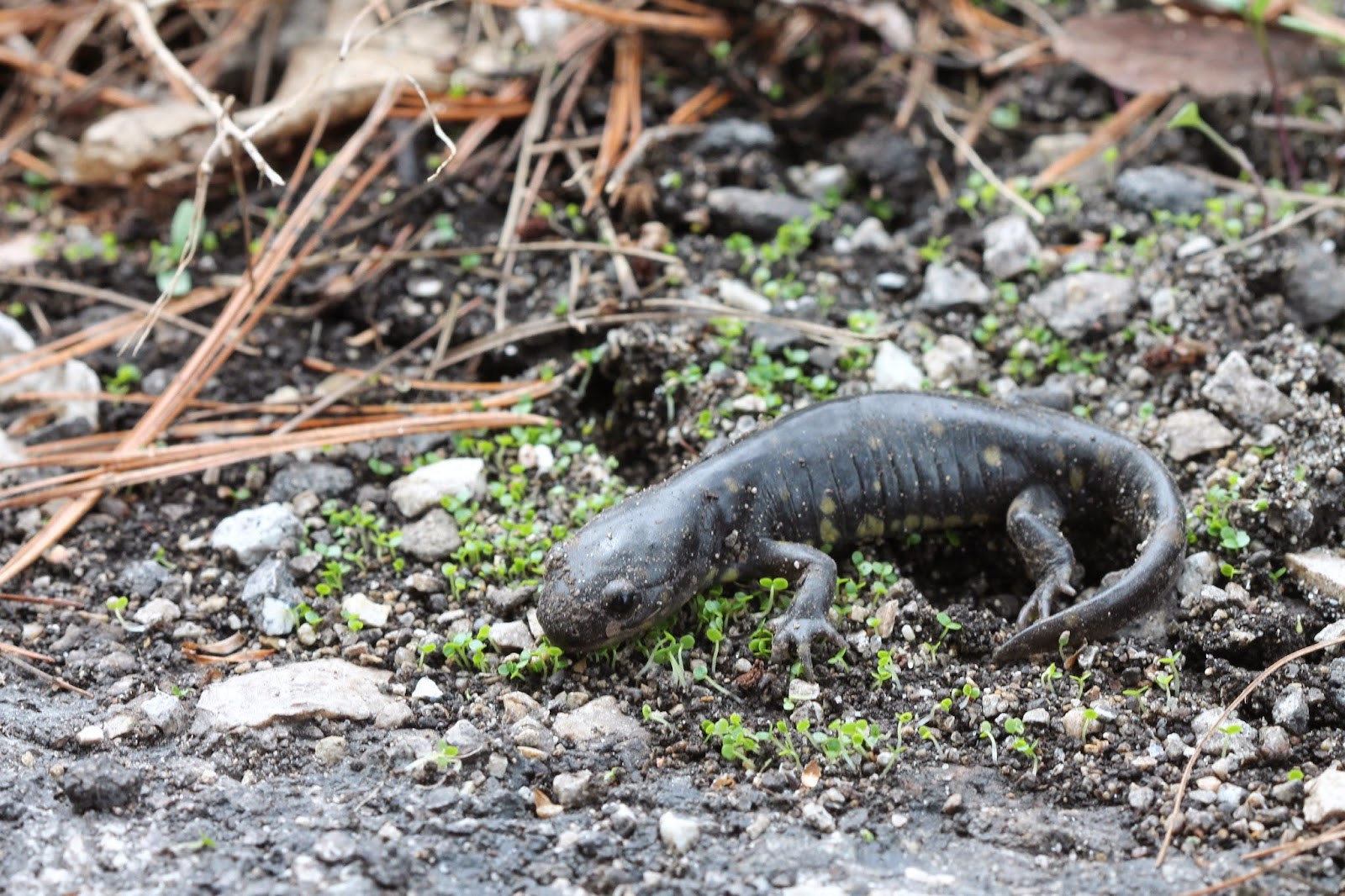
A tiger salamander (Ambystoma tigrinum).  I usually find one or two of these at this particular preserve.
 A big male prairie crayfish (Procambarus gracilis).  
At the Trestle, I chased down this big plains garter snake (Thamnophis radix).  I noticed that this population is gradually spreading southward into areas that were once choked with invasive brush and buckthorn but are now being restored.  
 The omnipresent midland brown snake (Storeria dekayi).
 Small whites (Pieris rapae).
 I promise...
 I was lucky enough to get pretty close to this mourning cloak butterfly (Nymphalis antiopa) before it flew off to do whatever it needed to do.


Friday, May 1, 2015

Vernals & vitality

Before I left for my first trip to Pennsylvania on business, I agreed to an outing with Matt Ignoffo to look for spotted salamanders (Ambystoma maculatum) at one of the few places they are still found in Cook County.  However, once I realized I was stuck at the airport in Allentown due to bad weather, I wasn't sure when I'd be home, or if I'd even want to go out in search of these introverted caudates right off a plane.  Informing him of my situation, he assured me we'd get out soon enough, even suggesting that the original plan may be too early anyway.

True to his word, he soon offered an alternative date - April 4th.  I was excited about the prospect of seeing spotteds again, but actually any amphibian would be great.  Until this point in the year, I saw a few snakes, but no amphibians yet.  And herping with Matt Ignoffo is like batting against Cy Young.  He's done his homework and put his time in the field to become as knowledgeable as he is.  He is the one who inspired me to improve my photographic skills.  Whether or not I succeeded in doing that is debatable, but it's got me trying anyway.

Matt, his two young kids, and I spent a few hours around a couple vernal ponds in search of spotted salamanders, but to no avail, even though spotteds have been recorded here and are found rather frequently - IF you know how and when to look.  We just weren't there at the right time.  However, we did find blue-spotted salamanders (Ambystoma laterale) and "Tremblay's" salamanders (Ambystoma "tremblayi"), the latter of which are a polyploid hybrid (specifically, a triploid).  Basically (well, as basic as I can put it), the Tremblay's salamander is a cross between the blue-spotted salamander and the Jefferson's salamander (Ambystoma jeffersonianum).  But it's not simply one species breeding with another species - those pairings don't typically produce a new species.  The Tremblay's salamander is unique is that is contains three sets of chromosomes, two from the blue-spotted salamander and one from the Jefferson's (these hybrid species are often referred to as "JLL", or jeffersonianum/laterale/laterale).  A female JLL salamander (the only sex they come in, as if this wasn't weird enough) has to breed with a male blue-spotted salamander in order to produce young, BUT the male's sperm does NOT fertilize the eggs of the JLL female.  She basically steals his sperm to stimulate egg development.  No genetic information is passed on to the male.  This process, called kleptogenesis (klepto as in kleptomaniac), is only known from a few species.  Tremblay's salamanders are effectively "sexual parasites", since they are taking sperm of blue-spotted salamanders, which a female blue-spotted salamander needs in order to produce eggs, just like the rest of the civilized world.  Another hybrid species, the silvery salamander (Ambystoma platineum, aka JJL), is similar in that it is a triploid, but it contains two sets of chromosomes from the Jefferson's salamander and one from the blue-spotted.  Whew!  This is like the Maury Povich Show of salamanders.

So, how did these crazy hybrid-species-things get here?  Well, they do occur in nature and are widespread.  However, the population in Cook County was introduced from its core range all because of a science project gone wrong.  Back in the 1970s, a professor studying these salamanders ended up releasing some of them into one pond, and over the last forty or so years, the salamanders have spread and now breed in several nearby vernal ponds.  You can still find pure blue-spotted salamanders here, but there are probably more JLL animals here due to their reproductive strategy.  I'm not sure what the future holds for these JLL animals, but for now, at least, they are here, and they are in good number.

Also heard and seen on this outing were lots of spring peepers (Pseudacris crucifer) and a few Western chorus frogs (Pseudacris triseriata).  And of course, in any open woodland during April in the region you're sure to find amorous Chicago garters (Thamnophis sirtalis "semifasciatus") on the prowl.

A Tremblay's (JLL) salamander
 The first garter snake we observed was this massive beast female.  She was the recipient of all kinds of battle scars from years past.  The full extent of her size isn't realized until another adult garter snake is placed next to her.  
 Oh what do we have here?  As I was photographing the female, this adult male enters the frame with love (or maybe lust) in his eyes.
 He quickly traces the outline of her body with his head until he is able to line up his cloaca with hers.
 In this shot, the male has commenced copulation.  This, folks, is how magic happens with garter snake.
Matt introduces his kids to a spring peeper.
One of several spring peepers found hopping alongside a vernal pond.  This particular one inadvertently jumped right into Matt's hand as he knelt down.  
Another shot of the often heard, but seldom seen peeper.
A peeper and a blue-spotted salamander.
Matt's son with a garter snake.  No better way of spending a mild April Saturday.

Wednesday, March 25, 2015

Pennsylvania

I spent all of last week in southeastern Pennsylvania on business.  Normally when I travel for business, it's long and dedicated work, but this particular trip offered me a bit of autonomy toward the end of each day, for a couple of hours before nightfall.  My only perspective of the area prior to my departure was through Google maps and a few websites.  I left on short notice and my familiarity of the area was limited to what I had learned from those maps and websites over a day and a half.

Anyway, here's a quick tour of a few of the interesting places I visited in PA.  I only had my iPhone, so excuse the poor quality.

This is a view of a 19th-century building across Little Lehigh Creek at Pool Wildlife Sanctuary in Emmaus.  This stream has undergone restoration in recent years.  Part of that restoration included the removal of a dam.
 Common snowdrop (Galanthus nivalis) - I think.  Native to Europe, and considered naturalized in PA. This was one of the few early emerging plants I saw in the woodlands.
 The path that I took at Pool Wildlife Sanctuary was an interpretive trail that showcased many trees common to the state.
 Visitors are encouraged to use this wooden boardwalk while passing through the stream floodplain.
 A blooming Crocus sp., one of the more showy flowers this time of year.
 I witnessed a murder in downtown Bethlehem, but nobody died.  Just hundreds and hundreds of noisy crows.
 A sign at a wooded area near Jacobsburg State Park in Northampton County.  I unfortunately witnessed no bears.
 Still quite a bit of snow.
 Bushkill Stream at Jacobsburg State Park.  This state park is located on the northern edge of Lehigh Valley, on the foothills of the Pocono Plateau.

 A partially frozen waterfall.

 I was hoping I might get lucky and witness some early amphibian breeding behavior, but virtually all of the vernal ponds were frozen.
 While driving back to my hotel one night late in the week, I noticed what appeared to be an abandoned house immediately of the expressway.  I pulled off the road at the first available exit, about two miles away.  Then, I managed to find the house via a motel parking lot - a dilapidated, OLD house that seems to have been partially buried, possibly during the construction of the expressway.  I would have gotten better photos, but as it was I was parked illegally and had to get back ASAP.
 Due to an onslaught of wind and snow, my flight was cancelled and rescheduled for the following morning.  Frustrated, I took this last shot from the airport terminal.  When I returned to Chicago, the snow followed me - less than two days later, we had over six inches of snow.  

Sunday, March 22, 2015

Silent Spring

This spring has started off on a dry note.  What I mean by that, is that despite temperatures mild enough to ensure that all precipitation will be rain and not snow, there hasn't been any.  It's sort of like last year, when, as it finally warmed up in April, there wasn't any real "explosive" breeding behavior from any of the area's "explosive" breeders.  There was no big breeding event.  Until it does rain, movement from any woodland amphibian will be slow and inconsistent.  Rain is the real driver when it comes to much of the region's breeding activity.  While the temperatures may reach unseasonably mild levels (such as when we experienced a number of 60-something and even a couple 70-something days), the fact that there hasn't been any rain means there is a delay in the mass migration of salamanders and chorus frogs.  Even all the snowmelt permeating into the ground isn't enough - warmer rainwater is the ticket.  Though several of my comrades have been able to flush out a salamander or two or catch the distinctive "comb bristle" call of a few impatient Western chorus frogs, I think it's safe to say that there are a whole lot more standing just behind the curtain, ready for their big appearance, as soon as the music starts.

In the meantime, there is another early spring breeder that relies not on precipitation but only a warm sunny afternoon to get in the mood.  The Eastern garter snake (Thamnophis sirtalis "semifasciatus"), or common garter as they are known, is bold enough to rise from its winter dens in order to mate during late winter or early spring, even if that window of warmth lasts but a few hours.  They are often observed on the crawl even as snow surrounds them.  Mating seems to be the stronger of two motivations after snoozing for a few months - the other is eating.  One might assume that the males would require some sustenance before their hunt for females, and certainly, a male garter likely wouldn't turn down a worm or frog if he happened across one in his search.  But I have repeatedly witnessed the Eastern garter snake in copulation while still covered in mud, a sign that leads me to believe that nothing more than warmth is needed in order to trigger reproductive behavior.  In my experience, I've found that males become active earlier, followed by the larger females, who release pheromones that entice the males.

The females' pheromones are released as they crawl about after "waking up".  They leave a pheromone trail that can attract more than one male.  In some regions of North America, the amount of males pursuing a female can be so great that the result is an aggregate of males on one female in what is termed a "breeding ball".  It is quite a sight to see.

On Sunday, March 15th, following a bi-annual reptile and amphibian conference (NARBC), my nephew Jeffrey Peffers and I met up with a fellow field herper from LaSalle County, Matt Bordeaux, and his wife and young daughter.  We wanted to try our hands at finding some amphibians at a nearby preserve in Cook County.  The conditions were ideal, with temperatures in the upper 50s to low 60s and partly sunny skies.  The only thing against us was the fact that it had not yet rained.  So, we searched high and low (well, mostly low) for salamanders, but did not find one.  Shortly after splitting up, I caught a breeding pair of sirtalis in a sunny spot on the woodland floor.  They represent the first herps of 2015 for me, the first since December 23rd, and the first snakes since I believe October 19th.

The scene as I approached.

A closer look.

Oftentimes, snakes don't seem to be distracted by stimuli while breeding.  It's like they enter a trance, during which they are vulnerable to predation.  This pair let me get up very close.  I even brushed against them in order to move a few leaves out of the way for a photo, and they hardly moved a muscle.
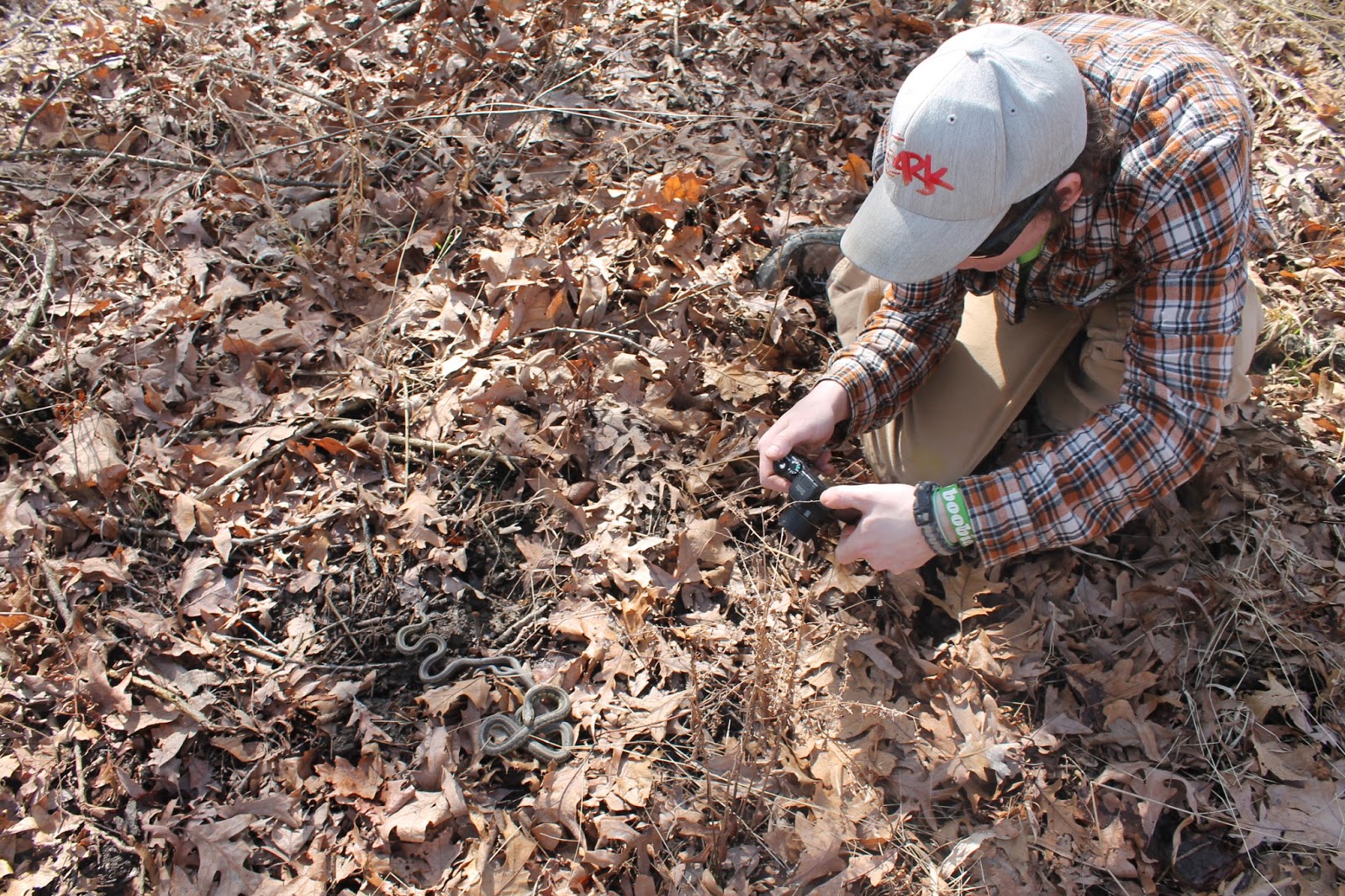
Matt shooting the breeding pair.
Matt showing his daughter the snakes.  Matt hardly ever (if ever) goes herping on his own.  He is typically expected to be in the presence of his wife and daughter.  I have a ton of respect for that.  There are far too few people out there who share their love for nature with kids.  
 This is the third garter snake we saw.  This one is in a periscoping position.  It is believed that this position essentially helps the animal get a better view of what's around.  It's a common behavior seen mostly with diurnal (day-active) snakes, but it isn't always easy to document, since a snake in this position is extra alert and easily startled.  This male, however, was on a mission.  Matt and I speculated that maybe it sensed the pheromones from the female we had just observed minutes before - in "adjusting" the set for a better shot, it is possible some of the pheromones transferred to my hands.  This one was curious and followed me briefly before slithering alongside a log in the opposite direction.
Eastern garter snake habitat.

Hopefully, it's just a matter of time before this dry, silent spring is interrupted by a good rain, and then, by the sounds of chorus frogs at every vernal pool that can support them. 

Monday, March 9, 2015

Canada

Better late than never - a quick glance at our 2400-mile road trip tour of eastern Canada.  This took place the first full week of February.  There are simply way too many photos to post, even just the highlights would have taken a full day to post, and ain't nobody got time for that.

We drove from sweet home Chicago straight to Toronto.  We stopped at an enormous discount imported junk store called Honest Ed's.  I guess it's a local landmark.  Anywho, you can buy pretty much anything your heart desires for less than most lunches.  Here are some jackets being sold for a buck.  Something tells me these jackets aren't made to last.


Aimee and I love greenhouses and conservatories.  They are especially worth visiting when the temperature outside is downright bitter cold.  We checked out Allan Gardens, located downtown and built in 1910.  It is free, and a really nice place.  Here's one of two resident red-eared sliders (Trachemys scripta elegans).

 There were two melanistic squirrels living inside the greenhouse.  One was asleep on top of some equipment near the ceiling as we first walked in, and another on the prowl.  This one nearly attacked this poor lady as she tore open some food packaging.  Gluttons.
Ripley's Aquarium was an amazing place.  Built in 2013, it is the newest aquarium I've ever been to and is very modern and well-designed.  We visited on an evening when they were open late, and there was a snowstorm, so we had the whole place pretty much to ourselves and a few brave souls.
I'm a sucker for these underwater tunnels.  This tunnel allowed for spectacular views of sharks, rays, and other fish, plus a green sea turtle.
Then we drove from Toronto to Quebec City.  Long drive.
It was very very cold in Quebec City.  So cold, that I stopped taking pictures because my hands would hurt from the cold.  Probably the most cold day was our first full day there.  We woke up and headed out to town for some frigid sightseeing, and it was just insane.
Aimee wanted to stay in the Hotel de Glace, aka the Ice Hotel.  Basically, it's what it sounds like, a hotel made completely out of ice and snow.  Everything - the walls, floors, chandeliers, bar, beds, and even the shot glasses are all made out of ice.  Very fun, very surreal, very...cold.
Maple whiskey shot
After our time in the QB, we drove to Montreal.  We had previously driven through on our way to Quebec City from Toronto, and the traffic had been oppressive.  This time, it wasn't as bad.  One highlight was our trip to the Insectarium.  By far one of my favorite parts of the trip.  If you love bugs, you'll love this place.  This is just one place we visited that is deserving of its own post.  Maybe one day I will, since there are just so many great exhibits.
Caligo eurilochis - a moth with what appear to be crazed eyes on the ventral side of the wings.
Cool blue flowers from a conservatory adjacent to the Insectarium.
 I chose not to stick to the rivers and the lakes that I used to.  Sorry, TLC.
Okay - on the campus of McGill University in Montreal, there exists a natural history museum called the Redpath Museum.  One of the best museums I have ever gone to.  It is free; donations are suggested, and we gladly donated to this amazing facility.  I was overwhelmed, to be honest.  Another topic deserving of a cold winter's day post someday.

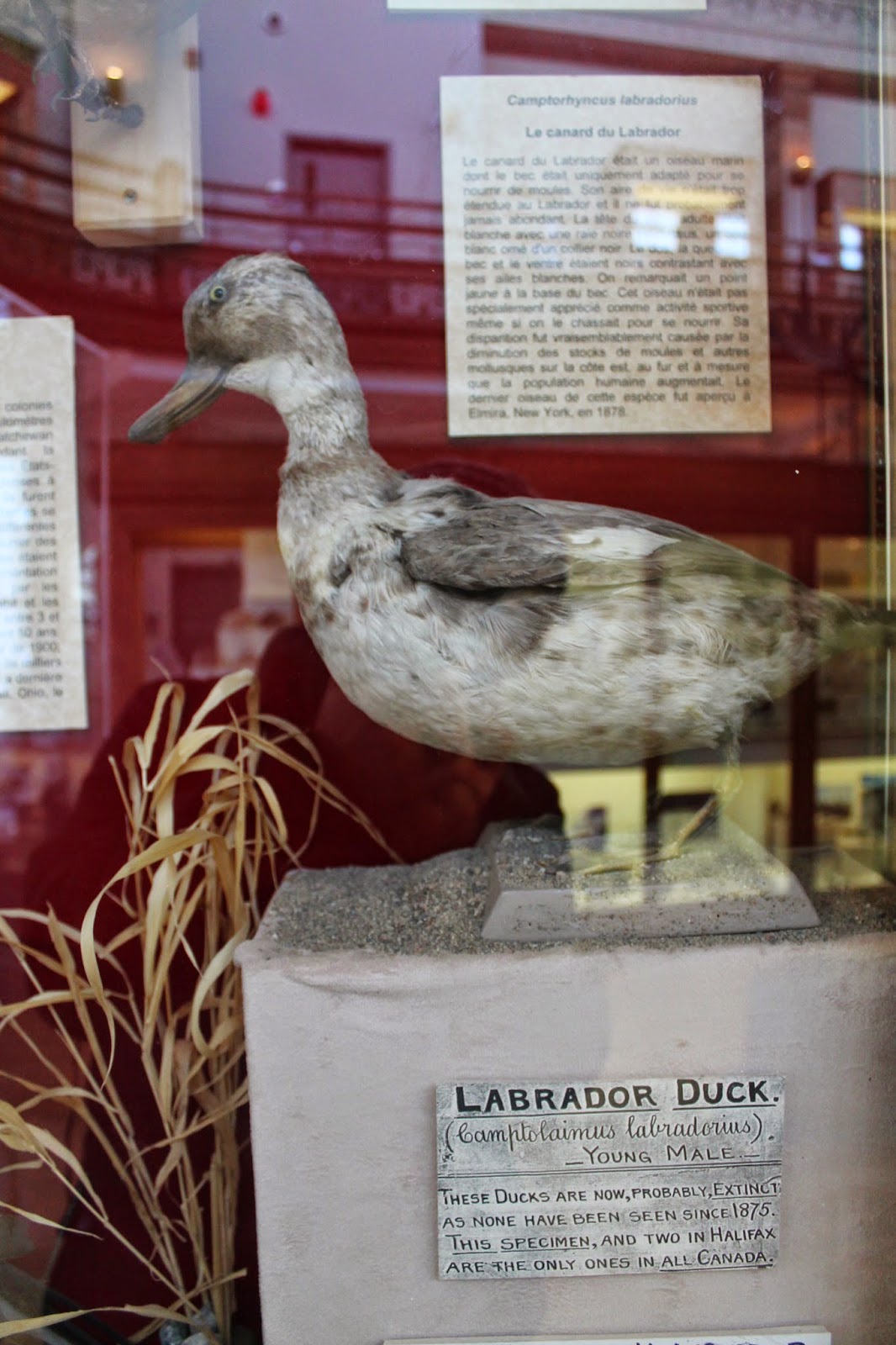
A Labrador duck (Camptorhynchus labradorius), one of only 55 known specimens in existence.  This species went extinct in the late 19th century.
Behind me, an impressive Gorgosaurus skeleton.
Documenting each day's activities for purposes of sentimentality.
We drove south from Montreal through upstate New York, south and west toward Niagara Falls.  Would you believe that on the way, we drove through Mexico in a tempestuous snowstorm?
Mexico, New York, that is.
I don't recall being as tired as I was when we arrived in Niagara Falls, Ontario.  Physically, mentally, I was beat.  But our view from the hotel room was worth the look.  Here are the American and Bridal Veil Falls at night, nearly frozen over completely.  Did I mention that it was cold?
Oh these silly Ukrainians.  This guy with the flag tried to get up and stand on the slick, iced-over railing separating man from the churning surge of water and ice that is the Horseshoe Falls.  His friends quickly urged him to get down immediately and insisted he stand on solid ground to wave his flag with pride.
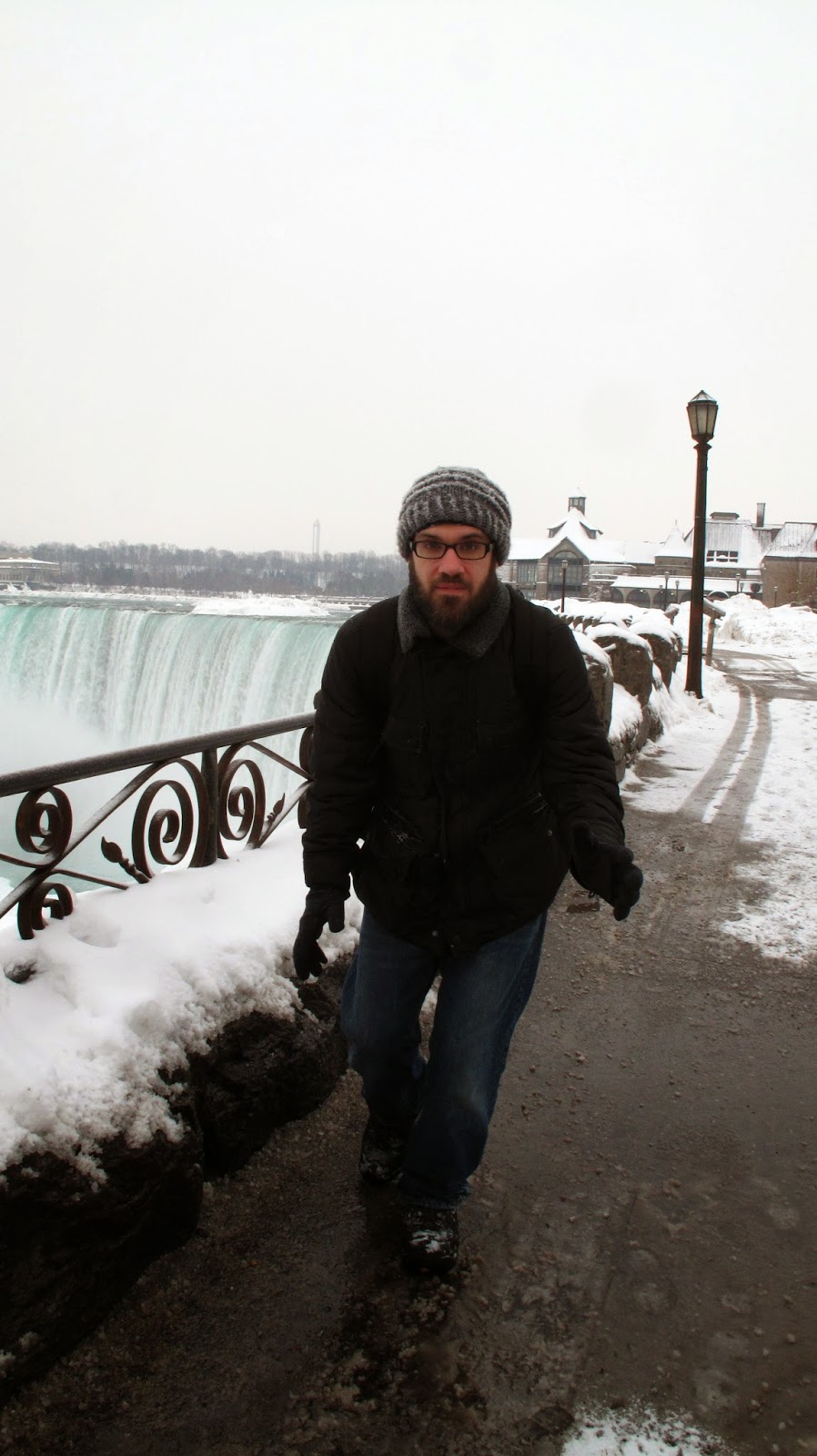
NIAGARA FALLS!  Slooooooowly I turned!  
And let's cap off the trip with a photo of me wrestling a fake snake as a silly chimp watches.

As I complete this post, the weather is warming and the snow is melting.  I sense some salamandering coming up - hopefully it won't be too long.