Sunday, January 31, 2016

Enter 2016: Mupuppies On Parade

You know what they say.  Once you go Necturus, you can't go back.  Or something like that.

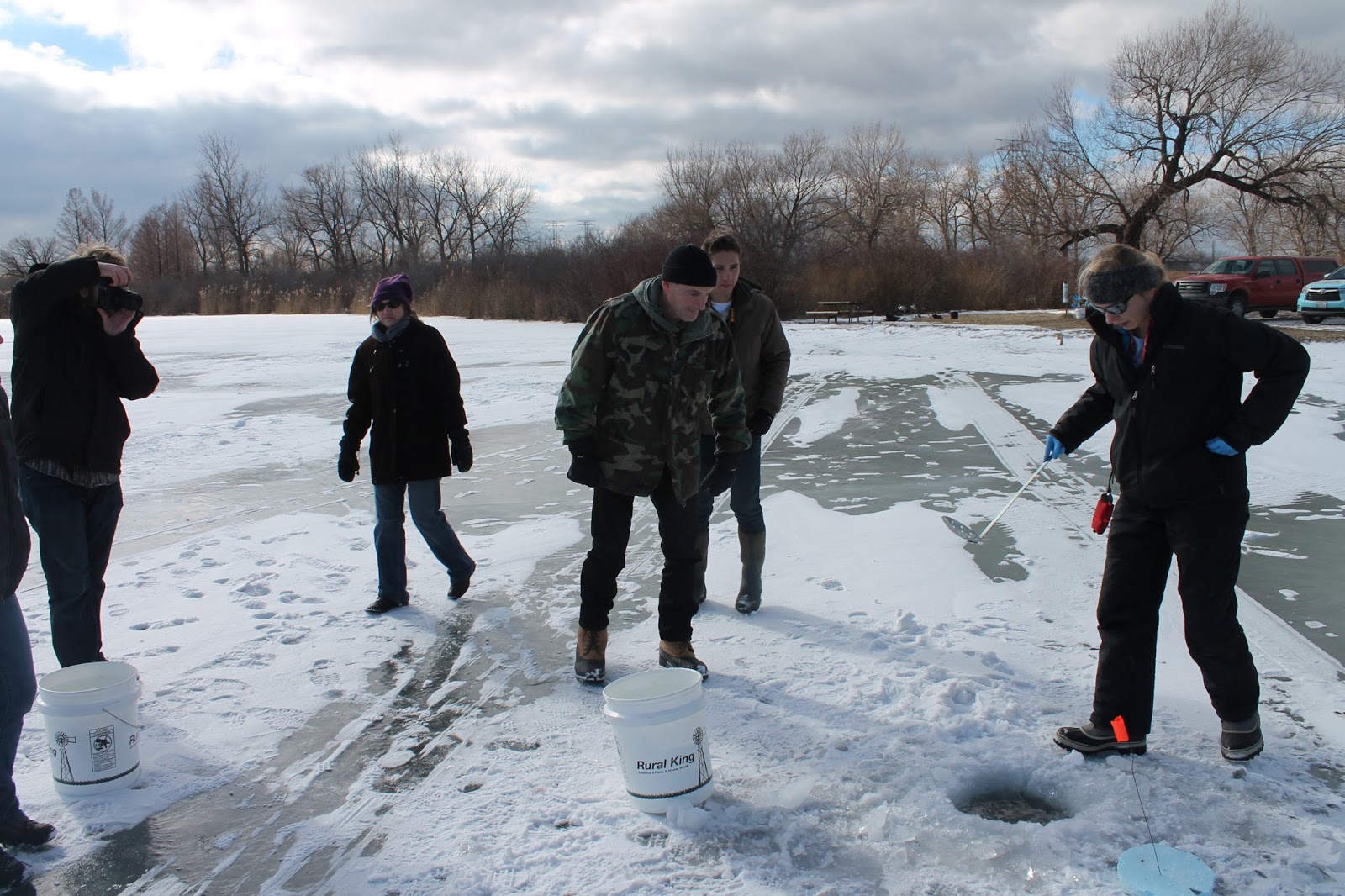
More assisting with mudpuppy (Necturus maculosus) research with Alicia Beattie & the Shedd Aquarium on January 22.  This time, much colder, almost a foot of ice, and bigger pups.


Pristine outdoor lab for the day.
 Actually, not a bad day to be on the ice, pulling traps and collecting mudpuppy data.
 One of Tristan's friends showed up to take good photos of a mudpuppy for an upcoming publication.  I should have paid attention on how to take good photos.
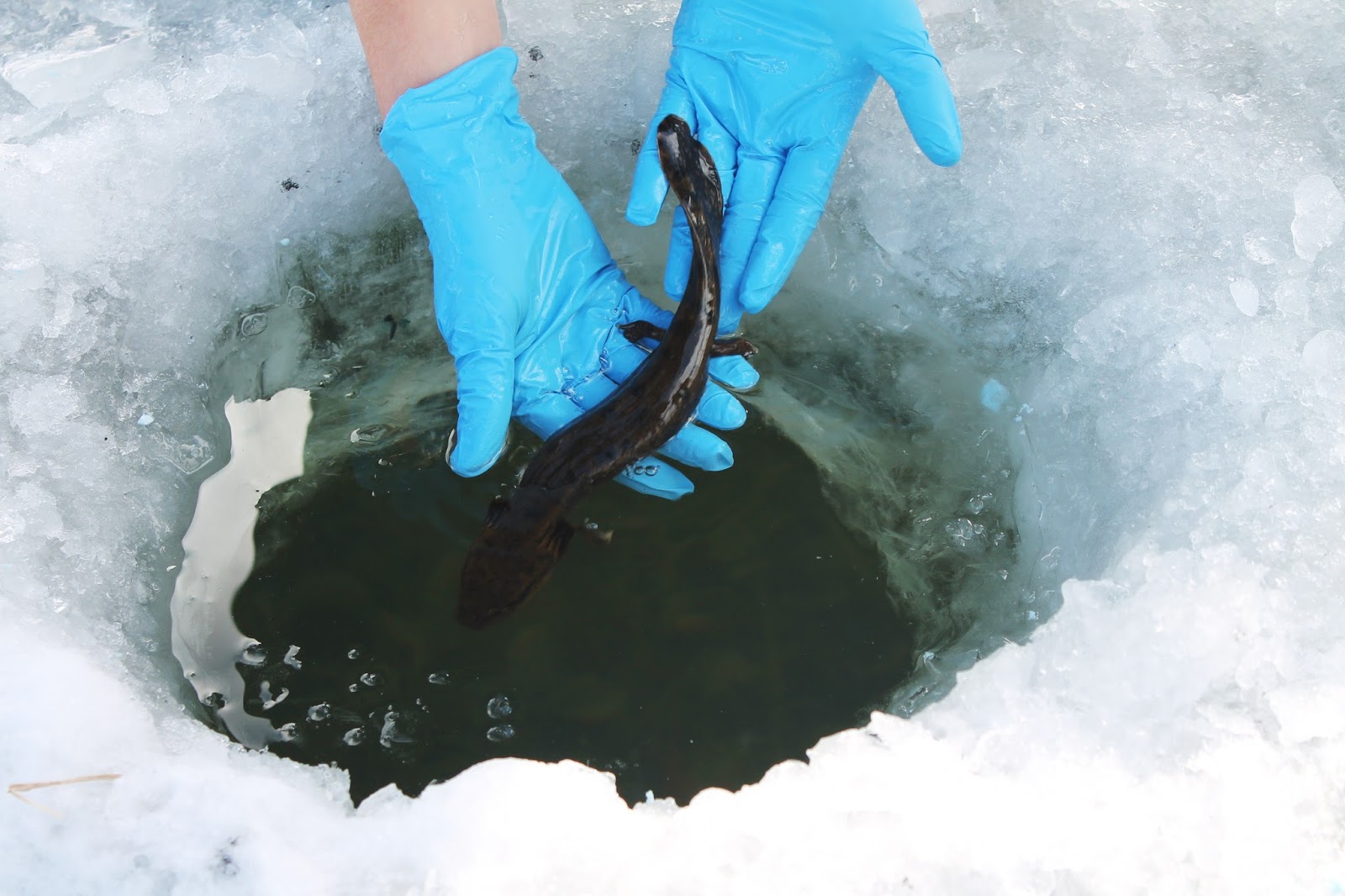
 One of two mudpuppies caught (from 50 traps).
 Tom snapping a mudpuppy shot with the good ol' phone.
 Gut contents flushed from one of the two mudpuppies - quite a bit in comparison to most.  These are mostly amphipods, with a few other squirmies in the mix.
 I think something important was happening here but I don't remember exactly what it was!
 Ah yes - the release of one of the pups, right back in the same hole it was conjured from.
 More than just a "fish with legs".  A stunningly gorgeous creature.
 So long and thanks for the data!

 "The sea, once it casts its spell, holds one in its net of wonder forever" - Jacque Cousteau
Alicia Beattie, Tom Anton, and Jaclyn Peterson taking environmental measurements.
 Coyote tracks
 Nature isn't always pretty.  The remains of a small rodent that appears to have been abandoned by perhaps a weasel or mink (Tom says if it were a hawk, its head would not have been there).

Monday, January 11, 2016

Winter herping - mudpuppies!

By my estimations, the Chicago region (Cook County and the surrounding collar counties) contains about 50 species of reptiles and amphibians.  I like to think that I am familiar with them, but to be honest, some are very foreign to me.  The common mudpuppy (Necturus maculosus) is a species that had eluded my attention for a long time, even though they've long graced lists of salamanders native to the region.  Completely aquatic and boasting a beautiful set of external gills that resemble ostrich plumes, the mudpuppy can grow to over a foot in length.  They lurk at the bottom of rivers and lakes, where they remain active year-round, feeding on various aquatic animals including crustaceans, worms, fish, and even other mudpuppies.

In Illinois, the mudpuppy is officially classified as threatened.  Many of the riverine habitats it once enjoyed have been polluted or altered to such an extent that the mudpuppy cannot withstand the environment.  However, oddly enough, it is found in large lakes that too are known for their not-so-polished reputation.  In Lake Michigan, they are occasionally caught by bewildered fishermen who have no idea what to make of these "fish with legs".  Reports from anglers at urban docks and piers, including Navy Pier, claim the capture of mudpuppies on baited fish hooks from time to time.  And maybe even more surprising is the prosperity of the mudpuppy in Wolf Lake, a small lake that straddles the Illinois/Indiana border.

Wolf Lake was once a pristine lake surrounded by lush wetlands, connected to Lake Michigan by an open channel.  Early natural historian Donald Culross Peattie once referred to Wolf Lake as "...a famous hunting ground for aquatic wildlife...where the plants form one of the most remarkable assemblages of aquatics in the country...no body of water of equal size can boast such a list".  Around the time of the Industrial Revolution, people began taking advantage of the lake for economical purposes.  Wetlands surrounding the lake were filled in with tons of slag and on those sites now sit various industrial facilities.  The lake itself has been separated into five sections by dikes, mostly on the Illinois side of the lake.  Railroad tracks and roads (and Interstate 90) cut across the lake from all angles.  The water level has changed dramatically as a result of the removal of beaver dams.  The water, though deceptively clear from the filtering actions of the invasive zebra mussel (Dreissena polymorpha), has suffered years of relentless abuse at the hands of heavy industry.  Friend and author Joel Greenberg, in his fantastic A Natural History of the Chicago Region, wrote, "The Calumet area (which surrounds Wolf Lake) has experienced every abuse that a wealthy society can subject to a small surface of the earth except significant radiation exposure and warfare...Concentrated in such a confined and biologically important area, the consequences are apparent.  A detailed account of what happened here would fill volumes, and even then it would be incomplete, for much went unrecorded."

Overall, the lake is a shadow of its former glorious self.  Still, somehow, it manages to support rare or uncommon animals including lake sturgeon (Acipenser fulvescens), Iowa darter (Etheostoma exile), and of course the common mudpuppy.  Explanations for the continued success of so many species in and around the lake range from the "cleansing" actions of factories as they take in water for cooling purposes, clean it, and feed it back, to the separation of the lake into various smaller sections, which may act to contain various pollutants, leaving other sections less affected.  Whatever the case, Wolf Lake has been called, "the lake that won't die".  It remains a biodiverse hotspot - one of the best in the state - as its waters gently lap the shore under a horizon teeming with factory smokestacks belching refuse into the air.

Alicia Beattie, a graduate student at Southern Illinois University, is researching Wolf Lake's mudpuppies.  Over the last year, she's collected a ton of data for her project - information that will ultimately serve as the foundation for the Shedd Aquarium's research (The Shedd is supporting Alicia and will resume research once she's completed her project).  There haven't been any detailed studies of Chicago's mudpuppies until now.  We know they are in Wolf Lake, but previously, we didn't know much, if anything, about their population density, diet, growth rate, habitat preference, etc.  Having all of this information is going to give us a good idea about how the mudpuppies - and the lake - are doing, and what we can do moving forward to further protect the slimy benthic beasts.

I jumped at the opportunity to help conduct a survey of the mudpuppies at Wolf Lake.  On December 5th, I met with Matt & Shannon Bordeaux, Alicia, Matthew Renik, and others to set up modified minnow traps in order to catch the mudpuppies.  We assembled fifty traps using minnows in a mesh bag as bait in one location, and about fifty more spread around in two other nearby locations.  I'm not going to lie, it was hard work.  The temperature was below freezing when we arrived early in the morning.  There was a thick, ominous fog across the lake, eerily meshing with the smoke coming off the nearby smokestacks.  As excited as I was to be wearing chest waders and thinking about getting out into the icy water to look for mudpuppies, the mood felt slightly somber.  I think it was because as a field herper, I expect a field herping outing to include warm weather.  I am NOT a cold weather guy.  The short, cold, dark days of December are typically accompanied by impatience as I sift through my readings, hoping that the mild days of spring arrive sooner than later.  Winter is a pretty depressing time for this guy.  I'm ectothermic.  I have a hard time functioning in cold weather.

To my elation, the sun eventually poked through the hazy clouds and uplifted my soul, even though it meant the insulation provided by the clouds was gone and the temperatures remained cold throughout the day.  Soon we were out in the frigid water, up to our waists (or deeper), securing traps to submerged rocks using rope.  I realized early on, that the waders provided to me were leaky.  The water slowly seeped in on the right side, until it filled up to my waist and spilled over into the left side.  Then, I managed to get water into my gloves when I reached down to pick up rocks that were too deep.  All of this made for a, um, challenging survey.  I tried not to whine about it because I didn't want to slow things down, and because I didn't want to look like a baby.  So for seven hours, I was a human slushy, net in hand, flipping rocks and trying not to slip on big, slimy boulders.  It's funny how much dexterity is lost when your core temperature drops!

In spite of all the technical difficulties, the day was a blast.  After we painstakingly set up all of the traps (to be checked by other team members in the following days), we tried to dip-net mudpuppies.  Ultimately, we ended up catching three, the third being #100 for the study.  Alicia took measurements, collected stomach contents, and PIT-tagged the mudpuppies before we released them in the exact spot they were found.  We also collected environmental data - length from shore, size and dimensions of rock each mudpuppy was found under, etc.  The extent of my condition wasn't fully realized until the end, when I removed the waders and poured all the water out of them.  I rang my socks out, put my shoes back on, and headed home to thaw after a full day of mudpuppy action.


It was early.  It was cold.  I don't drink coffee.  Nuff said.  Matt Bordeaux (on left) and me.  Photo by Shannon.
                                  
The stuff.
                                 
The cavalry has arrived...

 "If you truly love nature, you will find beauty everywhere" -Vincent van Gogh
Matthew Renick doing stuff with a rock and rope.
One of three mudpuppies.
Another...
Alicia swabbing a mudpuppy.
Before the mudpuppies were released, Alicia took a shot of all three for her own personal record.  We broke the 100-mark, and that was quite a feat.

And with that, the 2015 season came to an end.  It was, without a doubt, the best herping year yet.  Now that I'm all caught up with this, I can forget about posting stuff until next time - until then!

Friday, December 25, 2015

Southern two-lined salamanders revisited

Just a few shots from a little trip I took to see the southern two-lined salamanders (Eurycea cirrigera) on November 29th.  Some construction work occurred near one of the few sites in the entire state where this species is found.  I wanted to observe the extent of impact to the habitat after four months.  Air temperature was about 34 degrees F.

The impact of the construction project (which seemed to be either road repair or installation of piping under the road) seemed nominal on the surface; without testing the water, it's difficult to know the full extent.  What I found strange was that, under the very first rock I flipped, I found my first - and only - southern two-lined salamander.  I flipped many, many more after that, but no luck.  

 A trilobite fossil in a slab of rock, at least 250 million years old.
 I found this cold green frog (Lithobates clamitans) underneath a rock.
 A different seep-fed stream the next county over (but part of the same preserve).
 Here, on the bank of the Kankakee River, I stood and listened to nothing.  Almost pure dead silence.
 A close-up of one of the area's defining characteristics - an Osage orange (Maclura pomifera).  The Osage orange tree is not native to the area, but originated from when farmers planted them as hedges long ago.  There are a lot of Osage orange trees in this area, and as a result, a lot of the fruit on the ground in fall. They smell somewhat like an orange, which gives them their name.  Unlike oranges, these aren't edible.  Only the tiny seeds are edible, but they are hard to get to and typically, people don't waste their energy.  Squirrels love the seeds, and it's easy to find chewed-up Osage oranges all over the ground.

Saturday, December 19, 2015

IMBY.

On November 2nd, I was in my backyard when I heard a commotion next door.  My neighbor had been doing some yard work, and all of a sudden he shouted something and called for his wife.  Then I heard, "snake", and I ran over to the fence.  I looked down and there on the sidewalk next to his garage was a midland brown snake (Storeria dekayi).  I jumped the fence and caught it before it could get away, and was immediately overwhelmed by disbelief - how did this snake get here?  But before I could begin to think about that, I had to assure my neighbors that everything was okay - that these little slug- and snail-eaters are completely innocuous and are good for gardens.  They hesitated to be convinced but I think they were okay with that idea of living with a snake in their backyard.


The next day, I am out in my yard once again.  Cassius begins sniffing around the deck.  He is on to something.  His nose in stuck to the ground, his body language is telling me that there's something living under the deck.  Thinking it was going to be either a rabbit or a mouse, I looked under an inverted kiddie pool we store there.  Nothing.  Next, I flipped over an old sheet of vinyl siding leftover from when we had the siding done last year.  Resting there, all coiled up like she owned the place, was a chunky brown snake.  Two brown snakes in as many days.


So what does this mean?  In almost six years of living in this house, I've never seen a snake here, nor would I have believed that any could live here.  Did they migrate here from somewhere?  

To answer these questions, one has to really understand the brown snake.  Now, I've written about brown snakes many times here - about their grittiness, their stubbornness, their persistence.  The brown snake might be a small, nondescript little serpent, but for what they lack in aesthetics, they make up in sheer determination.  When development destroys a natural area, often, it's the brown snake that remains, making due with what little is left.  Because they are naturally found in a variety of habitats and not just one, they can easily adjust to changes in their environment.  Because they eat slugs and snails, they never have to move very far to find sustenance.  And, because they are live-bearers and produce a fairly large number of young (that are fully capable of fending for themselves from day 1), they have an upper hand at life.  Their small size helps as well, allowing them to move about without being seen in most instances.  Brown snake #2 (photos above of snake in hand) was one of the largest, if not the largest, brown snakes I've found.

The snakes did not migrate to my backyard.  At least, they didn't get here from a forest preserve or other place most people might associate with as being a place snakes live.  It's possible they could have come from someone's backyard nearby.  But, most likely, they have always been here.  They were here two hundred years ago, when the area was a pristine prairie with some patches of woodland.  Back then, they shared habitat with smooth green snakes, fox snakes, milk snakes, eastern massasauaga rattlesnakes, Kirtland's snakes, and more.  You will not find any of those around here now.  The brown snakes were here one hundred years ago, when the area was farmed.  They were here eighty or ninety years ago, when the neighborhood was subdivided.  They have dealt with the installation of sewer lines, power lines, and gas lines.  Dealt with impermeable surfaces such as roads, alleys, and patios, and the flooding that's often caused by them.  Dealt with invasive species, both directly and indirectly.  Cats, dogs, lawns, tulips, creeping charly, Japanese maples, yews, tomatoes.  Dealt with hazards such as lawnmowers, weedwhackers, grills, cars.  Not to mention Round Up, salt, motor oil, and automobile wash suds.  It is now 2015, with 2016 right around the corner, and the "lowly" brown snakes are still here, living in my backyard, eating slugs, and in all likelihood, brumating under my house's (or garage's, or neighbor's) foundation as we speak.  If that isn't enough to incite amazement, then I guess you're just not me I guess. 

Snake Road, Fall 2015

It was that time of year - early October, a time for trekking down to the Shawnee region of southern Illinois, for the fall snake migration.  Having made this trip numerous times, I always plan to explore new areas as well as hike Snake Road.  The entire region has captured my soul.  I dream about camping under the stars, warming my tired feet at the fire pit.  Hearing the sounds of the deep, dark woods at night - the coyotes, the barred owls, the frogs.  By day, walking miles and miles up and down roads, woods, cliff slopes, swamps.  All the while, looking for the reptiles, amphibians, and other interesting animals and plants that fascinate.  And I do just that, all while seeing old faces and meeting new enthusiasts.  It's just a great, great experience overall.

On each trip I've ever made to Snake Road, I've been welcomed by an impressive example of large-bodied snake at or near the north gate.  This time was no different.  Here we have an adult western cottonmouth (Agkistrodon piscivorous leucostoma).
Another cottonmouth, coincidentally, hanging out in white snakeroot (Ageratina altissima).
Nearby, this plainbelly (yellowbelly) water snake (Nerodia erythrogaster flavigaster).
A hiker noticed this large insect crawling on a plant and made a scene.  I approached it and was curious - I've never seen one of these before.  Looked like an armored bug with a mohawk.  I transferred it to my hand and inspected it closely.  How cool!  When I got home, I went through my books and the Internet and discovered that it was a wheel bug (Arilus cristatus), and that its bite is extremely painful.  The University of Florida's website claims, "When disturbed, the wheel bug can inflict a painful bite. The bite has been described variously as worse than stings from bees, wasps, or hornets. Barber (1919) and Hall (1924) described in detail the effects of such bites. In general, initial pain often is followed by numbness for several days. The afflicted area often becomes reddened and hot to the touch, but later may become white and hardened at the puncture area. Occasionally, a hard core may slough off, leaving a small hole at the puncture site. Healing time varies but usually takes two weeks...".  Do NOT try this at home!
Young cottonmouth savoring the last of the afternoon sun.
This cottonmouth has gotten an early start at brumation.  It was wedged in fairly tightly, along with bunch of its friends, in a crack along the cliffs.

The road.
Shortly before sunset, we began seeing many treefrogs along the road near the swamp.  While looking for them, I found this young western ribbon snake (Thamnophis proximus) emerging from underneath some peeling bark in a tree about five feet off the ground.
A big green treefrog (Hyla cinerea).
Another greeny.
Day two found us bouncing around from spot to spot.  I had a list of goal species, but I didn't find any of them.  I did find some other cool species though.  Here is a young bronze frog (Lithobates clamitans clamitans) I saw while looking for copperbelly water snakes in Johnson County.
A bird-voiced treefrog (Hyla avivoca) I saw while looking for eastern ribbon snakes in Johnson County.
Back at Snake Road, another green treefrog.
And a grey treefrog (Hyla chrysoscelis).
Day three began with a trip to the dolomite glades of eastern Missouri to look for, well, anything we could find!  I was previously invited to an outing by Peter Paplanus, one of the most remarkable field herpers I know.  Also joining us was Edward Prenzler.  I was very excited about visiting the glades and observing some of the unique features of this rare habitat.  After a two-hour drive, we got started early, and it was quite chilly out.  We flipped a few rocks before we found our first cool find, this striped bark scorpion (Centruroides vittatus).  It was the first of many.
A prairie ringneck snake (Diadophis punctatus arnyi).
An early morning view of the glades.
Peter turns over a rock while Aimee contemplates why she's here this early.
The first of a few lined snakes (Tropidoclonion lineatum) we found.  I've never found these in Illinois, but they are pretty common right across the Mississippi River in Missouri.
A familiar face, though I was told these are not a common find in the glades - a midland brown snake (Storeria dekayi wrightorum).
Peter casually picked up this three-toed box turtle (Terrapene carolina triunguis) and handed it to me without taking his eyes off the ground in search of more rocks to flip.  I'm not sure he understood how cool it was for me, since I had never photographed this subspecies in the wild before.  I didn't wait for this one to "come out of its shell", so this boring photograph will have to do.  Self-preservation trumps satisfying humans.
What's this under this rock?
Eastern hognose snake (Heterodon platirhinos).
Feigning death...
...and three idiots joining in.
A rocky hillside in the glades.
Following the leaders.
A southern black widow (Latrodectus mactans).
A male/female pair of brown/Missouri tarantula (Aphonopelma hentzi).  Really cool find.
A couple lizards we found - here is a fence lizard (Sceloporus undulatus) Peter and I chased down.
Six-lined racerunner (Aspidoscelis sexlineata).
The glades are characterized partly by their stunted trees.  Trees that grow on the glades themselves can't get their roots down far enough to support further growth due to the underlying layer of dolomite, and so they mature at a much smaller size.  Also, because their roots are not as extensive, the trees lose strength and tend to fall easily.  The deadwood provides great habitat for coachwhips, which we hoped to see, but didn't.  Hopefully, next year.
One more pass at Snake Road...
Photographing some treefrogs as Nick Asher stands there and regrets ever meeting me.
Two green treefrogs.
A zig-zag salamander (Plethodon dorsalis) found behind out campsite, in a dry wash.
In the same wash, this longtail salamander (Eurycea longicauda)
And this small green or bronze frog (Lithobates clamitans).
 Another trip in the books.  More memories forged.  More next time.