Monday, August 19, 2019

A Love Letter to My Trusty Field Guide

A lot of old-timers in field herping circles often credit their trusty old field guide they had when they were young kids when explaining their love of reptiles and amphibians.  There's something about an old field guide that just warms your heart.  A field guide to a child was like a cheat sheet for finding reptiles and amphibians in the wild.  You'd have this book that contained information on every kind of frog, salamander, lizard, snake, and turtle that could be found in your area and beyond.  Then it practically gave you directions on how to find them, by describing the habitat and habits of each species.

Well, I'm not an old-timer (yet, I think?), but I do consider myself fortunate to have grown up in a time where the Internet was still in its infancy and not a household word, and where the only ways to pursue knowledge on herps was through books, magazines, and resources of that nature.  I love the Internet.  I think the Internet was the best thing to happen to the developed world.  But the Internet contains so much information - endless, in fact - that it's hard for me to imagine opportunities for kids today to use investigative skills to unlock intriguing information that formed the basis of daydreams I had as a kid.  Information is consumed only as fast as one can receive it, and as a kid it was slow and steady.  There was much more time for reflection then than there is today.  Maybe someone will read this and completely disagree with that statement.  Maybe I'm wrong.  Cognitive bias or not, there's no refuting the value of good old-fashioned hard-copy literature in the days when it was the end-all-be-all for rabid curiosity-seekers.

As a young kid, I had some of the older, tiny pocket field guides like the Golden Guides.  I read them over and over again until the cover and/or back fell off.  In retrospect, the information contained within them was very basic.  To me, it was more about looking at the drawings of snakes I hoped to find someday.

But one particular book changed my outlook on herping forever.  It was gifted to me by my Uncle and Aunt from California, for my birthday in 1995.  It was the third edition of the Peterson Field Guide to the Reptiles and Amphibians of Eastern/Central North America, by Roger Conant and Joseph Collins.  My precious new acquisition was brand new and tightly-bound, and on the cover was an iconic photograph of a pine barrens tree frog.  I was so excited I could barely contain myself.  I probably ran off with it and shut the door to my room so as to block any distractions that would impede my fantasies.


In fact, the book came in handy A LOT.  I took it everywhere I went, even on trips where I wasn't expecting to go herping.  I  took it just in case.  Every time I traveled somewhere new, I'd take it in hopes of using it to help identify species new to me.  It became my Bible - the field herper's Bible.  It was the final word when it came to searching for, identifying, handling, and recording herps.

Of course, over time, I became quite proficient at identifying herps - so much, that I found that I was using the field guide less and less.  You can only use it so much when you're traveling throughout the Midwest.  The book set out to teach me and it succeeded.  It never was in jeopardy of leaving my possession - to this day it occupies a very prominent place on my bookshelves.  It stands next to a book that I consider to be far inferior - the fourth edition of the same publication (long story but it's a mess of a book).  I love my old copy of the third edition.  It's like an old friend that wants to remind me of the carefree days when I was a kid spending hours catching frogs and snakes.  It's the only book I own with snake musk and toad urine stains in it.

I think the point of this post is that material goods are always secondary to experiences, but do not underestimate the inspiration that may be sparked by a good book.  The effect this book had/has on me transcends paper and ink and glue.


Friday, August 2, 2019

Beyond the graves

The following is a little story about life and death, but also about the good things that can transpire if only we cared enough about ourselves, others, and the environment.

The story begins with a proposition from Nathan Kutok.  A budding naturalist and ecologist, Nathan has been working and volunteering with local herps and natural areas over the last year or so.  He hails from McHenry County, in an area rich in open space with lots of rolling terrain and farmland.  While surveying for snakes at a preserve near him home, he was introduced to adjacent landowners, who had been in the process of "naturalizing" their sizable property to act as a buffer for the preserve, and for their own interests and well being.  While scouting the private property, the landowners informed him of a very old graveyard on the property.  Nathan took a photo of one of the headstones and sent it to me.  Naturally, I was really excited about this.  Early private cemeteries are far and few between, since most have been relocated to larger communal cemeteries or just completely lost to time.  After I inquired about seeing the headstones myself, the landowners agreed to allow us to visit their place.  So it wasn't long before I made the trip up north to meet Nathan and to view the old headstones and graveyard.

July 7th was an absolutely gorgeous day - you couldn't ask for a better day.  I met Nathan at the property in the morning, and we immediately began flipping cover boards he had previously placed out into a grassy field (I hesitate to call it "prairie", as it mostly consisted of Eurasian grasses, probably a remnant from the days when it was grazed by livestock).  A single snake was found - a young Storeria dekayi - before we noticed the landowners approach us from near the house.  The landowners, a wonderful couple originally from my old neighborhood in Chicago as chance would have it, were gracious enough to spend time with us, leading a tour of their property.  As they pointed out all of the restoration that has occurred over the last 17 years, it became clear to me that these people were real salt of the earth folks.  They didn't strike me as being overly concerned with worldly goods, with bitter politics, or with vanity.  They loved being close to nature and teaching people about history, and their philosophies regarding nature, conservation psychology, and connectivity.  It reminded me how easily we can become so completely wrapped up with stupid, meaningless issues and unwarranted stress in our everyday lives when we just don't spend enough time outdoors.

We reached the first of several headstones, a slab of limestone set so deep into the ground that only a portion of the engraving was legible.  As it turns out, all of the headstones that remained at or near their original location were in the same state of submersion; the landowners believe the stones had been knocked down long ago by clumsy cows, and over the years they simply began to sink down into the soil.

One of the headstones (which I unfortunately did not photograph) was for a woman named Olive.  Olive died at the age of 31 on November 1st, 1856.  On November 13, the Woodstock Sentinel carried the following notice: "Mrs. Chauncy Brandoe, of Alden, in this county, died very suddenly on Saturday night, the 1st inst.  She retired at the usual time, in apparently perfect health, and at daylight was found dead by her husband, who spoke to her, without a suspicion until then, that anything unusual had taken place.  A post-mortem examination, made by Dr. J.F. Hamilton, of this place, proved that she died of disease of the heart."  An inscription on her stone reads:

"When midnight darkness fills the skies,
And death and darkness reigns, 
I had my bonny bride torn from my side"

Coincidentally, the Olive stone was uncovered by restorationists on November 1st, 2003 - 147 years to the day she died.

What I found interesting was that though there was a small concentration of graves near where the original house stood long ago, there was one grave by itself a little down a hill near a modern driveway.  I couldn't make out the writing but I was told it was for a young girl.  Why was this grave site so far from the others?  I thought that maybe the stone had been moved at some point.  Later, I leaned that the graveyard began as a family plot but grew through the mid-1800s to include non-relatives.  Once the larger town cemetery was established nearby, families began moving bodies to that cemetery.  Around 1885, the little graveyard was abandoned, leaving only the original family members' graves on site.  The little girl by the driveway could have been a family member buried away from the family, or a non-family member who remained following the opening of the new cemetery.

Finally, we found our way to several small and broken pieces of headstones that were propped up against a good-sized glacial erratic.  The landowners explained to me that when they first purchased the land, they carried out some rearranging and clean up of the property.  When they pried up some stepping stones near their house, they were surprised to find out that the stepping stones were actually inverted headstones.  Someone at some point thought that using headstones as stepping stones was a good idea?  It made me scratch my head.  How hard would it have been to ethically source some conventional stepping stones?  Regardless, the landowners decided to return the headstones to the family grave area, but without knowing where the bodies are located, the stones were simply left in the general area.

Today, what's left of the family cemetery is concealed by a prairie restoration, which makes finding the headstones difficult in the summer.  The landowners were kind enough to send me photos they took during the spring or fall, when they stones were not covered in vegetation.  There are also several very large and old oak trees, certainly predating the homestead.  There are enough historic elements remaining to create a feeling of connectivity with the past, which really is an incredible thing to experience.
Of course, Nathan and I eventually resumed our search for herps and ultimately came away with about four species, including a group of grey treefrog (Hyla versicolor/chrysoscelis complex) tadpoles in an absolutely outstanding wetland the owners transformed from a goldfish pond the previous owners installed.


Nathan has since made additional trips to the site, and I plan on returning before the end of the season to help document herp species and distribution.  Any trip I make back there, however, will not be without a stroll through the old graveyard.

Monday, July 1, 2019

The Fox

Seven years ago yesterday, I was sitting in the back office of Chicagoland Canoe Base, at 4019 North Narragansett in Chicago, meeting with the venerable Ralph Frese, longtime owner and respected environmentalist and historian.  I had scheduled a meeting with him to discuss the nearby Dunning-Read Conservation Area, a natural area at which I was working in order to complete my internship.  Our meeting was supposed to last an hour or less, but we went off on tangents and ended up talking for nearly four hours.  At one point, Ralph began talking about a project he was involved in during the early 70s, one that has become legendary in the field of local canoeing.  He asked if I was familiar with the re-enactment of the Jolliet-Marquette voyage that was carried out on the tricentennial year of 1973.  I said no, which led to him rolling his eyes slightly.  He huffed, got up, walked to a disorganized bookshelf, and pulled out a box containing a book about the re-enactment.  It was photo-heavy, full of grainy 70s photos of men wearing period clothing, riding and portaging primitive-looking canoes.  As it turns out, it was a pretty big deal at the time.  Ralph had been commissioned to build and supply canoes for the voyage, and it became clear that while talking with him (mostly listening to him), that this was a highlight of Ralph's illustrious career.  Decades later, he was careful not to bend or fold the pages of the book.  And when we had paged through the entire thing, Ralph carefully placed the book back into its commemorative box, and back onto the shelf it went.


Ralph was aware of my internship project and major.  He had pointed out that one of the participants of this reenactment was an old friend of his named Jim Phillips, and asked me if I had ever heard of "The Fox".   I sort of sat with a blank look on my face because I had no clue what he was talking about.  Again slightly miffed, he proceeded to tell me about this Fox.  The Fox was a mysterious character, who, during the late 60s through the early 80s, became an environmental activist after witnessing illegal pollution go unenforced by relatively uninterested rural law enforcement agencies.  He secretly committed acts of nonviolent protest against polluting industries and used the media coverage as fuel to tighten laws governing waste disposal.  Over the course of many years, he was responsible for countless acts of what some consider environmental terrorism - plugging up factory sewage outfalls resulting in backups and damage to equipment, placing caps on smoke stacks, and dumping buckets of ripe road-killed skunks and toxic waste into lobbies of companies he knew were violating pollution standards.  All the while, nobody except for his closest confidants knew the true identity of the Fox.  His calling card was usually a note, signed "Fox", the "O" being a customized logo of a fox head.

When I heard all of this, I knew right away this was someone I wanted to learn more about.  It was my lucky day, since Ralph had copies of The Fox's book, "Raising Kane" for sale in the store.  I bought a copy, and it remains one of the more inspiring books I have.  Had I known that this would be the last time I'd see Ralph, I would have thanked him graciously for his time.  Ralph was a sweet man, but hard-nosed, and I was always trying to play it cool with him.  He was secretly battling cancer, and passed away less than seven months later, on December 10, 2012, at the age of 86.


In early April of this year, the company I work for relocated me to a location in Montgomery, not far from the Fox River.  It occurred to me that I was now working very close to the site of perhaps the Fox's most infamous exploit - the old Dial soap factory on Aucutt Road.  This was the Fox's first foray into direct action activities.  After learning that the toxic soap scum he saw in a nearby creek came from the soap factory, and finding dead animals in and around the creek, he plugged up the sewage outfall several times under the cover of nightfall, causing major backups which eventually caught the attention of authorities.  Today, the factory sits mostly silent, as production was halted last year due to lackluster sales of bar soap.  The surrounding landscape has changed drastically since 1969 - the year the Fox first hit the factory.  In his book, he describes the surrounding area as prairie and woods, but today those areas have mostly been filled in with more industry.  The creek, though, appears to be reasonably clean - at least, there doesn't appear to be "dirty grey soap curds, rancid fats, septic water, and a variety of scented esters", as the Fox had described.  This is due largely to the actions of the Fox.

I've attempted to locate the exact location of the outfall, as well as other spots described in Raising Kane, but haven't been able to.  Of course, these events occurred fifty years ago, and much has changed, so the outfall may not even exist now.  But a lunch break trip to the Little White School Museum in Oswego tipped me off to the existence of a memorial to Jim Phillips and the selfless work he put in to bring awareness to pollution of the Fox River.  This memorial is located at Violet Patch Park, a short stretch of riverside designed for passive recreation.  I decided to head that way to see the memorial on Wednesday, June 26th.

Today, the Fox River, as seen here from a bridge at Violet Patch Park, is much cleaner than it was fifty years ago.

As a testament to the cleanliness of the river, here is a recently deceased example of spike mussel (Elliptio dilatata), an Illinois species of special concern, found at the park.  The presence of this species here is an indicator of the good quality of water it lives in.  Also seen were examples of elktoe  (Alasmidonta marginata) and round pigtoe (Pleurobema coccineum).


Saturday, June 29, 2019

Natricinae

While so many other local snake enthusiasts foam at the mouth at the prospect of searching for and finding big, meaty snakes like bullsnakes, milk snakes, kingsnakes, and such (species I refer to as "big game"), my life-long fascination with the smaller, leaner, and usually rougher-textured snakes has never ever waned.  Don't get me wrong - my appreciation for snakes applies to all species.  But personally, it's the scrappy little garter snakes, the secretive and mysterious Kirtland's snakes, the enigmatic lined snakes, and the pugnacious water snakes that command my attention more so than the others.

These snakes, and others like them, belong in the family Colubridae and subfamily Natricinae.  The local natricines are usually small, lean snakes with keeled scales that impart a rough feel and texture.  Most are strongly associated with water, and many feed at least in part upon aquatic animals like annelids, amphibians, fish, and crayfish.  Though some local natricines are habitat generalists, others are to a degree choosy about where they can live.  In spring, summer, and fall Chicago, one doesn't have to search long and far to find the plains garter snake, a resourceful serpent that has eked out an existence living among weedy railroad rights of way or in backyards.  Finding a Graham's crayfish snake, though, is going to require a lot of research and probably a pair of comfortable waders.

I probably have a soft spot for the snakes in this group because they were the first snakes I saw, captured and kept in captivity when I was really young.  But my fascination for them transcends nostalgia.  Their peculiar habits continue to have me wondering, and in my opinion, the group on the whole is sorely understudied.  Most aren't rare.  Their relative abundance doesn't seem to necessitate conservation measures by governmental organizations.  We take the yellow-striped black snakes for granted because they are pretty stinkin' common.  A lot of the recreational field herpers refer to them as "junk snakes", an asinine gesture if you ask me.

As I get older, I find myself whittling my herpetological focus down to certain groups or certain species.  Natricines are one of those groups, and though they aren't gaudy or aristocratic as defined by the broader contingent of herpetologists, they've got my vote.  There's so much to be learned of the Kirtland's snake's natural history, the queen snake's dietary evolution, the garter snake's pheromonal communication, and the water snake's...attitude.  It is certainly a group of reptiles that brings me joy each day, and one that deserves more attention.

Monday, December 31, 2018

The Indigo

*This post was written for another, more personal, blog of mine, but I found this blog to be a more appropriate platform for it.

I'll never forget the first time I experienced the exhilaration of interacting with my first indigo snake.  I was attending, for the first time ever, a reptile swap out in then still semi-rural Streamwood, in northwestern Cook County.  I had learned about this swap from a Petco employee by the name of Rocio (somehow that name stuck with me).  Petco was where my friend Joe and I would go to to look at subjects of his interest - cichlids.  While we chatting up our love of herps, Rocio revealed to us that she had been going to this secret swap meet for awhile and that if we were into herps we too should go.  So we looked up the swap in the newspaper ads and found the address and dates/times.  Fast forward a week or so and there we were, standing just beyond the entry door of a prefabricated horse stable where we had just paid four dollars to enter and had the backs of our hands stamped like we were now part of the "club".  

Previous to this, I had always loved herps.  My exposure to them was through the ones I'd catch at home in Chicago, ones in zoos and pet stores, and of course, ones in books.  On this day, I was thrust into a fairytale world where surrounding me on all sides were animals I had never seen before, and many I had only dreamt of seeing.  Rows and rows of folding tables, covered with all sorts of exotics.  Deli cup-style containers held young snakes and lizards, ten-gallon tanks with an inch or two of water teeming with baby turtles, larger bird cages housed chameleons and iguanas, and big plastic tubs contained everything from tortoises to tegus.  Of course there was no shortage of amphibians, arachnids, and all of the feeder mice, rats, rabbits, crickets, mealworms, and caterpillars you could shake a stick at.  This carnival's aroma was a unique blend of humus, rodent urine, musty barnyard, and (human) body odor.  The air was thick and warm.  Most might hold their noses.  But just like snake musk, when it's associated with something you love, you tend to embrace it.


The swap meet was crowded.  To even see many of the tables, you had to push through the sweaty people gawking at exotic animals.  These people, where did they come from?  So many, dare I say, unsanitary and overall sketchy-looking people, most with bad tattoos, old dirty leather, and facial piercings.  Lots of oily or greasy hair.  Cold sores were rampant.  In order to communicate among each other or to vendors, they had to shout in most instances.  It looked like a trading floor run by the Ramones' technicians and groupies.

I wanted to see everything I could while I was there.  My friend Joe, a lifelong squeaky-clean suburbanite from the Norridge Bubble*, stayed close.  We shuffled and zig-zagged our way through the first of two connected buildings.  I was tantalized by many of the reptiles for sale and wanted to bring some home but I kept reminding myself that I was ill-prepared for new additions.  I quickly became discontented with the brusque demeanor of many of the vendors; I'd ask questions related to their animals and they'd stand there, gazing to the side with arms folded, offering the most vague answers as if they were being bothered.  Maybe it was because I was a young teenager who smelled like I had taken a shower in the last four days, maybe it was because I wasn't being aggressive enough or didn't appear interested enough.  Soon enough it occurred to me that if I wasn't overtly making an offer, I was not worth their time.  It was strictly business.

Entering the second building through one of two narrow doorways, I noticed that this area was decidedly less dense.  It was airy and cooler than the humidity factory that was the first building, and featured more cages and supplies than livestock.  There were heaps of tangled pieces of driftwood for sale as well as old aquariums and other enclosures.  At the back of the building, there was an open door ushering in some sweet fresh air heavy with the scent of fresh cut grass.  I wasn't in the market for cages or driftwood but I thought I'd use this opportunity to open up my lungs before heading back into the sweltering melee of the first building.


It all happened really quickly.  I was turning a corner when all of a sudden, there's this guy behind a table holding a large (7-8 foot) eastern indigo snake.  The owner was fidgeting with something else - trying to do two things at once but the snake was making the process difficult.   Before I had a chance to fully process what I was seeing, the guy looks at me and sort of chuckles, and says, "Hey, would you mind hanging onto this guy for a sec?"  Slightly flustered, he handed me the huge, writhing serpent before I could even mutter anything.  Holding this animal was probably the most incredible snake-related experience I had ever had to that point (and remains so today).  Until that point, I had handled several larger boas and pythons, but none could compare to the tense power of the body of an indigo snake.  Boas and pythons are indeed very strong, but most move pretty slowly and have softer, looser skin, which gives them a bit of a "tamer" feel.  The indigo snake, however, was a fast and lean animal, moving about expeditiously and never really presenting as if it were comfortable in my possession.  It darted its head and body about in order to liberate itself from me, though at no point did I ever sense that it was going to bite.  It just didn't want to sit still like a boa constrictor.  While marveling at its strength, I was awestruck by its deep blue-black hues and iridescent quality of its scales.  Its eyes, made fierce by its overhanging supraocular scales, were like daggers to the soul.  A flash of red color along the jaws and neck was the only feature breaking up the dark theme, yet it seemed very appropriate.  And its large black tongue flicked in and out with clear purpose.

I spent probably less than a minute with that snake before its owner offered to take it back now that he had achieved what he had been trying to do.  "Pretty cool, huh?".

"Yes...YES...just, wow..." is probably all I was able to get out.

Now in the hands of its owner, the big indigo snake writhed a big more before being put into a temporary enclosure.  "I should have babies next year", he said.

I quietly chuckled.  Of course, I thought I found a semblance of soul among frantic wheelers and dealers at this place - AND I had one of those "A-ha!" moments to boot - but in the end it was all about business.  I suppose that's what the swap was there for, anyway.  Still, for me, those moments with the indigo snake transcended society's money.  I didn't need to have one to understand everything the indigo snake represented.  A snake of that magnitude isn't built for inclusion within a stack of plastic cages.  Though I've always been an advocate for the proper, responsible keeping of pet reptiles and amphibians ("herpetoculture", as it's known), there was no way I'd ever provide an artificial landscape to the snake's liking.  Nor did I care to.

I had separated from Joe briefly, but long enough that he had no idea what had just occurred by the time he came walking toward me.   Even if he was witness to my interaction with the big indigo, there was no way he'd understand the high I was experiencing.  It was a dream I had had for many years that materialized unexpectedly and I couldn't find a way to adequately convey my feelings at the time.

In the ensuing years, I'd go to the reptile swap many, many times, but I was never able to match the feeling I felt from interacting with that big indigo.  In fact, I'd never see another indigo snake there again.  My goal is to one day experience one of these beasts in the wild, in their native habitat.

The only place truly fit for a king.

*"Norridge Bubble" refers to an area comprised of two suburbs, Norridge and Harwood Heights, which are surrounded on all sides by Chicago.  Not only is it truly a "bubble" geographically, but the term also refers to the isolation incurred upon its residents out of fear of Chicago.

Photo 1:  From "Snakes" by George S. Fichter (1953).  One of my first books on reptiles.
Photo 2:  From "Snakes" by Ruth Belov Gross (1973).  Also one of my first books on reptiles.
Photo 3:  From "Living Reptiles of the World" by Karl Schmidt and Robert Inger (1957).  Also one of my first books on reptiles.

Monday, October 29, 2018

Rails

In past posts, I've talked about railroad tracks and right of ways (ROWs) and the frequency with which all sorts of herps are found around them.  Reasons may include the open nature,  a fair degree of trash/artificial cover, abundant and often varied vegetation, a well-drained substrate of ballast rock, thermal gradient, ample refugia, and often ditches or low areas along the perimeters that collect and hold water.  ROWs provide easy access into otherwise difficult-to-navigate habitat like tallgrass prairie or wetlands, so they are often exploited for the purpose of herping, or whatever people do that takes them into these types of areas.

But it's risky business, and technically it's illegal.  Active and inactive ROWs are private property and many are actively patrolled by a dedicated police force trained to catch trespassers and discourage the practice.  Every year, an average of 500 pedestrians per year are killed by trains in the United States.  So it's wise to remind yourself that should you decide to walk along or on railroad tracks, use extreme caution and pay attention to the situation at all times.  I do not advocate walking along railroad tracks.

Now that I've got that disclaimer out of the way, I'll admit that I am a train-track-aholic.  I grew up frequenting the railroad tracks in Chicago looking for snakes and I'll probably always be on the lookout for habitat in the vicinity of tracks.  It's kind of addicting, really.  Admittedly, there is often a slight sense of uneasiness while poking around in the vicinity of active railroad tracks, and it's almost like adrenaline on top of adrenaline.  A double dose, if you will.  There have been many instances where my searching has been interrupted by massive freight trains barreling their way down the tracks, forcing me to quickly abort and literally dive into whatever vegetation might conceal me from a train operator.  I've gotten hurt doing this - twisted ankles, arms and legs full of thorns, cuts and bruises.  But most of the time I've well aware long before a train is in the vicinity and I simply wait it out on the sidelines, without incident.

 ROW through dolomite prairie, IL
 Friend Yanni capturing and photographing a snake alongside
ROW in IL
 ROW near Fermilab
 Long-abandoned ROW in NW IN
 Freight train approaching in IL; I normally do not make myself this visible.
 Home sweet home - abandoned ROW near my childhood home in Chicago
 ROW in Milwauke, WI
 Fox snake hibernaculum, IL
Secondary succession tackling ROW in IL

Saturday, July 14, 2018

Ghosts of LaSalle: The Timber Rattlesnakes of North-Central Illinois

If I had ever in my life felt so weakened from dehydration as I did that day, I couldn't recall. But I doubt it. It was an awful, nearly unbearable feeling. By the time we were headed back toward the car, every strenuous step I took felt like it might be my last before I passed out.

I really, really regretted not eating breakfast that morning. I'm not much of a breakfast person, but even a snack or candy bar would have made a difference.  Instead, I was satiated by an intense rush of adrenaline because I knew what was about to unfold - a trip to a remote stretch of LaSalle County in search of a possible vestige of timber rattlesnakes, spirits that haunted herpetologists for some time.  I had spent the majority of that year leading up to that day on daddy duty.  I was not planning trips or getting outdoors like I was used to and I was suffering from a bad case of cabin fever.  So when I was asked if I'd like to join a small team of herpetologists and comb the woods in search of rattlesnakes, I was elated and of course I jumped at the opportunity.

Long ago, timber rattlesnakes (Crotalus horridus) thrived along the river bluffs and rocky outcrops of west-central LaSalle County, in and around Starved Rock State Park. The habitat was ideal -  there were vast mature forests that nurtured the snakes' prey, openings in the canopy where exposed limestone or talus slopes discouraged the proliferation of trees and where the snakes basked in the sun, and fissures and crevices in the rock that provided refuge for the snakes.  There are early published reports of timber rattlesnakes, mostly by locals, but also by the droves of visitors who came to witness the sheer scope and beauty of the region.  Many of these visitors came from Chicago, and while the city folk probably weren't as well-versed in snake identification as the locals, there is certainly no doubt that most of the reports were accurate; big timber rattlesnakes are quite a visual spectacle in and of themselves.

But over the years, various circumstances led to the disappearance of these big Midwest vipers.  In particular, mining activities in the region played a substantial role in the destruction of the rocky habitat crucial to the persistence of the snakes.  The ensuing ecological succession following the unrestrained removal of natural resources created environments unfit for these habitat specialists.  Invasive vegetation took up residence, further interrupting the natural community.  In areas protected from mining, pressure caused by millions upon millions of human visitors took its toll on the landscape.  Without a doubt, timber rattlesnakes within Starved Rock State Park and other nearby parks were persecuted by both visitors and those responsible for maintaining those parks as recreation areas; conservation as a term had a whole different meaning back then.

By the 1990s, biologists were unsure if the rattlesnakes were even still living in the area at all.  Searches were often marred by treacherous obstacles, biting insects, and reluctant and/or ornery landowners.  Certainly, if the rattlesnakes still persisted anywhere along the Illinois or Vermillion Rivers, it really couldn't be THAT hard to find them.  Right?

In 1994, during a search for signs of timber rattlesnake life in the area, herpetologists Tom Anton and Dave Mauger stumbled across a healthy adult female rattlesnake.  They took measurements and collected photos and other data from the snake before releasing it where it was found.  It would be the last confirmed live timber rattlesnake record from that area to date.  Ten years later, in 2004, a local store owner found one, supposedly already dead. He skinned it and displayed the skin in the store before it was discovered and recorded.  The last reliable record is from 2007, when a local fisherman claimed to have seen one while wetting his line.  His account, according to Tom Anton, was deemed accurate, as he was able to describe many of the physical attributes of a timber rattlesnake.  In the last decade, no additional records, but also not much searching.

I hoped that would change on the morning of June 11th, 2017.  I joined the reunion of Tom and Dave to search the same places they had searched over the years, including the locale of the 1994 rattlesnake.  Riding in the back of the car en route to LaSalle County, I could have consorted with the two as they discussed previous searches, their feelings about the status of the snakes, and expectations.  Instead, I mostly stayed quiet, as I usually do when in the company of such knowledgeable people.  At times I polluted their discussion with questions or remarks, if only to remind them that there was a third guy in the car.  In situations such as this, I'm not contributing anything of substance, so I choose to sit back and absorb what I could.

We arrived at the first stop, an area that has been tragically obliterated by mining.  We set out on a path surrounded on both sides by tall, tick-infested grasses, until we reached a former mining site.  To our left was dense woodland that quickly led to a steep river bank, and to our right, a dry, clayey, desolate landscape punctuated by young cottonwoods and non-native evergreens.  A large, obtuse hill spanned the horizon - this being a pile of mining spoil left to become dominated by invasive grasses and weeds.  While Dave disappeared into the woods to search for rocky ledges and crevices, Tom and I worked our way toward a deep, steep-sided hole in the ground which contained a few feet of relatively clear water.  Our approach spooked a group of young green or bullfrogs into the shallows, and Tom pointed out a snapping turtle actively patrolling the deeper part.  I turned back and began flipping some flat pieces of limestone, hoping to find herps.  Within a few minutes, I stumbled upon a blue racer that was warming in the morning sun.  It had blended almost perfectly with the tall grasses it was in, but my trained eye caught the distinct serpentine form.  I picked it up and handed it to Tom, who photographed and geotagged it, before I released it back to its original location.

We continued our way across the apocalyptic terrain toward the river.  We could hear the gushing of a fast-flowing river grow louder as we approached.  In short order, we reached the edge of a steep, rocky cliff. Below us was the river, and in between, a massive pile of jagged boulders in what appeared to be an old rockfall.  The three of us briefly surveyed the area, climbing down the huge rocks and peeking in between and around them for potential dens.  At one point I became overly confident and leaped off a rock to the ground below, only to discover that the ground was very thick, pasty mud.  I sank down below my ankles and nearly lost a shoe trying to extract it from the muck.  For the rest of the day, I was that guy with the filthy shoes.

Sometime later we convened near the parking lot and decided to head to the second location.  It is an area that, like the previous location, has been heavily scarred by mining activities, but has been the source of most of the last records of timber rattlesnakes in the area.  Getting to the trail head involved parking the car and walking down a tranquil gravel road quite a distance.  It seemed to take forever, but we eventually got there (by this time, I had exhausted all of my water and was beginning to build up a thirst).

We made our way through the woods along a path that started out well-worn but eventually surrendered to nature.  Tom and Dave had been here a number of times and knew the lay of the land well, so there was an air of confidence as we made our way through a densely forested landscape interspersed with open patches.  Yet, I was trying to decide what was worse - hiking in the open or under the leafy cover of trees.  When in the open, the scorching sun baked me and hastened my dehydration.  Conditions in the shade were ideal, except for the mosquitoes which were thick and persistent.  It seemed like no matter where I was, suffering was imminent.

Mustering what little gas I had in the tank, I followed Tom to an area he claimed appeared to be conducive to timber rattlesnakes years ago.  It was a depression in the ground, perhaps created by man through the action of mining, and lined with tall stone walls, perhaps fifteen or twenty feet high.  We accessed the bottom of this pit through a shortcut - an obstacle course of dense thorny or spiky branches and twigs.  Once at the bottom, we were completely surrounded by a deep, dense sea of Phragmites.  Tom and I sort of stood there for a few minutes, surveying our surroundings.  Tom, never one to waste an opportunity regardless of the expected outcome, began pushing forward.
"This is NOT how I remember this area being", he asserted.  "None of this was here before. This is totally unrecognizable" (his exact words - I was actually filming with my phone while we bushwhacked our way through).  Finding nothing indicative of the presence of rattlesnakes, or anything other than Phragmites, we decided to scamper back the way we stumbled in, resulting in more snags and scrapes.

By the time we again caught up with Dave and decided we'd call it a long, hot day, I was on the verge of complete heat exhaustion exacerbated by dehydration.  My excuse was that I was out of shape after a year of fatherhood, but the truth was that I was just plain hot and dehydrated.  I followed Tom and Dave out of the woods, occasionally teetering on the edge of collapse.  A few times, I had to stop and sit down, lightheaded, and indifferent to huge tiger mosquitoes sucking the blood out of my neck and arms.  I would sit with this thousand yard stare, panting pathetically.  As soon as I felt some semblance of orientation return, I had to remind myself that the other guys weren't waiting for me.  They were also under attack by the mosquitoes, and they too were thirsty and oh so ready to get to the car and probably head straight for the first beer establishment they could find.  So I had to get up and catch up to them.  After what seemed like an eternity, we reached the gravel road that led to the little parking area - itself a hike.

When we reached the car and I sat down in that upholstered slice of civilization, I felt very relieved.  I immediately felt closer to satisfaction.  Tom quickly pulled out of that tiny gravel lot, and in a cloud of dust, we made a bee line toward a microbrewery in town they had been to, or wanted to go to.  I didn't care where we went, as long as they had liquid.  When we arrived, the blast of cold air that greeted us was like a shot in the arm.  Better yet, the endless glasses of water I pounded resurrected my soul.  I felt whole again.  My mind was clear, allowing me to finally engage in some discussion summarizing our efforts that day.  Though we didn't find any timber rattlesnakes, we knew more about the state of the habitat and began tentatively planning future outings to other corners of that area we didn't have time to search that day.

The consensus between Tom Anton and Dave Mauger is that timber rattlesnake are likely extirpated from LaSalle County.  All evidence points to that conclusion.  But conceding completely to the idea seems a tad defeatist.  Our collective understanding of the distribution of Kirtland's snakes as recently as a few years ago was largely a result of a lack of attention paid to the species.  Recent searches have resulted in the species being found for the first tine in decades at some sites, as well as some new records.  Just within the last month, the re-discovery of the Kirtland's snake right here in DuPage County created a lot of buzz and excitement in the herpetological community, causing others to wonder where else these secretive snakes are hiding.  Who's to say there aren't a few tiny, isolated populations of timber rattlesnakes tucked away somewhere in a quiet, relatively undisturbed nook of LaSalle County?  The discovery of such a population would be historic.  Then, in that case, work to protect or enhance protection of the snakes and habitat ideally would commence.

But for now, the timber rattlesnakes remain a back-of-mind obsession for a few people who understand the implications of the existence of such animals far from the nearest known populations.  They haunt dreams - ghosts of the bluffs of LaSalle County.


 Above:  Dave Mauger (left) and Tom Anton survey the landscape from atop a bluff.
Above: A depression chock-full of invasive Phragmites viewed from above.  This depression was likely created by miners blasting away at the rock many years ago.  

Saturday, March 3, 2018

462

462.

That's the number of days that have transpired since my last entry here.  Be assured, that I haven't "lost my way" or felt disinterested in contributing to this little thing here.  Granted, life hasn't afforded me many opportunities to get out there and give me a lot of reasons to write here, but there's been some.  2017 was a whirlwind.  In all my life, I've never had a year like 2017.  I watched my daughter spring up from 6 to 18 months old (currently over 20 months old).  We put our house in Chicago for sale, sold it, and relocated to West Chicago (the suburb).  My job is increasingly more demanding of my mental resources.   And, I've been working on The Project.

We don't talk about The Project...someday, hopefully in the not-so-distant future, I will unveil The Project.

This is a short post, a check-in if you will.  Soon I'll get a post together about one of the few herping outings I was involved in last year - it was a doozy.  I'll also expound on my incredibly risky but ultimately rewarding move to a semi-rural area from a life of hustle & bustle.  I never thought I'd say this, but, there are frogs in my yard.  What.

That's right, guys.  Frogs.  This is going to be good.


Friday, November 25, 2016

All we do is search

I think it's safe to say that the 2016 field herping season has come to an end.  Last winter, I was involved in a mudpuppy study here in Chicago, and I've been told that it's going to be taken over by a new researcher this season, but so far I haven't heard anything.

2016 was a really interesting year.  At almost exactly the halfway mark on the calendar, my daughter Lumen was born, and well, babies have a way of asserting their presence and dependency.  And for the first two months or so, it was legitimately difficult.  For a borderline dromomaniac like myself, it took a lot of strength and patience to stay home and combat the near-constant screaming and crying of my colicky baby.  I knew the condition would eventually wane, but there were some late nights/early mornings, where sleep deprivation and hysteria were well and alive in this house.  Just another day, I told myself.  Just go day by day.

One morning we woke up to find Lumen quiet in her bassinet.  I feared something bad had happened.  But nope, sound asleep and calm.  Was this the turning point I was waiting for?  Soon after, she began smiling back at us and was able to support her head, which allowed her to look around inquisitively.  THAT was a milestone if I ever saw one.  It really benefited us that she was rewarding us for all the love and care we were providing.  Now, at nearly five months of age, five minutes don't pass where she doesn't look right at me and smile and giggle.  It makes a WORLD of a difference.  It makes me a proud daddy.  And most importantly, it makes me feel invincible.  If I could survive all that happened early on, I could take on anything (but Lumen, please don't challenge me!).

Since Lumen has been around, I haven't been as goal-oriented/able to commit to any comprehensive herping projects.  Just little excursions for fun mostly, which is still great.  It's a lot more acceptable for me to become distracted when I'm just outdoors and having fun.

Warning:  The following are all cell phone captures.  No glamour beyond this point.

A few shots from a September 24th expedition to the coal strip mines of Mazonia, best known for their extremely rich quantity and diversity of fossils hundreds of millions of years old (or, if you're a young earth creationist, you can convince yourself that humans were sympatric with the Tully monster and other marine life forms right here in Illinois, perhaps as little as a thousand years ago...).  Anyway.  Tom Anton enlisted my help in capturing a plains leopard frog for a then-upcoming exhibit at the nature museum.  It probably would have helped had either of us cared to bring along a net.  We saw a few plains leopards, including one beastly beauty, but despite the cool temperatures, the frogs outwitted us and disappeared into the vegetation just at the right moments.  Ironically, we ended up catching bullfrogs and green frogs, the ones we had no official use for.
 A small tributary of the Mazon River.
 A feisty eastern garter (Thamnophis sirtalis).
 This tiny northern water snake (Nerodia sipedon) was found in a roadside puddle the area of a football.  In the puddle were a few Rana larvae too big for this snake to eat.  It probably didn't stop it from trying.
 One of many gravel roads that criss-cross the area.  Today they are mostly used by outdoor sportsmen and fossil hunters.
A November 19th trip with the goal being to get some good photographs of the southern two-lined salamander (Euycea cirrigera), since I still haven't gotten any before.  When I found my first salamander, I prepped to shoot it when I realized my camera battery was dead.  Words cannot describe how frustrated one can get after driving an hour and a half for the sole purpose of getting some shots of a tiny salamander, only to be shafted.  Good thing I was with a botanist (Trevor Dean Edmonson) and a fossil/mussel mogul (Matthew Ignoffo).  They paved the way to happiness, and Trevor even brought doughnuts.

Here's a crappy cell phone shot of one of the two-lineds.
 Creek-walking and exploring.
 Some really cool geology here.
 Looks like decent mudpuppy habitat, but no mudpuppies were found.
 Trevor looking for pups
Trilobite impression Matt's son found
Trevor in his unyielding pursuit of Necturus maculosus.  

Friday, November 4, 2016

Peanuts & Cracker Jack

The Chicago Cubs, the baseball team I've hated loved for so many years, the team that has induced episodes of manic tantrums, a lot of head-shaking and exaggerated sighing, shouting of obscenities at the TV, chronic nail-biting, and serious thousand yard stare sessions, have won the World Series.  A couple nights ago, I watched in disbelief as Kris Bryant fielded a bouncer and tossed it into the glove of Anthony Rizzo at first base, ending an unforgettable game 7 of a really good Fall Classic.  As a long-suffering fan of the team, I felt this immense calmness, a satisfying sense of accomplishment, and a lot of old dead weight off of me.  Becoming attached to such a team can be dangerous.  As if I don't have enough things to worry about in life, I always have to hear from others about how bad the team is, how they'll never win because they are cursed, and whatever.  Over time it all sort of accumulates like junk in the home of a hoarder. Now I feel like I've thrown out all of the trash and am living in a pristine, bright new house.  Maybe the grey hairs in my beard will cease to proliferate.

Lumen turned four months old on November 1st.  She has grown from the tender, pink, screaming, colicky newborn to a more inquisitive, smiling, and interactive infant.  She is a lot of fun and Aimee and I are simply swooned.  She started daycare on Halloween and dealing with her inevitable and expected cold symptoms (from the other dirty little kids) has added another dimension to her care.

I'm still pretty much locked into a more routine schedule for the most part.  It's not easy, and over the last few months I see how a lot of parents (namely fathers) become frustrated and walk out of such situations.  I mean, it's not bad when you remind yourself that these are the early years and that this doesn't last forever.  I really enjoy picking Lumen up from daycare, or waking up in the morning and greeting her in her crib, where she always sports a big smile (not sure where she gets this whole happy in the morning thing).  I walk around the house with her, showing her the beautiful fish, or Mr. Turtle, or anything that grabs her attention.  Sometimes when the weather is conducive, we go outside and look at milkweed, and all of the milkweed bugs.  We will see trees, and she watches as I touch the bark and say, "ooohhh, so nice!".  It's something I never really thought I'd like to do, but I see how well she responds and it makes me happy and willing to try new things.  Makes up for all of the diapers, spit up, boogers, cheesy neck, and sicknesses she has had and will continue to have for some time.

Here's a "photo dump" which sort of represents some of the routine and extracurricular activities I've involved myself in the last month or so.


Lumen! Shhh...
 Photographing marine life in the depths of Lumen's nursery.
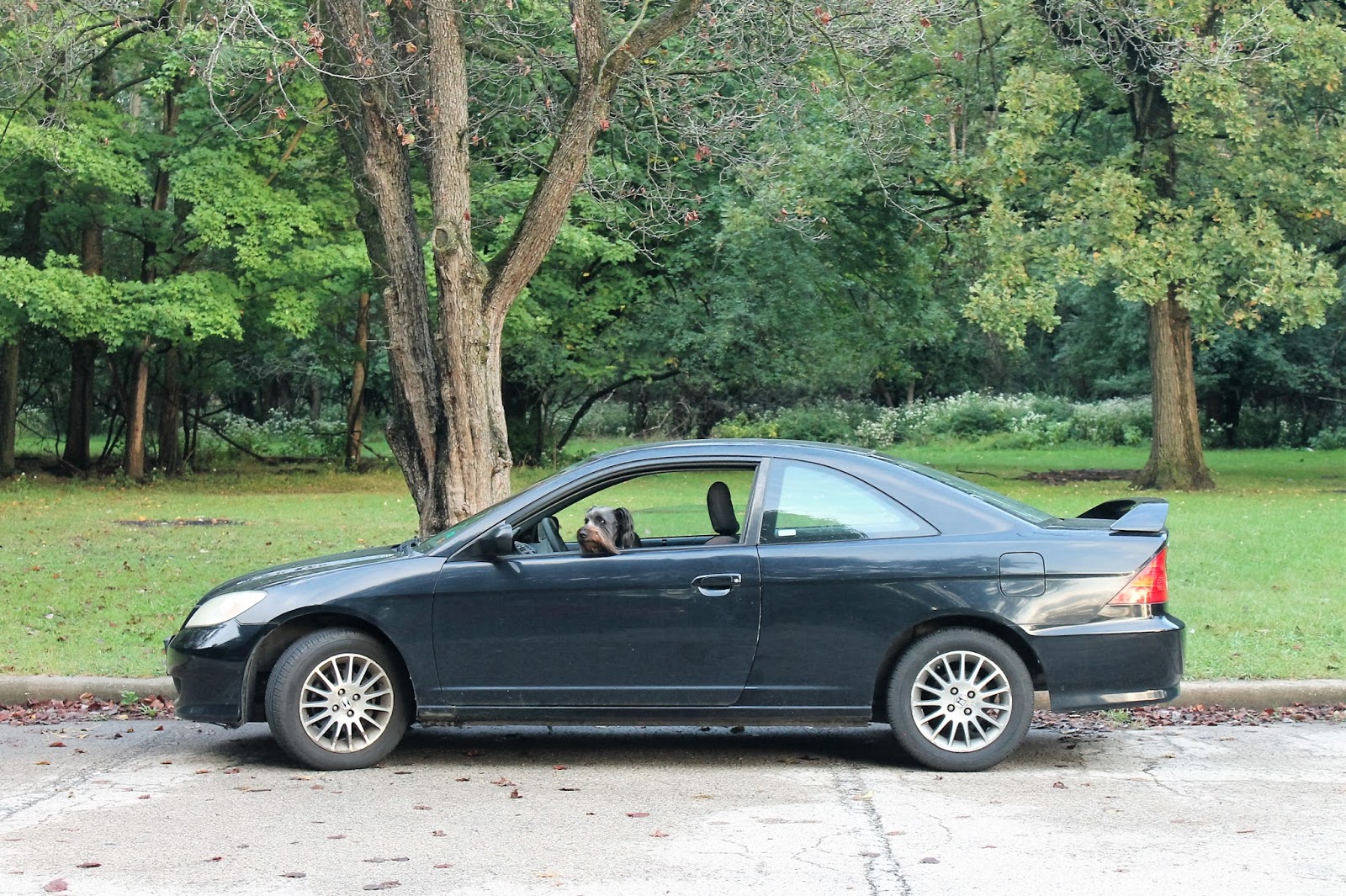
 My pride & joy, 2005 Honda Civic, in its last day in my possession.  First car I ever bought new, back in 2005.  A lot of adventures, a lot of memories...just not compatible with a baby seat.  That's Cassius' big dog head sticking out the window.  
 New England aster (Symphyotrichum novae-angliae)
 Fringed gentian (Gentianopsis crinita) in Cook Co.

 Plains garter snake (Thamnophis radix) in typical urban habitat
 Pine corridor
 Autumn foliage

 Spotted salamanders (Ambystoma maculatum)
 Large, mature oaks bordering old field
 Blue-spotted salamander (Ambystoma laterale)
 Three wiseguy green frogs (Rana clamitans) in a mild state of torpor
 Will Co central newt (Notophthalmus viridescens)
 Cassius at Potawatomie Woods in northern Cook Co
 Early settler cemetery in northern Cook Co