Sunday, April 23, 2023

Slightly Off Topic - My Worst Snakebite

 People often ask me if I'm ever bitten by snakes during my field outings.  I'll give a presentation on salamanders and afterward, someone will ask me if I've ever been bitten by a snake.  I guess it's a burning question.  As I've explained many times before, if you are going to pursue snakes, you're going to be bitten.  And it's not a big deal.  I know a few beekeepers who love their hobbies/jobs and so they are able to brush off bee stings as if it were a mere mosquito bite.  It's just part of the package.  So yes, I have been bitten by snakes far too many times to recall.  During certain times of the year, it's at least a few times a week.

Most of the bites are painless, drawing little to no blood.  Some are somewhat uncomfortable.  Very few I would have considered painful.  Until 2001, the worst bite I ever received came from a large, likely gravid female common garter snake.  She was one of a mass of writhing snakes crammed into a small glass aquarium at Fishing Schooner on Irving Park Road between Elston and Kimball.  I asked an employee if I could hold one of the snakes, and the employee obliged.  Not long after I had my hands on the biggest, fattest snake, the snake bit into the webbing between my thumb and index finger on my right hand and thrashed about, something I had never experienced with a garter snake prior.  It took a minute or so to carefully pry her off, as I was working around the blood and several teeth that she shed into my flesh.  As a thirteen year old kid, the experience was disheartening and I elected not to buy a garter snake that day.  Little did I know that years later, that experience would become dwarfed by a more memorable incident.

In 2001, I was in my third year working at a pet store that specialized in tropical fish and exotics - it was year one as manager of the reptiles/exotics department.  It was an era during which herpetoculture was growing exponentially due to several popular television shows and things like that.  But it was also during  a time before social media (as we know it), Craigslist, and all of the outlets by which many people buy, sell, trade, and rehome animals.  So when people got tired of their pets, they would often bring them into the store.  One day, a polite English woman came in and asked if I would be interested in a Burmese python.  She told me she was moving back to England and couldn't take it.  So without any questions asked, I told her, sure thing.

A couple of days later, the woman and her body-building boyfriend pulled up in front of my house.  The boyfriend opens the back of the SUV and slides a 75-gallon aquarium out and carries it into my living room unassisted (it was impressive).  In the tank was a large, writhing bag.  "His name's Jake", the woman said in her thick accent.  The snake let out an exasperated hiss.  "He hisses a bit."  

"Yeah, big snake", grunted the boyfriend, reminiscent of a caveman.

In minutes, they were off, never to be seen or heard from again.  And there I was, looking down at the large glass aquarium, intimidated by what was in that bag.  It was a lot larger than I expected.

I dragged the aquarium into my room and carefully opened the bag and slid the python out.  It was an albino, clad in eye-catching oranges and yellows.  I estimated it was about eleven feet in length.  Far too big to be in a four-foot aquarium.  

I began to have buyer's remorse.

After letting the snake settle in a bit, I was tempted to handle it.  I dropped a towel on its head in case it was defensive and then hefted it out.  This was a very heavy and very strong snake, stronger than the eight-foot boa constrictor across the room.  But it was placid, and it was clear this snake was loved by its former owner.  It wasn't long before this snake became one of my favorites.

Photos taken in 2001 by me

The snake inspired me to write a poem about it for a writing class I was taking at the time.  My professor was impressed with it and suggested that I try to publish it somewhere other than the college's arts journal.  Young naive Joey submitted it to the International Library of Poetry, the not-so-discriminating organization that will publish virtually anything as long as you agree to pay their fee.  Anyway, here it is, as published in 2003's Nature's Gentle Kiss (note the repetition):

Python

In the still and silent room

Sleeps the giant snake

Coiled against itself

And the glass

Snoozing bulk

Salted in light fragments

Sleeping off its savor


As it slumbers 

It dreams of slick escape

Sly

Hugging the heat source

Scales piled

Soon to wake

Just to sleep, satisfied


Jake and I hit it off over the course of several months.  I wanted to get him into something larger, but I was concerned about the lack of room in my bedroom.  At the time, my collection of snakes was so expansive that I replaced my bed with a futon which was folded into the couch setting.  I wasn't sure what to do.  In the meantime, the snake was growing quickly.  I don't recall how much it weighed but it was beefy.  It had a very strong feeding response which *usually* kept me on my toes.  It would take one fateful evening to reverse the course of our little friendship.

I returned home from work one night, exhausted and not wanting anything to do with my menagerie (I did work with reptiles all day - occasionally this would happen).  Upon entering my room, I was hit by the pungent aroma of big snake poop (anyone who has ever kept giant snakes in warm rooms knows what I'm talking about).  There was in fact a large pile of feces and urates in the python's large crock water bowl.  Under the room's dim lighting, I unlatched the cage's lock and reached down with my left hand to remove the bowl.  This wasn't something I'd ever do under normal circumstances.  The routine typically involved using a hook as if to say, "No - not food."  But I wasn't thinking straight that night.  The growing boy of a snake, thinking it was dinner time, took the opportunity to lunge for my hand, which it did with pinpoint accuracy.  Before I could even process what was happening, the snake had wrapped around my arm and began constricting up to about mid-bicep.  

I lifted the snake up and out of the cage and tried to unwind its body from my arm.  I was unsuccessful at first, but I began to grow nervous and a little scared. So I used more force and eventually the snake's body flopped onto the floor like a tight corkscrew.  By this point, my blood was all over the place.  All over the snake's mouth and head, all over the floor, and all over my clothes.  The bite had gone from uncomfortable to painful.  The snake was committed and it took my grabbing of its neck and pulling it off to get it to release its toothy grip.  A bit disoriented, Jake sort of laid there half under my computer desk, probably about as confused as I was.  Panicking at the sight of all the carnage, I dashed into the bathroom and began washing the blood off of my hand and arm.  The snake had gotten my four fingers (all but the pinky), the back of my hand, and the palm, and left a few teeth for me to remove.  After cleaning up, I returned to my room, where Jake had now gotten comfortable completely under the desk.  I returned him to the cage and anxiously cleaned the wooden floor like a killer who had just murdered someone.  When I was done, I sat on my futon nursing my wounds with paper towels, and watched the snake for about ten minutes.  This was a turning point, one where for the first time I considered the idea that I was not prepared for such a wild animal.  Regretfully, within a week, I gave the snake to a friend who was more experienced with snakes of Jake's magnitude.  

But the story doesn't end there.  You may want to hear this.

Following the bite, I experienced pain in my afflicted hand.  It was largely localized below the first knuckle on my index finger - in the palm-side meat.   At first it was mild, but soon it would worsen and at times become unbearable.  I'd wake up in the middle of the night with throbbing pain.  The finger would swell and turn red, and I'd sweat and occasionally nearly pass out.  This went on for weeks, and then months.  Yeah, I should have seen a doctor, but nineteen year old guys are sometimes known for being irresponsible and dumb.  Plus, what was I going to tell a doctor, that I was in pain because a large python bit me in my bedroom?

One night, I was out shooting pool at Lee Street Billiards (in Des Plaines) with some friends, when all of a sudden the pain rose to an all time high.  I motioned to my good friend Tom (who was aware of the bite and my pain) that I needed to sit down.  I back stepped until I made contact with the wall, and slid down onto the floor, between two small tables with ashtrays.  The room started spinning a little, and the rock music began morphing into some liquified mush of sounds and I felt a sort of nauseous high.  Concerned but clearly helpless, Tom came to my side for support.  I slowly glanced at my inflamed left hand, and in sheer desperation, I grabbed my finger with my other hand and just squeezed the hell out of it.  And with Tom as my witness, a large python tooth popped right up from the swollen knuckle.  His jaw dropped like a cartoon character.  Maybe mine did too.  And wouldn't you know it, in an instant the pain was gone.  Like, completely gone as if nothing had ever happened.  After the sweat dried up a little, I got up and played what very well could have been the best round of pool I ever played.  As for the tooth, I saved it, but in the melee that is life it went MIA.  It doesn't matter though, because I still have the scars on my hand to remind me of that late night in my old bedroom twenty two years ago.  

So yes, since then I have been bitten by snakes a lot.  But so far none have come close to Jake's.  I imagine Jake has since passed, but his legacy hasn't.  I am no less fascinated by snakes, no less fearless, but maybe a little more respectful than I was at nineteen.  

Oh, and I never told my mom about what happened.  So if you ever read this, mom, don't worry, I'm fine.

Thursday, April 20, 2023

We spotted turtles

What do great plains rat snakes (Pantherophis emoryi), bird voiced treefrogs (Hyla avivoca), Mississippi green watersnakes (Nerodia cyclopion), and spotted turtles (Clemmys guttata) have in common?  They are all herps.  Well, yeah.  But more than that, they are all species with very restricted ranges in Illinois, existing in as few as one or two places.  As a consequence of this limited distribution, each is listed as either threatened or endangered in the state.  But while most of those species are relatively secure outside of Illinois, the spotted turtle is dwindling across its entire range.  Once enjoying a rather large swath of the eastern United States (as well as portions of southern Canada), today it hangs on in widely isolated wetlands and has disappeared from many areas it once was found in.  Habitat loss/degradation has taken a huge toll on the turtles, but so have other threats, including vehicles, predation by an increasing number of mesopredators, and collection for the pet trade. The spotted turtle’s small size, attractive patterns, and charming disposition made it a very popular pet decades ago.  Probably tens of thousands were collected from the wild throughout the middle of the 20th century.  While not as popular as a pet today, a very strong demand from Asia (where the turtles are popular in medicinal circles) ensures that these animals will remain at risk.  While the species isn’t (yet) protected by the Endangered Species Act, it is listed as endangered by the International Union for Conservation of Nature (IUCN) and is protected to some degree in each state it occupies.  In Illinois and in Indiana, it is listed as endangered.  Illinois’ populations are especially imperiled.  It can only be found in two preserves in one county.  Illinois represents the spotted turtle’s western limit, so there is some justification for its restricted distribution.  The species had a better shot across the border in Indiana, but the widespread destruction of its wetland habitat there brought its occurrences down to a piddling few.  The draining of the Grand Kankakee Marsh may have taken a huge toll, and certainly the conversion of much of the dune region to industry wiped out countless locales.


But there are still a few - and I mean a FEW - places in Indiana where the spotted turtle can still be seen.  Miraculously, a few swaths of habitat remained undeveloped in the steel and manufacturing era.  Some of these sites are actively and properly managed, which is great news.  But while they seem to be doing okay in a few areas, I remain cautiously optimistic about their long term future.  


Matt and I recently hiked a stretch of habitat that looked very spotted-turtley.  While I’m tempted to post photos of the habitat, I’m a little hesitant to do that out of fear of giving away the very sensitive location (yes, in today’s world, anyone can find anything they want though the internet.  But it won’t be from me).  We ended up finding three spotted turtles as well as other interesting bycatch.  While we caught a few snakes, none of the turtles were disturbed - they were allowed to forage among the vegetation in the shallow waters of the marsh.  We were exuberant upon seeing these animals in their natural habitat for the first time in Indiana.  And we were reminded of the importance of habitat preservation even in parts of the country that have been blighted by heavy industry.  Now we can only hope that these little patches of habitat will sustain the species that depend on them for perpetuity.


Spotted turtle number one (spotted by Matt's daughter Anya) was the only of the three turtles that was "photogenic".  It was found ambling along and after it saw us it hastily burrowed under the aquatic detritus, out of site.  The second turtle found (also claimed by Anya) was swimming away a bit too quickly, while the third stuck around long enough for me to film it swimming slowly near the bottom of the marsh.

An eastern milksnake (Lampropeltis triangulum) displaying colors typical of its species in the region (i.e. not brilliant but instead warm and rich earthy tones).

Get your fill of cricket frogs (Acris blanchardi) up this way while you can because they are far less common than they were fifty years ago (though they may be recovering in some areas).

As we walked the site, we spooked this snake into the water.  It moved swiftly and for a moment I thought it may have been a western ribbon snake (Thamnophis proximus).  While pursuing the snake I found it periscoping with only its head above the water - clearly just a clean common garter (Thamnophis sirtalis).

Railroad tracks nearby

Matt exploring some dunes

Back at home later that day, I took my daughter and her cousins to look for calling toads at West Branch.  This marsh straddles the West Branch DuPage river and was home to a family of muskrats (see lodge along left edge of marsh) but the toads were on the other side of the river.  That's for another day!

Monday, March 20, 2023

Wildlife Discovery Center: The End of an Era

The Chicago region has been graced by the presence of a number of natural history-themed educational facilities over the years, mostly in the form of nature centers.  I’ve written about the Grove (back in 2014, way before its amazing remodel - something else I need to touch on in the future), and I volunteered at the Peggy Notebaert Nature Museum (both are associated with Robert Kennicott).  River Trail Nature Center is another Cook County classic; out by me we like Hickory Knolls for both its indoor exhibits and outdoor hiking.  I’ve convinced my daughter that the large, abandoned water tower located atop a wooded kame is actually a monkey cage.  We have to look out for wayward monkeys in the woods because they are mischievous as most monkeys tend to be.


Then there was the Wildlife Discovery Center, standing out - far out - from the rest.  Located on Lake Forest’s historic Elawa Farm and positioned adjacent to one of the finest oak savannas in the state of Illinois, the facility showcased one of the finest collections of reptiles and amphibians in the region.  It was the brainchild of Rob Carmichael, a passionate herpetologist whose vision was to provide an unsurpassed interactive educational experience, free of charge, to visitors from Lake Forest and beyond.  For over twenty five years, Rob and his crew have worked extremely hard to build up an impressive collection of animals - mostly reptiles - all the while using them as tools for education and outreach.  


In 1996, Rob’s dream of curating a large collection of animals began to take shape.  While working with Lake Forest Parks and Recreation, he was given the opportunity to assemble a collection of live animals to use for education.  At first, the collection was small, but over the following years the collection would expand to the point where it encompassed numerous rooms within the 1917 gentleman’s farm.  The name “Wildlife Discovery Center” worked in the early years but by the 2000s the facility outgrew that title to become a herpetological powerhouse, all the while maintaining a respectable variety of non-reptilian life forms.


Some of the more memorable species on display over the course of the facility’s existence were komodo dragons (the only place in Illinois where one could see them), king cobras, numerous species of rattlesnakes, sailfin lizards, green mambas, eastern indigo snakes, gila monsters, a Fly River turtle, a nineteen-foot albino Burmese python, Aldabra tortoises, hellbenders, tentacled snakes, crocodiles, and more.  Favorites included Grug, a water monitor once owned by Nicolas Cage, a bearded dragon once owned by Ryne Sandburg, and Flora, the friendliest rhino iguana you’ll ever meet.  An outdoor area featured Boris the bobcat, as well as coyotes, Blanding’s turtles, an arctic fox, and a fine selection of raptors including a large Eurasian eagle owl and a majestic bald eagle.  Rob’s obsession with herps and his vast network of connections led to the acquisition of all of these animals and much more.  While he was an active member of the IUCN Crocodile Specialist Group, his interest was never limited to just crocodilians.  He fell in love with every animal that entered his facility, whether it was a box turtle or a two-fingered sloth.  


The Wildlife Discovery Center was in a constant state of evolution.  Rob liked to mix things up a bit to enhance the visitor experience. Animals on display one week may not have been on display the next week, and vice versa.  Animals on breeding or display loan would come and go, all the while the fan favorites would usually remain in place consistently.  Some of the animals at the facility until recently were on display from the very beginning.


In addition to curating a large collection of animals, Rob created and organized a number of fund-raising events.  Croctoberfest was a popular event during which he and his team would walk the grounds with some of the "hands-on" animals while visitors viewed several species of crocodilians behind the glass.  Proceeds would go to crocodile conservation efforts.  Another popular event was Reptile Rampage, the Wildlife Discovery Center’s own version of the Chicago Herpetological Society’s Reptile Fest.  Here, visitors paid to view an entire gymnasium full of reptiles and their keepers and enjoy interactive experiences beyond what they might find at Elawa Farm.


In addition to his work with the Wildlife Discovery Center, Rob was a faculty member at his alma mater, College of Lake County.  He taught biology and organized week-long field trips to Beaver Island, Michigan.  He even created a summer camp for young children, where they too could travel to Beaver Island and study the area’s ecology (but especially herpetology).  The Wildlife Discovery Center itself was an accredited biological field station.


When Rob announced his plans to retire, it was sad to hear that Lake Forest was not going to continue on with another curator, instead announcing the closure of the Wildlife Discovery Center.  This was a crushing blow to all who have enjoyed the facility for many years but most importantly to the future generations who won’t ever be able to experience the spectacle that was the Wildlife Discovery Center.  As Rob assured, there are in fact other great nature centers in the area to patronize.  While that is true, NONE come close to the sheer wildness of the Wildlife Discovery Center.  It was a true herpetological institution in the Chicago region, and one that hopefully will never be forgotten.  


My nephews Mason and Luke, with Burmese python, in 2016
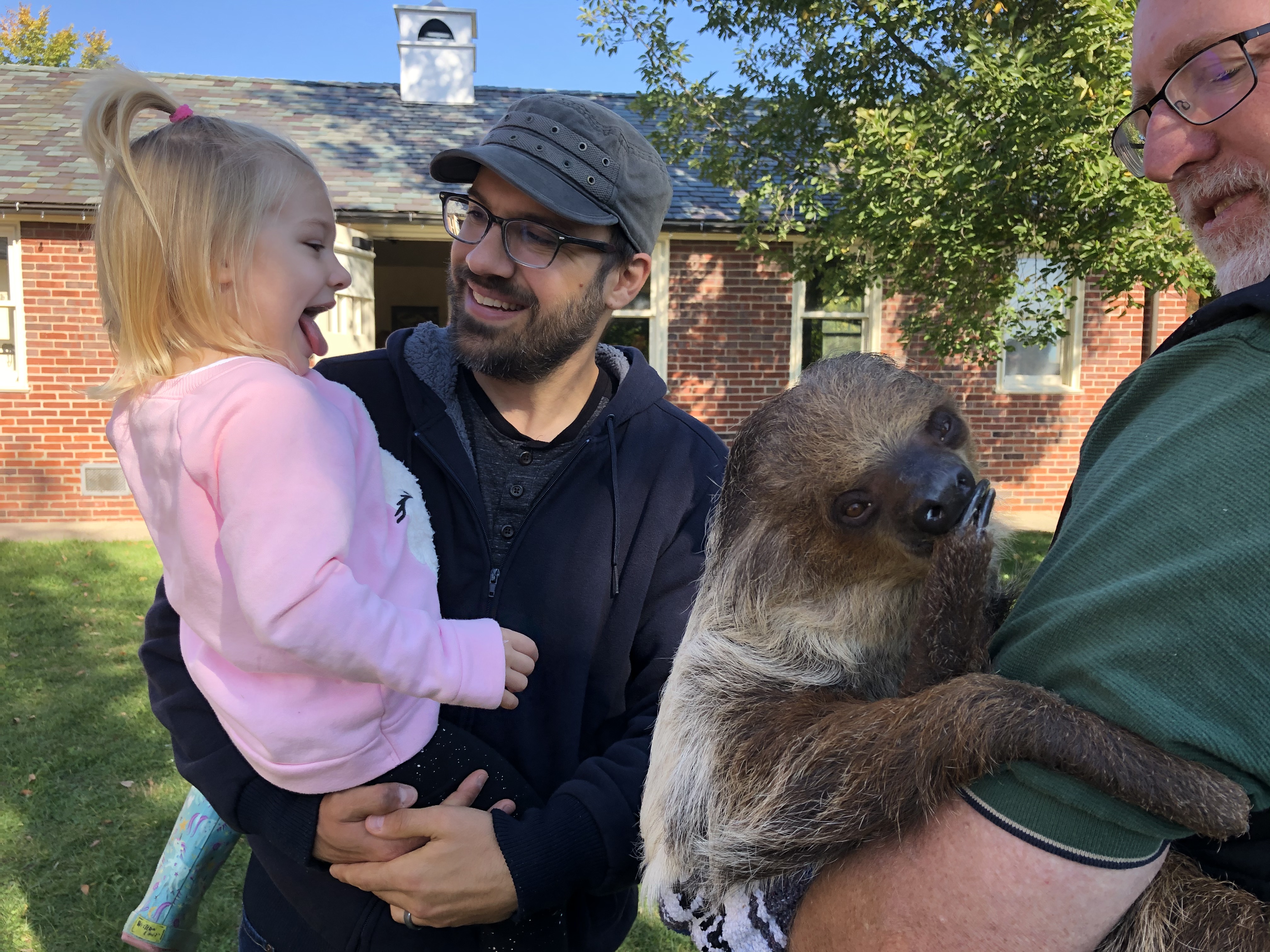
Aimee and I with Henry, one of two sloths in 2018
An unforgettable moment with one of the largest alligator snapping turtles ever kept in Illinois (2018)
He was a biggun'
Shrimp, the Komodo dragon, 2018
Lumen's first experience with a sloth in 2019
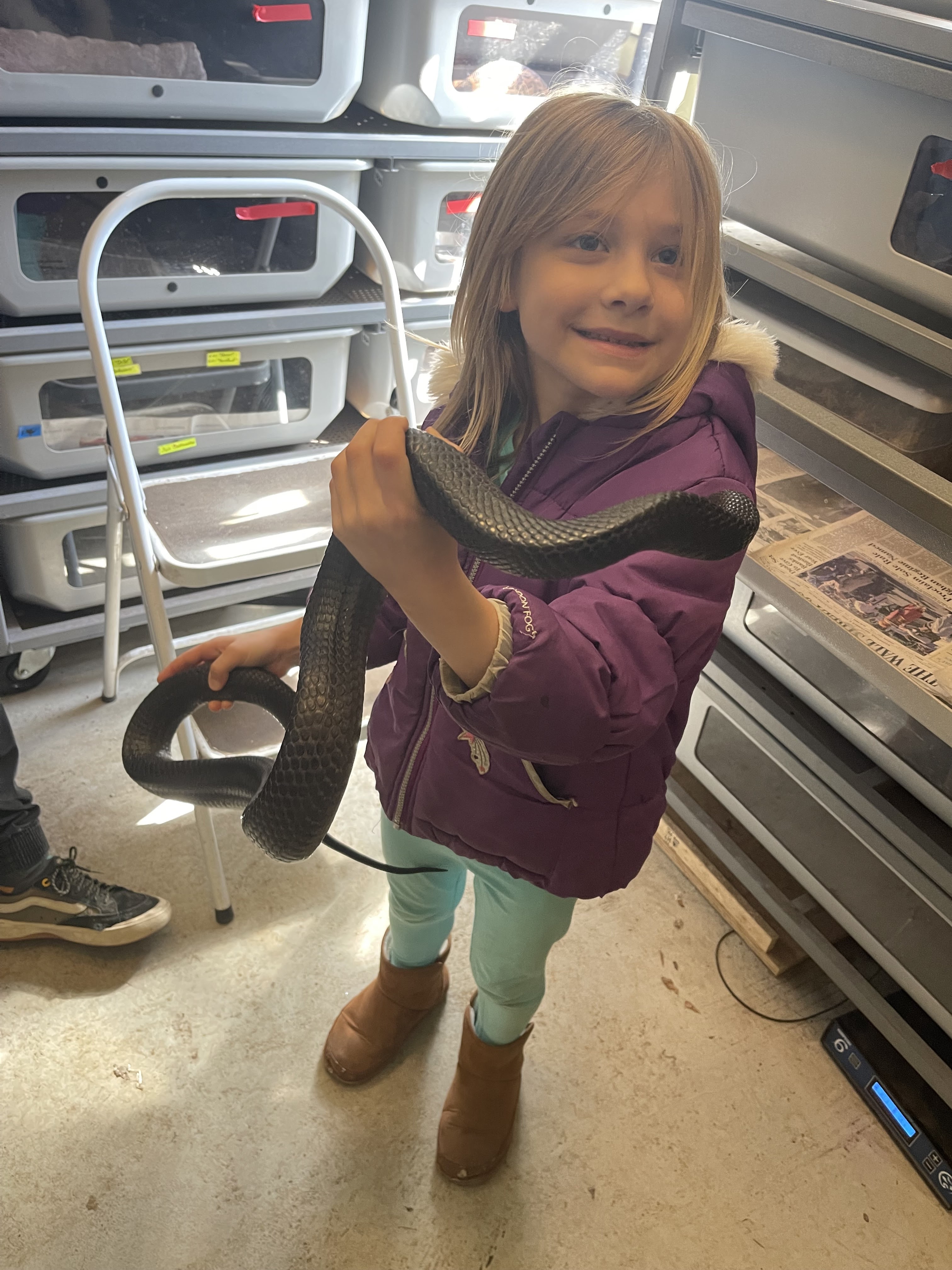
Lumen with a Burmese python (2019)
Bald eagle, 2023
Lumen with eastern indigo snake, 2023
Yours truly with same indigo snake, 2023
Rob and me, 2023
A somber moment as Lumen and I prepare to leave a mostly empty Wildlife Discovery Center during its final operating weekend, 3/19/23.


Friday, March 17, 2023

IL-GA-FL Part 4 - the Finale

 It was time to wake up for our final full day in the field.  We had to leave Peter’s place in Tallahassee and head north to south-central Georgia for our meeting with the fine folks at the Orianne Society.  But first, we stopped  at a trash site Nathan knew of, where Eastern diamondback rattlesnakes (Crotalus adamanteus) are known from.  The sky was growing darker as we approached the site and by the time we had left the car and committed to walking hundreds of yards into the site, the rain was coming down heavily.  We were drenched, with muddy shoes/boots - and snakeless.  Not a single snake was seen, though I did find a single ground skink (Scinella lateralis).  Getting soaked is okay if a significant find is made, but when you come up short, AND it’s kind of cold, it can make you feel rather dispirited.  On top of that, I ended up walking through a thick patch of stinging nettle - with my sleeves pulled up - and with wet arms.  As I write this (March 14), my arms still bear the nasty wounds inflicted by this horrible plant.  Luckily, we had plans to visit Dirk Stevenson at his home not far away.  Dirk is a legendary ecologist, friendly, funny, and very accommodating.  After a nice conversation, Tom, Nathan and I headed to the Orianne bunkhouse, where we met up with Ben Stegenga and two techs living there at the time.  We discussed herping options, ultimately deciding on a nearby lake where rainbow snakes (Farancia erytrogramma) and mudsnakes are found.

It was a lesson in humility 

We packed into two cars and once again arrived at a lake in the pitch black darkness.  As we all entered the water, Ben spotlighted a very large greater siren (Siren lacertina) and skillfully caught it in his net.  However, the siren outwitted all of us by slithering its way out of the net and back into the water, where it slinked into the dark depths.  After that, we spread out, some remaining at the lake shore and others into a spring-fed floodplain forest.  I hopped back and forth - the call of the floodplain was clear but I also wanted to stick around and wait to see if the siren would return.  Pushing into the dark forest, I walked through shin-deep water, shining for Farancia but with an awareness that other species are found here too.  I found a few common frogs, and someone found a tiny yellowbelly slider (Trachemys scripta).  Maybe thirty minutes into our hunt, I could see two sets of flashlights from near the parking lot move closer and closer toward myself and two others.  I knew they were the conservation officers we passed in their darkened car when we arrived at the lake.  They called us over to explain what we were doing and they were sort of taken aback when we told them we were looking for snakes.  When they asked if we had permits, we told them that we did, but they were not interested in seeing the permits.  They left us to our own devices, but nothing else was found.  We headed back to the bunkhouse when all hell broke loose.  Tom, Nathan, and I were so deprived of sleep over the course of the previous four days that we snapped and laughed in a dizzying display of hysteria.  I’m not going to go into detail but we forged some funny material that night, much to the confusion of the Orianne staff.

A dead/frozen eastern diamondback road casualty

The next morning, we regretfully packed up for our very long (15 hour) trip back to Chicago.  Only one problem - I’ve got a flat tire.  Fortunately, there is a tire shop ten minutes away.  I get the spare on and we drive to the tire shop where my tire is repaired in almost no time.  Great service from a VERY small town shop.  Our very last hurrah is in southern Illinois - one of the flooded farm fields we tried for crawfish frogs several days before.  Still no crawfish frogs, so we completed our trip to Champaign and then to the Chicago area.  I arrived home at 4:00 AM.  My bed never felt so good before.
Par for the course (photo by Nathan)
This guy was badass.


Tom catching up on some well-needed sleep

The trip was loads of fun and netted 44 species of herps, which isn’t bad considering most of our time was spent driving.  The people I met were awesome, and the memories will last a lifetime.

IL-GA-FL Part 3

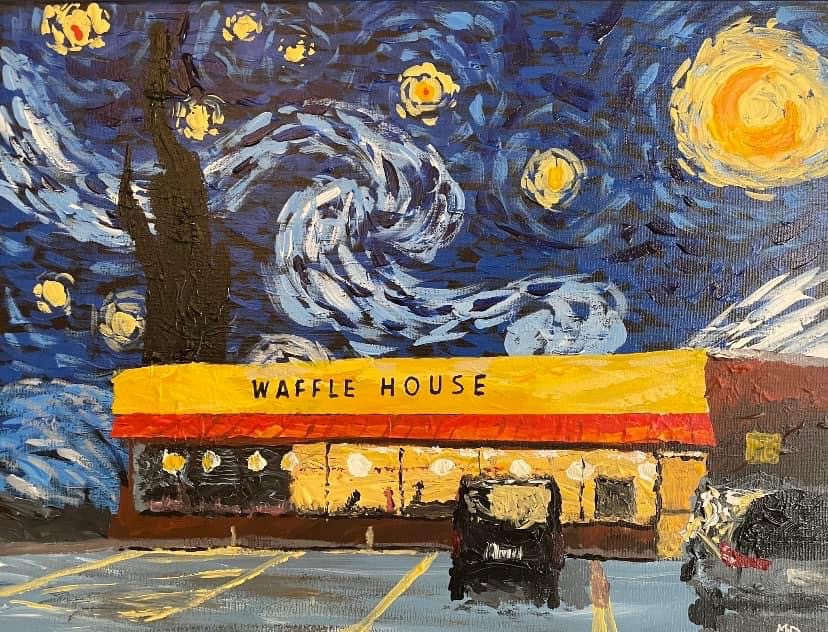
 March 9th began with an early morning start in Peter’s front yard, where I found a southern ringneck snake (Diadophis punctatus) under a log.  But we had bigger fish to fry that day - soon we were headed to Apalachicola National Forest, an expansive natural area encompassing multiple types of habitat.  Our first stop was a beautiful woodland full of seeps, sand hills, and salamanders.  Once we were out of the car and in the woods, the mosquitoes made it abundantly clear that we were not at the top of the food chain here.  We persisted, pushing through and carefully turning cover as we went.  We found a southern toad (Anaxyrus terrestris) and a narrowmouth toad (Gastrophryne carolinensis) before reaching an area that looked very salamandery.  We ended up finding a number of three-lined salamanders (Eurycea guttolineata), southern two-lined salamanders (Eurycea cirrigera), southeastern slimy salamanders (Plethodon grobmani I think), and Apalachicola dusky salamanders (Desmognathus apalachicolae).  I also spotted a large adult Gulf Coast box turtle (Terrepene carolina) ambling along a seep, and while making my way up a sandy hillside, found a gopher tortoise (Gopherus polyphemus) burrow, excavated right into the steep dune.  Since we skipped breakfast that morning, we were building an appetite, one that can only be cured with Waffle House.  So off to WH we went, to further broaden my junk food road diet horizon.


Nathan and I with a very large and old cypress tree
Another perspective 
Seepy woodland

Three-lined salamander
Southern two-lined salamander
Apalachicola dusky salamander
Gopher tortoise burrow on a steep dune
A gentle woodland creature, the Gulf Coast box turtle
Breakfast of...something

Later, we decided to try to cruise some longleaf pine preserves for dusky pygmy rattlesnakes (Sistrurus miliarus).  This habitat is characterized by the dominant vegetation, which is largely longleaf pine and wiregrass.  It is a very flat area, short on relief but teeming with life.  A recent prescribed burn breathed some life into this landscape; the palmettos were bursting with tender new growth and the pine trunks exposed and free of undesired undergrowth.  We didn’t have much luck cruising and so we decided to make a few stops to look for downed pines.  We would split up three ways, each person exploring a different area to improve our chances of finding snakes.  Aside from one green anole (Anolis carolinensis), I didn’t find much.  An hour or so into one of our searches, I met up with Tom, and we were both pretty exhausted.  The temperature was nearing eighty degrees; it was also quite dry.  Remember, we were coming straight after a Chicago winter, so we were not quite acclimated to this sort of weather yet.  In the distance, we heard Nathan shout “Pygmy!”.  Tom and I attempted to answer his shouts with our own, which mostly went unanswered.  Nathan was further away than we expected. But eventually we bushwhacked around an unburned section of briars to where Nathan was standing, where we could see him holding a snake.  I knew he wasn’t holding a rattlesnake - what was he talking about?  As he got closer we could see that he was holding a southern black racer (Coluber constrictor).  As it turned out, the rattlesnake crawled away under a large log nobody was willing to move, much to the appreciation of the snake.  But after the rattlesnake made its escape, Nathan spotted the racer basking in the open.  So while Tom and I were skunked on the rattlesnake, our painful trip through the briar patch was not made in vain.

This is what much of the Florida panhandle looked like before it became what it is today
Southern black racer Nathan caught

We wanted to make our rendezvous with Peter and friend Hari Parasu, so we hopped back in the car and headed toward the paved roads which lead back to Tallahassee.  As the car crunched over the gravel road toward the main highway, Nathan shouted, “Pygmy!” again.  I slammed on my breaks and all three of us jumped out of the car.  Indeed, a pygmy rattlesnake was in the process of crossing the road, so we took some photos and moved the snake off of the road to safety.  Success!  


Dilapidated roadside structures in the south are snake goldmines...
...but not so much when the conditions aren't conducive to thermoregulatory activity.  Nothing was found here.

Back in Tallahassee, Tom, Nathan, Peter, Hari, and I transferred to Peter’s vehicle, which took us to a VERY remote stretch of coastal Florida.  We were hoping to see blue-striped ribbon snakes (Thamnophis sauritus) among other species.  Temperatures were dropping rapidly, though, threatening our chances.  When we didn’t spot a single snake, we decided to turn our attention to the one-toed amphiuma (Amphiuma pholeter).  We netted some roadside ditches and swampy areas to no avail.  It was very dark, and the calling barred owls added to the spooky ambience of our outing.  Before we left, we did end up finding a single banded water snake as well as a young cottonmouth.  The odds seemed to favor amphibians due to the temperatures, so our next stop would be a local spring-fed lake Peter and Hari like.  

Young cottonmouth
Me with banded water snake

We arrived at the lake access point, where a boat launch and small beach had been constructed.  Tom shined a newt in the water, walking along the boat ramp surface.  A southern toad was seen emerging from its sandy spot on the beach, and several leopard frogs were calling.  A pine woods treefrog (Hyla femoralis) was spotted on a tree, and Nathan managed to catch a good-sized bowfin.  Hari and I separated from the others and walked the boardwalk to a large cypress tree that doubles as a launching pad for rope swingers.  By chance, my flashlight beam caught a brightly-colored, serpentine form along the tree’s knees.  It took a moment but eventually I identified the colorful thing as a scarlet kingsnake (Lampropeltis elapsoides).  This is where things get dicey.  In order to catch the snake, I had to take a “leap of faith”, reaching out with one foot to land it on the top of one of the cypress knees in one shot.  Then, I could stabilize myself and reach the snake with one hand while supporting myself against the tree with the other.  I handed Hari my flashlight and quickly made the move.  I managed to catch the snake and get back to the boardwalk without slipping in my muck boots and landing in the drink.  Our excitement was over the top.  This animal was absolutely beautiful, a real jewel.  We all met up and everyone was able to get some photos before the snake was released exactly where it was found minutes later. It was a fine way to end the day.


Southern toad on a beach
Pine woods treefrog in the poison ivy
What the...??
A stunner of a scarlet king!


Check back for the final installment!


IL-GA-FL Part 2

 On the morning of March 8th, we headed south to our next destination - Pigeon Mountain, located along the Cumberland Plateau in northwestern Georgia.  Here, we hoped to find the green salamander (Aneides aeneus) and the Pigeon Mountain salamander (Plethodon petraeus).  The Pigeon Mountain salamander is endemic to this area and found nowhere else on earth.  While Tom searched close to a road, Nathan and I hiked all over the place, ascending and descending steep hillsides, getting wet from water dripping over large rocks, and taking in the stunning scenery.  We didn’t find any greens, but we saw approximately twenty five Pigeon Mountain salamanders, one of which we were able to photograph without causing any stress to the animal.  It is a beautiful salamander, similar in appearance to its cousin the slimy salamander but awash in light browns or oranges along its dorsum, reminiscent of a deep-space cloud nebula.  


Pigeon Mountain outcropping
Waterfall
Nathan and I looking for salamanders behind the falls.  Photo by Tom

Nathan putting some elbow grease into it
Pigeon Mountain salamander
Violet woodsorrel
Violets growing from a crack in the rock face

The three of us convened at the car several hours later, where Nathan and I were surprised to see that Tom had found a southern devil scorpion (Vaejovis carolinianus).  As an enthusiastic scorpiologist, Tom was smiling ear to ear.  

Southern devil scorpion
Tom with scorpion.  This was out makeshift photo staging rock.

We would have stayed much longer but we had business in Tallahassee.  Another long drive (6.5 hours) and we were at the home of Peter Kleinhenz and his finance, who graciously let us stay in their home for two nights.  After a quick greeting with our hosts, Tom, Nathan, and I drove to a nearby lake where a large alligator (Alligator mississippiensis) once stalked Nathan while he searched the shoreline for herps that can’t eat you.  In the pitch black darkness, we pulled into a gravel lot for a boat landing, grabbed our flashlights, and headed toward the riprap-lined shore via an elevated walkway.  This led to a concrete spillway, where others have had some luck in the herp department. We saw some pig frogs (Rana grylio) squatting in the muddy shallows and heard southern leopard frogs calling further out beyond the scope of our flashlights.  While Tom shined the lake from the walkway, Nathan and I began flipping rocks, hoping to find a mudsnake (Farancia abacura).  Within minutes, Nathan found a rather lethargic adult banded water snake (Nerodia fasciata).  From the boardwalk above, Tom wanted to see the snake.  We tried to pass the snake to Tom a la Michaelangelo’s “The Creation of Adam” but we couldn’t quite reach his hand.  No problem - I placed the snake in my net and raised the net to Tom.  Eureka!

1:30 AM

Pig frog

While Tom evaluated the Nerodia, Nathan spotted a large, dead mudsnake.  It was partially wedged under a rock and appeared smelled to have been dead for some time.  Nathan was dead-set on collecting this snake for the museum collection (it should be mentioned that all three of us possessed the proper permits for all three states in which we actively herped).  However, his sense of smell was on lunch break or something because while I gagged on the stench of decomposing mudsnake, Nathan had no issue with taking it back to the parking lot.  Eventually he was persuaded to simply collect the head, minimizing the source of the awful smell.  Sealed tight in a container of preservative, we now could resume our search.  Down by the water’s edge, several cottonmouths (Agkistrodon piscivorous), one adult and two young, were seen forging among the emergent vegetation.  The eyeshine of a large alligator nearby kept us on our Ps and Qs as we continued our search.


The spillway presented an obstacle that put me in my place and reminded me that I am no longer in my 20s (or 30s for that matter).  Below the spillway was a narrow metal ledge and wooden supports overhead.  If one were so inclined, one could navigate a shortcut across the spillway by stepping on the ledge and holding on to the support beams overhead.  Below was deep, black water, the kind I really don’t want to be in at this point in my life.  Nathan skillfully made his way across this route to get to the other side of the spillway and encouraged me to do the same.  I sized up this challenge by stepping on the ledge and supporting myself by holding on to the beams.  Wobbly and stiff, my muck boots just didn’t feel right on the ledge.  I trusted my upper body strength but overall I had a bad feeling that I was going to end up in the lake.  The other option was to backtrack and walk to the other side from the boardwalk, and I wanted to conserve my energy.  I waffled for a minute until I decided that it would be in my best interest to just walk around to the other side.  I kind of feel like I’m going to be making more of these kinds of decisions as I’m getting older - and no, it’s not easy to concede to middle age, especially when I feel young and spry much of the time.  Bah!


Just say no

As the night wore on, we remained steadfast in our quest to find Amphiuma.  Nathan spotted one in the water but due to the structure of the rocks was unable to catch it.  Shortly afterward, he shouted that he had found a black swamp snake (Liodytes pygaea).  I turned to look in his direction, and with the snake in one hand, he quickly grabbed at another target - a southeastern five-lined skink (Plestiodon inexpectatus).  Both had been under the same rock.  I rushed over to where he stood and suggested he just release the lizard because we were THRILLED to find Liodytes.  It was a first for both of us, and we celebrated with a high-five.  The black swamp snake is a small, chiefly aquatic natricine native to the southeastern United States.  It is dark brown or black in color with a colorful orange belly.  We took some photos of this animal before releasing it near its original location.  Around 2:00 AM, we decided to call it a night.  On the way back to the car I found a southern cricket frog (Acris gryllus).  It would represent the final herp of the day, as we were in need of some sleep, whether or not we felt tired (I was not).  


Black swamp snake
Young, lean cottonmouth


See part three for more!